Spectre Brands

DeadOnline grocery delivery · Foster City, California

Webvan

Founded December 1996. Stopped delivering July 9, 2001.

Webvan promised groceries at your door inside a 30-minute window you chose. It built the warehouses first and waited for the customers.

Why dead: Webvan Group stopped all deliveries on July 9, 2001, filed for Chapter 11 four days later and was sold off at auction;81028 Amazon later owned the name and ran webvan.com as a shop for packaged groceries from 2009 until at least 2016,2021 but the address no longer loads a website and nothing operates under the name today, so we file it as dead and not as a ghost.32

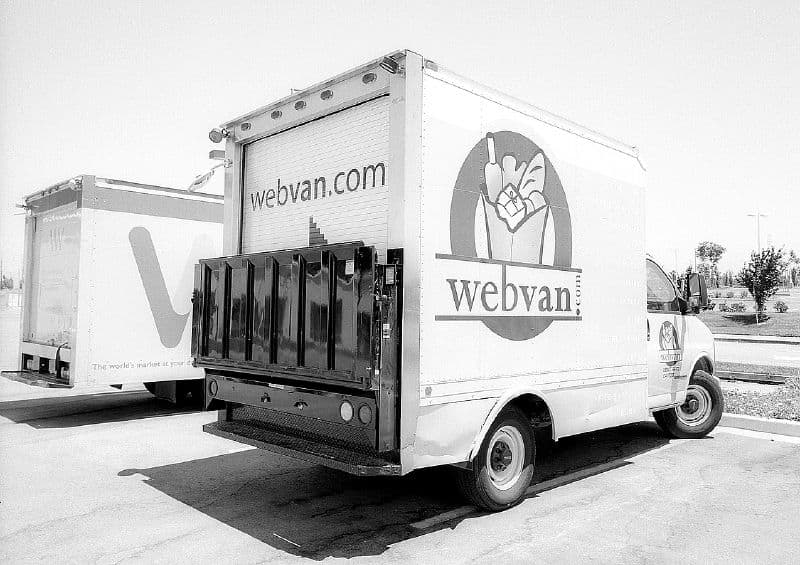
Black and white photo of two parked Webvan delivery trucks seen from behind
Undated Two trucks, two liveries: the earlier round grocery-bag logo on the right and the later W on the left. The photographer’s caption calls Webvan defunct; the picture was posted in 2005.Photo: Mark Coggins, via Wikimedia Commons, CC BY 2.0.
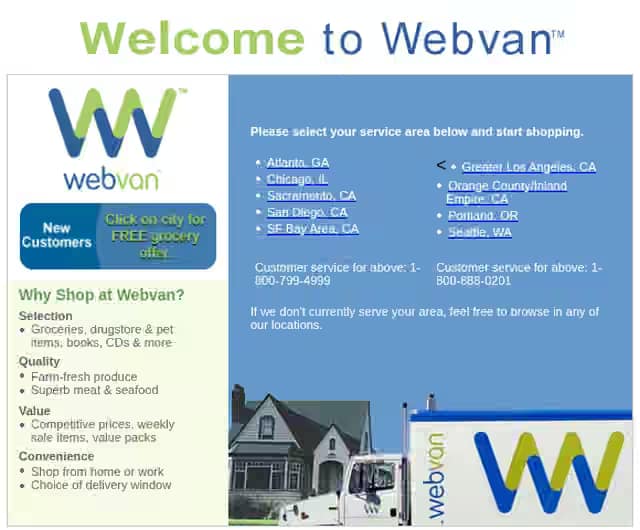
Webvan archive image: Home page, Nov 2000
Home page, Nov 2000
Webvan archive image: Truck livery, 2000
Truck livery, 2000Cropped from an Internet Archive capture of webvan.com (Nov 9, 2000). Shown for commentary; trademarks belong to their owners.
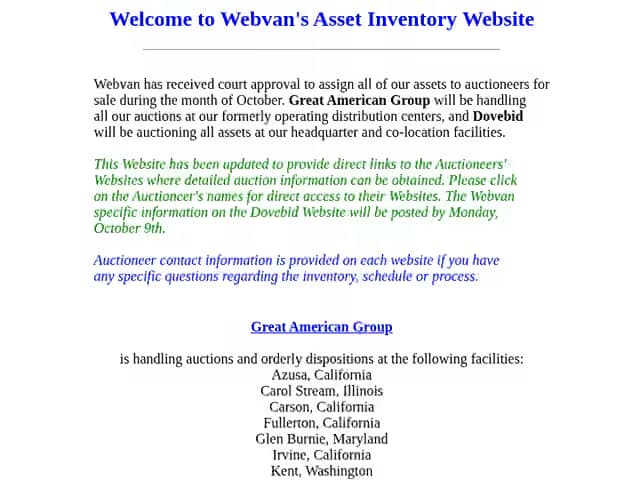
Webvan archive image: Auction notice, Oct 2001
Auction notice, Oct 2001

It raised about $393M privately and $375M in one of the largest IPOs of 1999, signed a deal with Bechtel to build up to 26 more distribution centers, and merged with its closest rival. Its gross margins were positive from late 1999. Its warehouses never ran anywhere near full. This post-mortem is built from Webvan’s prospectus, 10-Ks, 10-Qs and bankruptcy filing, contemporary press and the archived website.

The company in four numbers

$375M
raised in the November 1999 IPO: 25 million shares at $151
8,000
orders a day each distribution center was designed to handle. Actual volumes were “significantly below”3
$827M
cumulative net loss from 1998 through March 200137
~2,000
employees let go on July 9, 2001, when it stopped all deliveries1011

Key findings

  1. It made money on the groceries. Gross margin was 25–28% in every quarter from Q1 2000. The losses came from fulfillment, delivery, real estate and technology, booked as general and administrative costs.36
  2. It built for demand that never arrived. In 2000 G&A was $292.3M, 1.6 times sales. Distribution centers designed for 8,000 orders a day never came close.3
  3. It expanded before it worked. Atlanta opened in May 2000 and Chicago in August, and the Bechtel contract covered up to 26 more centers, while the Bay Area still lost money.13
  4. The merger doubled the problem. The all-stock HomeGrocer deal cost about $1.04B, $901.6M of it goodwill, and added more cities to fix.3
  5. The idea survived. Four former Webvan executives later helped build Amazon’s grocery business, and Amazon bought the webvan.com name.1920

The bubble it was born into

Public at the peak, priced like a platform

Webvan went public in November 1999, four months before the Nasdaq’s all-time bubble high, as a company with $13.3M in annual sales.

The market Webvan was born into
476U.S. IPOs in 1999, with an average first-day gain of 71.2%31
$34Webvan’s high in its first quarter of trading, against a $15 IPO price2
>$10Bthe market value that $34 a share implied, as reported by the Los Angeles Times13
$13.3MWebvan’s net sales for all of 19993

The Nasdaq Composite, with Webvan’s life marked

Weekly averages of daily closes. Hover over a marker for the event.

Data table
The Nasdaq Composite, with Webvan’s life marked: marked events
DateEventValue
1999-06-02Bay Area store openson the index line
1999-11-05IPO at $15on the index line
2000-03-10Nasdaq peakon the index line
2000-09-05HomeGrocer merger closeson the index line
2001-04-13Shaheen resignson the index line
2001-07-09Shutdownon the index line

The index line is the Nasdaq Composite weekly close from FRED (series NASDAQCOM), 1999-01-01 to 2001-09-30.

Index data: NASDAQ OMX Group via FRED, series NASDAQCOM, weekly average27. Events: SEC filings and press1310.

The story

A warehouse company that sold groceries

Webvan’s founder built bookstores. His bet was that automation could make home delivery cheaper than the supermarket. The bet needed scale, and scale needed time the market didn’t give it.

Chapter 1 of 5

$118.3M

raised in private preferred stock before June 30, 1999

Film · 2010Inside a Webvan distribution center Seven minutes of footage of the carousels, conveyors and totes that each center was built around. It was uploaded in 2010 with no description, so 2010 is the upload year: we do not know who filmed it or when. Each center was designed for 8,000 orders a day.3 Watch on YouTube

1996 – mid 1999 · Birth

A bookseller’s logistics machine

Louis Borders, who founded Borders Books in 1971, founded Webvan in December 1996.1 The plan was a network of highly automated distribution centers, each designed to fill 8,000 orders a day, feeding vans that delivered inside a customer-chosen 30-minute window.13

By June 30, 1999 it had raised $118.3M in private preferred stock, net of costs.1 Benchmark, Sequoia and SOFTBANK were among the largest holders.1 The Webstore launched in the San Francisco Bay Area in June 1999, served from a 340,000 sq ft center in Oakland.13

Chapter 2 of 5

26

more distribution centers Bechtel agreed to build over three years, July 1999

webvan 340,000 sq ft · Oakland
One center, designed for 8,000 orders a day. The Bechtel agreement covered up to 26 more. Original illustration.

Jul – Sep 1999 · The build-out

Ordering warehouses in bulk

In July 1999 Webvan signed an agreement with Bechtel for the construction of up to 26 additional distribution centers over three years.1 The prospectus named Atlanta for 2000, then Chicago and Seattle, then Dallas, Washington, D.C. and five other markets in 2001.1

That summer it sold $275.0M of Series D preferred stock.1 In September George Shaheen left the top job at Andersen Consulting, reported as a $4M-a-year post, to become CEO.117

Chapter 3 of 5

$34.00

high in the first quarter of trading, after a $15 IPO in November 1999

Commercial · 1999“Manifesto,” a one-minute Webvan commercial The uploader dates this spot to 1999, the year the Bay Area store opened and the company went public.1 It shows the earlier truck livery, a beige van with a round grocery-bag logo. We could not confirm the air date independently. Watch on YouTube

Nov 1999 · The IPO

Worth more than the grocers it meant to replace

Goldman Sachs led the sale of 25 million shares at $15, raising $375M gross.1 The stock traded as high as $34 that quarter, which the Los Angeles Times later said gave the company “a value of more than $10 billion.”213

Webvan had $13.3M in sales that year and a net loss of $144.6M.3 Its average order was $78.3

Chapter 4 of 5

$1.04B

paid in Webvan stock for rival HomeGrocer, September 2000. $901.6M of it was goodwill

Black and white photo of two parked Webvan delivery trucks seen from behind, one with a round grocery-bag logo and one with a large W
Two Webvan trucks, one with the earlier grocery-bag logo and one with the later W. Photo: Mark Coggins, via Wikimedia Commons, CC BY 2.0.

2000 · Expansion and merger

More cities, before the first one worked

Atlanta opened in May 2000 and Chicago in August.3 On September 5, 2000 Webvan completed its merger with Kirkland, Washington-based HomeGrocer, issuing 138.3 million shares at 1.07605 per HomeGrocer share. The total purchase price was about $1,044.0M, of which $901.6M was recorded as goodwill.3

Sales rose to $178.5M for the year, but the net loss rose to $453.3M.3 By the fourth quarter the stock traded as low as $0.28.3

Chapter 5 of 5

~2,000

workers let go on July 9, 2001. Chapter 11 followed on July 13

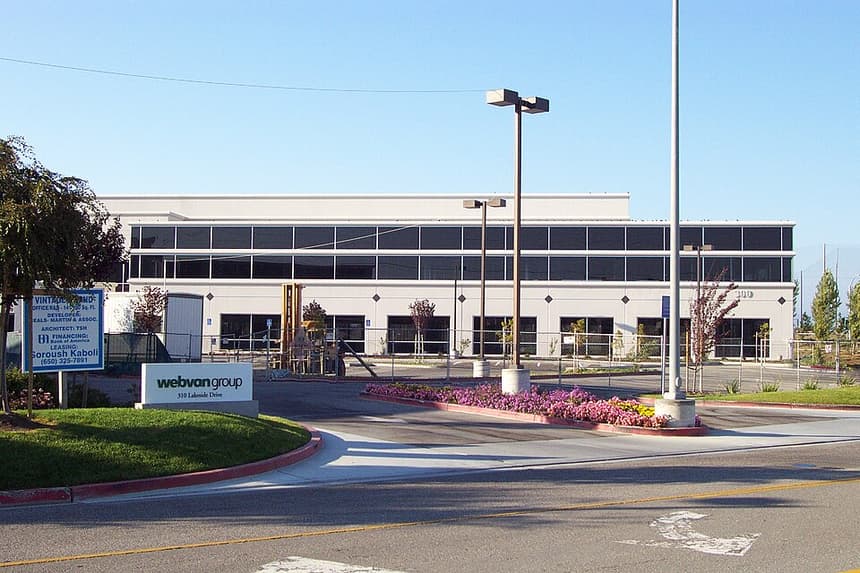
A low white office building behind a temporary fence, with a Webvan Group sign at the driveway
The headquarters at 310 Lakeside Drive, Foster City, in September 2001, two months after the shutdown. Photo: Pal Danyi, via Wikimedia Commons, CC BY-SA 4.0.

2001 · Collapse

Closing cities, then everything

The 2000 annual report carried a going-concern warning.7 Webvan closed Dallas in February 2001 and Sacramento soon after, then Atlanta in April, cutting about 485 jobs there and about 400 at headquarters. Cash fell from $212M at the end of 2000 to $115M by March 31.715 Shaheen resigned on April 13 and COO Robert Swan became CEO.1415

On July 9, 2001 Webvan stopped taking and delivering orders in all seven remaining markets and let about 2,000 workers go.1011 It filed for Chapter 11 in Delaware on July 13 and pursued a sale of its assets.8

Timeline

From founding to auction, with the market alongside

Filter by thread.

All 21 events as a list
  1. Dec 1996
    Corporate

    Founded

    Louis Borders, founder of Borders Books, starts the company.1

  2. Jun 21999
    Operations

    The Bay Area store opens

    Commercial launch, served from the 340,000 sq ft Oakland center.13

  3. Jul 1999
    Operations

    Bechtel contract

    Agreement for the construction of up to 26 more distribution centers over three years.1

  4. Jul – Aug1999
    Money

    $275.0M Series D

    21.7 million preferred shares, just before the IPO filing.1

  5. Sep 1999
    Corporate

    George Shaheen becomes CEO

    He leaves the top job at Andersen Consulting.117

  6. Nov 1999
    Money

    IPO at $15

    25 million shares on Nasdaq as WBVN, $375M gross. Goldman Sachs leads.1

  7. Q4 1999
    Market

    $34 high

    The stock's high in its first quarter of trading.2

  8. Mar 102000
    Market

    The Nasdaq peaks

    The index closes at 5,048.62, its bubble high.27

  9. May 2000
    Operations

    Atlanta opens

    A 350,000 sq ft center in Suwanee, Georgia.3

  10. Aug 2000
    Operations

    Chicago opens

    A 355,000 sq ft center in Carol Stream, Illinois.3

  11. Sep 52000
    Corporate

    HomeGrocer merger closes

    138.3M new shares; about $1.04B total, $901.6M of it goodwill.3

  12. Q4 2000
    Market

    Low of $0.28

    The stock trades between $2.28 and $0.28 in the quarter.3

  13. Feb 2001
    Operations

    Dallas closes

    The ex-HomeGrocer Carrollton, Texas facility shuts. Louis Borders leaves the board.314

  14. Early 2001
    Operations

    Sacramento dropped

    Service ends there too.15

  15. Apr 132001
    Corporate

    Shaheen resigns

    COO Robert Swan takes over, and is named CEO on Apr 26.1415

  16. Apr 262001
    Operations

    Atlanta closes

    About 485 jobs there and 400 at headquarters. Cash is down to $115M. A 1-for-25 reverse split is planned.15

  17. Jul 92001
    Death & estate

    Shutdown

    All deliveries stop in seven markets. About 2,000 workers are let go and 750,000 active customers lose the service.101112

  18. Jul 132001
    Death & estate

    Chapter 11

    Filed in Delaware, case 01-2404, to pursue a sale of the assets.8

  19. Oct 2001
    Death & estate

    The auctions

    Court-approved auctions at ten facility sites and headquarters.28

  20. Sep 2009
    Death & estate

    The name returns

    Amazon is reported to own webvan.com and uses it to sell groceries by mail.20

  21. 2012
    Death & estate

    Kiva sold to Amazon

    $775M for the robotics company founded by ex-Webvan logistics manager Mick Mountz.1923

The map

Ten metro areas in two years

Webvan operated in one market for eleven months before opening a second. After the HomeGrocer merger it ran distribution centers in ten metro areas, and closed three of them in the first half of 2001.

Webvan’s distribution network, 1999–2001

What this map shows: every market Webvan served, the facility that served it, and when it closed. Press play or pick a date on the timeline: pins appear when a site opened and gray out when it closed.

Distribution centers and marketsOffices and customer serviceOn the 2001 auction list, never openedClosed by the selected date
All 14 places as a list
  1. Oakland, CA: the first distribution center Jun 1999 – Jul 2001
    340,000 sq ft, serving the Bay Area from June 1999, and Sacramento until early 2001.1315
  2. Sacramento, CA by Nov 2000 – early 2001
    Served from Oakland. Listed on the Nov 2000 home page; service ended in early 2001.315
  3. Suwanee, GA: Atlanta May 2000 – Apr 2001
    350,000 sq ft. Opened May 2000; closed April 2001 with about 485 jobs cut.315
  4. Carol Stream, IL: Chicago Aug 2000 – Jul 2001
    355,000 sq ft, the largest center. Opened August 2000.3
  5. Renton, WA: Seattle Webvan from Sep 2000
    110,000 sq ft, from HomeGrocer, which began in Seattle in June 1998.3
  6. Portland, OR Webvan from Sep 2000
    A HomeGrocer market from May 1999, served with Seattle.3
  7. Carson, CA: Los Angeles Webvan from Sep 2000
    100,000 sq ft, from HomeGrocer (Sep 1999).3
  8. Fullerton, CA: Orange County Webvan from Sep 2000
    100,000 sq ft, from HomeGrocer (Sep 1999).3
  9. San Diego, CA Webvan from Sep 2000
    102,000 sq ft, from HomeGrocer (May 2000). First site moved to Webvan’s platform, Jan 2001.3
  10. Carrollton, TX: Dallas Webvan Sep 2000 – Feb 2001
    From HomeGrocer, operating from May 2000. Closed February 2001; charge of up to $60.0M.3
  11. Foster City, CA: headquarters
    About 113,000 sq ft of offices at 1241 E. Hillsdale Blvd.13
  12. Kirkland, WA: offices
    HomeGrocer’s home; about 82,000 sq ft. About 400 jobs here and in Foster City were cut in April 2001.315
  13. Las Vegas, NV: customer service
    The National Customer Service Center, 33,500 sq ft, listed in the 2000 10-K.3
  14. Glen Burnie, MD
    On the October 2001 auction list. The prospectus planned a Washington, D.C. market; we found no record that it opened.128
Pins are placed at city level, and some are nudged apart so they don’t overlap; a thin line joins a moved pin to its true location. Facility sizes are from the 2000 10-K3. Launch and closing dates are from the 10-K, 10-Q and press3715. Base map: U.S. Census Bureau via us-atlas29.

Operating facilities in the 2000 10-K

FacilitySq ftMarketOpenedFate
Oakland, CA340,000Bay Area and SacramentoJun 1999Sacramento dropped early 2001; Bay Area shut Jul 9, 2001
Suwanee, GA350,000AtlantaMay 2000Closed Apr 2001, about 485 jobs
Carol Stream, IL355,000ChicagoAug 2000Shut Jul 9, 2001
Renton, WA110,000Seattle and PortlandHomeGrocer, Jun 1998 (Seattle)Shut Jul 9, 2001
Fullerton, CA100,000Orange CountyHomeGrocer, Sep 1999Shut Jul 9, 2001
Carson, CA100,000Los AngelesHomeGrocer, Sep 1999Shut Jul 9, 2001
San Diego, CA102,000San DiegoHomeGrocer, May 2000Shut Jul 9, 2001
Carrollton, TXn/aDallasHomeGrocer, May 2000Closed Feb 2001; restructuring charge up to $60.0M

Smaller “station” sites fed the large centers, and the 10-K doesn’t list them. The October 2001 auction list adds Azusa, Irvine and Kent, plus Glen Burnie, Maryland, which fits the planned Washington, D.C. market.128 We found no evidence that Glen Burnie ever served customers.

Part 2 of 6

Business

The numbers · Unit economics · Marketing · Rivals

The money

$768M in, almost nothing out

Webvan raised about $393M privately and $375M at its IPO, then paid for HomeGrocer with more than a billion dollars of its own stock. Shareholders received nothing in the bankruptcy.

Who owned Webvan before the IPO

Share of 296.8 million shares outstanding, Oct 20, 1999.

Data table
Who owned Webvan before the IPO
PeriodOwnership before the IPO
Louis Borders28.3%
SOFTBANK15.6%
Sequoia Capital13.6%
Benchmark Capital12.3%
All other holders30.2%
Prospectus, principal stockholders table1. Directors and officers as a group held 60.5%, including the venture funds represented on the board.

Money raised, by source

$ millions. The HomeGrocer stock was not cash.

Data table
Money raised, by source
PeriodRaised
Private preferred, to Jun 1999$118.3M
Series D, Jul–Aug 1999$275M
IPO, Nov 1999$375M
HomeGrocer, paid in stock (Sep 2000)$1044M
Prospectus1 and 10-K3. Private rounds are net of issuance costs; the IPO figure is gross. Reuters later put the total at “more than $800 million in venture capital and IPO proceeds”19.

Where $914.5M of cash went

Cash that came in from 1998 through 2000, and where it stood on December 31, 2000, six months before the shutdown. From the cash-flow statement in the 2000 annual report.

$914.5M cash in, 1998 to 2000: $382.9M of preferred stock and $402.6M from the IPO (both net of costs), $101.1M of cash that came with HomeGrocer, and $27.9M of loans, leases and other stock sales (sum derived)
$356.7M 39%Warehouses, vans and equipment$324.1M 35%Running the business$211.9M 23%Still in the bank$21.8M 2%Everything else (derived remainder)$356.7M 39%Warehouses, vans and equipment$324.1M 35%Running the business$211.9M 23%Still in the bank$21.8M 2%Everything else (derived remainder)
  • Warehouses, vans and equipment. Purchases of property, equipment and leasehold improvements: $32.7M in 1998, $64.3M in 1999 and $259.8M in 2000 (sum derived).3
  • Running the business. Net cash used in operating activities: $2.2M in 1998, $58.8M in 1999 and $263.1M in 2000 (sum derived).3
  • Still in the bank. $40.3M of cash and $171.6M of marketable securities on December 31, 2000.3 By March 31, 2001 this was reported as $115M.15
  • Everything else (derived remainder). What is left after the three reported figures: repayments of loans and leases, deposits, loans to shareholders and small investments, less the $2.9M of cash on hand at the start of 1998. We did not itemise it.
Data table
Where $914.5M of cash went
Where it wentAmountShareNote
Warehouses, vans and equipment$356.7M39%Purchases of property, equipment and leasehold improvements: $32.7M in 1998, $64.3M in 1999 and $259.8M in 2000 (sum derived).
Running the business$324.1M35%Net cash used in operating activities: $2.2M in 1998, $58.8M in 1999 and $263.1M in 2000 (sum derived).
Still in the bank$211.9M23%$40.3M of cash and $171.6M of marketable securities on December 31, 2000. By March 31, 2001 this was reported as $115M.
Everything else (derived remainder)$21.8M2%What is left after the three reported figures: repayments of loans and leases, deposits, loans to shareholders and small investments, less the $2.9M of cash on hand at the start of 1998. We did not itemise it.
Webvan 10-K for 2000, consolidated statements of cash flows and liquidity discussion3. The total, the three-year sums and the remainder are derived. The 10-K counts 28,750,000 shares sold in the IPO for $431.3M gross and $402.6M net; the prospectus covers 25 million shares, or $375M1. The $1.04B paid for HomeGrocer was stock, not cash, and is not in this figure.

Sales peaked at $81.8M a quarter, with a loss more than twice as large

Net sales and net loss by quarter, in $ millions, from the first orders to the last full quarter reported.

Net lossNet sales
$0.0M$100.0M$200.0M$300.0MQ2 ’99Q3 ’99Q4 ’99Q1 ’00Q2 ’00Q3 ’00Q4 ’00Q1 ’0112345$0.0M$100.0M$200.0M$300.0MQ2 ’99Q4 ’99Q2 ’00Q1 ’0112345
  1. Q2 ’99 · the store opens The Bay Area Webstore launches on June 2, 1999. The first quarter brings in $0.4M.13
  2. Q4 ’99 · the IPO Webvan goes public at $15 in November 1999 with $13.3M of sales for the whole year.13
  3. Q3 ’00 · the merger HomeGrocer joins on September 5, 2000. The quarterly loss roughly doubles, from $74.4M to $148.0M.36
  4. Q4 ’00 · the peak $81.8M of sales in the first full quarter with HomeGrocer (derived), against a $173.1M loss (derived).36
  5. Q1 ’01 · the retreat Dallas closes in February 2001 and sales slip to $77.2M. The loss reaches $217.0M, including $73.9M of restructuring charges.7
Data table
Sales peaked at $81.8M a quarter, with a loss more than twice as large
QuarterNet lossNet sales
Q2 ’99$23.4M$0.4M
Q3 ’99$60.4M$3.8M
Q4 ’99$49.0M$9.1M
Q1 ’00$57.8M$16.3M
Q2 ’00$74.4M$28.3M
Q3 ’00$148.0M$52.1M
Q4 ’00$173.1M$81.8M
Q1 ’01$217.0M$77.2M
Quarterly 10-Qs and 10-K405/10-K34567. Q4 1999 and Q4 2000 are derived by subtracting nine-month results from full-year totals. Q4 2000 and Q1 2001 include HomeGrocer.

WBVN share price, quarterly high and low

Nasdaq, $ per share. The 2001 points are single reported prices, not ranges.

Data table
WBVN share price, quarterly high and low
PeriodQuarterly low–high rangeSingle reported price
Q4 1999$15.06 to $34.00n/a
Q1 2000$7.69 to $18.25n/a
Q2 2000$4.53 to $7.50n/a
Q3 2000$2.31 to $9.31n/a
Q4 2000$0.28 to $2.28n/a
Apr 26, 2001n/a$0.16
Jul 6, 2001n/a$0.06
Quarterly ranges from the 10-K3. Apr 26, 2001 price from CNNfn15; Jul 6, 2001 price from the Los Angeles Times13. A 1-for-25 reverse split was proposed in April 200115; prices shown are as reported, not adjusted.

$827M of losses, period by period

Net loss as reported, in $ millions. More than half of it came in 2000.

1998
$12.0M
Before the first order.
1999
$144.6M
The store opens in June; the IPO is in November.
2000
$453.3M
Atlanta, Chicago and the HomeGrocer merger.
Q1 2001
$217.0M
One quarter, including $73.9M of restructuring charges.
Data table
$827M of losses, period by period
PeriodNet lossNote
1998$12.0MBefore the first order.
1999$144.6MThe store opens in June; the IPO is in November.
2000$453.3MAtlanta, Chicago and the HomeGrocer merger.
Q1 2001$217.0MOne quarter, including $73.9M of restructuring charges.
Annual net losses from the 10-K3; Q1 2001 from the 10-Q7. The four periods sum to $826.9M (derived), in line with the $827M cumulative loss cited above37.
The cash runway
$212Mcash and investments at Dec 31, 2000, as reported by CNNfn15
$115Mat Mar 31, 2001, after a quarter with a $217.0M net loss715
~$25Mof new debt or equity under discussion with existing investors in April 200115
Q1 2002how long Webvan said its cash would last, in May 2001. It lasted until July710

Unit economics

Profitable groceries, unprofitable warehouses

Webvan’s problem was not the price of a box of cereal. Its gross margin was healthy by grocery standards. What it couldn’t cover was the fixed cost of the machine built to deliver that cereal.

Quarterly sales, costs and losses, Q2 1999 – Q1 2001

$ millions. Switch to see gross margin against the size of the loss.

Data table
Quarterly sales, costs and losses, Q2 1999 – Q1 2001 (Dollars)
PeriodNet lossNet salesCost of goods soldSales & marketing
Q2'99$23.44M$0.38M$0.41M$1.91M
Q3'99$60.44M$3.84M$3.49M$3.93M
Q4'99*$49M$9.07M$7.38M$5.49M
Q1'00$57.81M$16.27M$12.14M$8.36M
Q2'00$74.36M$28.3M$20.31M$9.91M
Q3'00$147.97M$52.06M$37.51M$13.99M
Q4'00*$173.13M$81.83M$61.28M$19.23M
Q1'01$216.97M$77.23M$55.56M$16.28M
Data table
Quarterly sales, costs and losses, Q2 1999 – Q1 2001 (Margins)
PeriodGross margin (% of sales)Net loss (% of sales)
Q2'99-7%6121%
Q3'999.1%1573%
Q4'99*18.6%540%
Q1'0025.4%355%
Q2'0028.2%263%
Q3'0027.9%284%
Q4'00*25.1%212%
Q1'0128.1%281%
Quarterly 10-Qs and 10-K405/10-K34567. Q4 1999 and Q4 2000 are derived by subtracting nine-month results from full-year totals. Q4 2000 and Q1 2001 include HomeGrocer. Q1 2001’s loss includes a $73.9M restructuring charge.

Where a $104 order went in 2000

Full-year 2000 costs divided by an estimated 1.72 million orders. Derived, not reported.

Data table
Where a $104 order went in 2000
PeriodRevenueGoodsSales & marketingEngineeringG&A: fulfillment, delivery, real estate, corporateNon-cash and one-time
Revenue$104n/an/an/an/an/a
Costsn/a$76.48$28.63$14.87$170.37$92.92
Order count is estimated as 2000 net sales ($178.5M) divided by the reported $104 average order3. G&A includes fulfillment, delivery, real estate, technology and customer service. “Non-cash and one-time” is goodwill amortization, deferred stock compensation and restructuring.
$27.56
gross profit on the average $104 order in 2000 (26.5% margin)
$801K
of 2000 G&A to cover every day ($292.3M ÷ 365)
29,057
orders a day needed just to cover G&A (derived)
~4,700
estimated actual orders a day in 2000 (derived)
Derived from the 2000 10-K3: G&A of $292.3M, a 26.5% gross margin and the $104 average order. The order estimate is $178.5M of sales ÷ $104 ÷ 365. These are our calculations, not company figures.

What one day of overhead cost, counted in grocery orders

$801Kof general and administrative cost for every day of 2000 (derived)3
=
291 ×batches of 100 orders, each order leaving $27.56 of gross profit after paying for the groceries (derived) ($27.56; each icon is 100 orders)

Derived $292.3M of G&A ÷ 365 days = $801K a day. $104 average order × 26.5% gross margin = $27.56. $801K ÷ $27.56 ≈ 29,057 orders a day, drawn as 291 carts of 100 orders each. Our estimate of actual volume in 2000 is about 4,700 orders a day, or 47 of these carts. All inputs are from the 10-K3; Webvan did not disclose order counts.

Data table
What one day of overhead cost, counted in grocery orders
Value
of general and administrative cost for every day of 2000 (derived)$801K
batches of 100 orders, each order leaving $27.56 of gross profit after paying for the groceries (derived)$27.56
Ratio291 (derived)
Derived from the 2000 10-K3: G&A of $292.3M, a 26.5% gross margin and the $104 average order. These are our calculations, not company figures.
Scale against design, 2000
8,000orders a day one distribution center was designed for. A HomeGrocer-style CFC was designed for 2,5003
1,200orders a day used as an example in the prospectus. At that rate a center running seven days a week would bring in about $35M a year. Oakland was then running five days a week1
~4,700orders a day across the whole company in 2000, if the estimated 1.72 million orders were spread evenly over 365 days (derived)3
$177.0Mof 2000 G&A was distribution-center operating cost: $141.3M for the Bay Area, Atlanta and Chicago and $35.7M for HomeGrocer sites3
$259.8Mspent on property and equipment in 2000, up from $64.3M in 19993

Webvan never disclosed order counts or per-facility volumes. The 10-K says only that average daily volume “in any facility has been significantly below” design capacity and below the level needed to be profitable.3

The promise

A service priced like a supermarket and run like FedEx

Unlike Pets.com, Webvan didn’t spend its way into fame. Its marketing budget was modest. The expensive part was what it promised every customer for free.

What Webvan promisedWhere it said soWhat it cost to keep
Delivery inside a 30-minute window you choose, same dayProspectus1; 1999 homepage28Dense routing, a fleet of vans and salaried couriers. Couriers were Webvan employees who got two weeks of training, including 36 hours in a classroom3
Free delivery on orders over $50, and no tippingProspectus1; 1999 homepage28Delivery cost sat inside G&A, which was 164% of sales in 20003. In late 1999 the site extended free delivery to all orders through Dec 3128
Prices “generally at or below everyday supermarket prices”Prospectus1Capped gross margin at grocery levels: 26.5% in 20003
A store designed to carry over 50,000 items, with hand-cut meat and live lobstersProspectus1Large automated centers of 100,000–355,000 sq ft, built before demand3
No membership or service feesProspectus1No second revenue line to subsidize delivery
Commercial · 2000“The line” One of a series that the uploader dates to 2000 and describes as pointing up “how unpleasant the grocery store experience is.” The pitch was convenience; the price promise was in the prospectus.1 Watch on YouTube

Marketing as a share of sales

Sales and marketing expense divided by net sales, by year. Pets.com is shown for scale.

Data table
Marketing as a share of sales
PeriodMarketing as % of sales
Webvan 199988.3%
Webvan 200027.5%
Webvan Q1 200121.1%
Pets.com, 6 quarters326%
Webvan 10-K3. Pets.com figure is marketing & sales over net sales for Q2 1999 – Q3 2000 from its filings, as published in our Pets.com post-mortem.

Customers came back

Average order size, as reported.

Data table
Customers came back
PeriodAverage order
1999$78
Q4 1999$81
Launch to Mar 2000$84.33
Launch to Jun 2000$87.6
2000$104
Q4 2000$112
10-K and 10-Qs345. Cumulative averages are from inception to the date shown. The 10-Q for Q2 2000 said more than 75% of orders came from repeat customers5.

The rivals

The online grocery class of 1999

Webvan’s 10-K named its online competitors: Peapod, PDQuick and Albertsons.com, plus GrocerWorks, Safeway’s affiliate. Only the ones attached to a grocery chain lasted.

CompanyModelBackingFate
WebvanOwn automated distribution centers, own vans and couriersBenchmark, Sequoia, SOFTBANK; $375M IPO1Shut down Jul 9, 2001. Chapter 11 on Jul 138
HomeGrocerSmaller centers (CFCs) designed for 2,500 orders a day3IPO in March 2000, reported at $288M (secondary source)26Merged into Webvan Sep 5, 2000 for about $1.04B in stock3
PeapodOnline ordering tied to a grocery chain’s storesRoyal Ahold3Survived as Ahold’s online grocery business
GrocerWorks.comOnline arm of a supermarket chainSafeway3Folded into Safeway’s own online service (not covered in our sources)
Kozmo.comOne-hour delivery of convenience goods by courierReported $250M–$280M raised24Ceased operations April 200124
Streamline.comSubscription delivery to a refrigerated box at the home$42M IPO, June 199925Closed November 2000, citing losses and tight capital25

Four delivery start-ups raised money in 1999 and 2000. None was operating by the end of 2001.

Money raised by each company, and what became of it. The survivor is a later company, shown by its revenue.

Webvan

Dead
$768M $393.3M of private preferred stock plus the $375M IPO.1 Shut down July 9, 2001.10

HomeGrocer

Merged
$288M IPO in March 2000, as reported by a secondary source.26 Merged into Webvan in September 2000 for about $1.04B in stock.3

Kozmo.com

Dead
$250M–$280M Reported total raised. Ceased operations in April 2001.24

Streamline.com

Dead
$42M IPO in June 1999. Closed in November 2000, citing losses and tight capital.25

Instacart (public since 2023)

Survived
2023: $3.04B2025
$3.74B 2025 revenue, on 338.8 million orders.33 Webvan’s 2000 sales were $178.5M.3
Data table
Four delivery start-ups raised money in 1999 and 2000. None was operating by the end of 2001.
CompanyOutcomeMoney raisedNotes
WebvanDead$768M$393.3M of private preferred stock plus the $375M IPO. Shut down July 9, 2001.
HomeGrocerMerged$288MIPO in March 2000, as reported by a secondary source. Merged into Webvan in September 2000 for about $1.04B in stock.
Kozmo.comDead$250M–$280MReported total raised. Ceased operations in April 2001.
Streamline.comDead$42MIPO in June 1999. Closed in November 2000, citing losses and tight capital.
Instacart (public since 2023)Survived$3.74B2025 revenue, on 338.8 million orders. Webvan’s 2000 sales were $178.5M.3042, 3378, 3742
Company figures as cited. The Webvan total is the derived sum of its private rounds ($118.3M and $275.0M, net) and the gross proceeds of the 25 million shares in its prospectus1. HomeGrocer’s and Kozmo’s figures are from secondary and press sources2426. Instacart’s figure is annual revenue from its 10-K, not money raised33. Peapod and GrocerWorks are left out because we have no sourced figures for them.

Peapod’s and GrocerWorks’ later histories are context we didn’t source in detail, so we don’t give figures for them.

Part 3 of 6

Brand

Commercials & footage · Old website · Brand gallery

Commercials & footage

What Webvan looked like on television

Webvan advertised far less than Pets.com, but its commercials survive, and so do two TechTV news reports from its last months. Dates for the commercials come from the people who uploaded them; where that is the only evidence, the caption says so.

Commercial · 1999“Manifesto,” a one-minute Webvan commercial The uploader dates this spot to 1999, the year the Bay Area store opened and the company went public.1 It shows the earlier truck livery, a beige van with a round grocery-bag logo. We could not confirm the air date independently. Watch on YouTube
Commercial · 2000“The line” One of a series that the uploader dates to 2000 and describes as pointing up “how unpleasant the grocery store experience is.” The pitch was convenience; the price promise was in the prospectus.1 Watch on YouTube
Commercial · 2001A Webvan commercial from the final weeks Labeled May 2001 by the uploader, which we could not confirm. If the date is right, it aired about two months before deliveries stopped on July 9, 2001.10 Watch on YouTube
Film · 2010Inside a Webvan distribution center Seven minutes of footage of the carousels, conveyors and totes that each center was built around. It was uploaded in 2010 with no description, so 2010 is the upload year: we do not know who filmed it or when. Each center was designed for 8,000 orders a day.3 Watch on YouTube
News segment · 2001TechTV news: Webvan and the Nasdaq’s $1 rule A TechTV news report on the threat of delisting, preserved by the Internet Archive with the description “Delisting Webvan.” The archive gives no air date; the stock chart on screen ends in April at $0.24, and the file name carries the date April 25, 2001, the day before Webvan quit Atlanta and proposed a 1-for-25 reverse split.15 Watch on the Internet Archive
News segment · 2001TechTV news: “Webvan sells off assets” A Tech Live report from the week of the shutdown, with interviews filmed in a supermarket. The archive gives no air date; the file name carries the date July 13, 2001, the day of the Chapter 11 filing.8 Watch on the Internet Archive
Retrospective · 2021Bit of Business: “The Collapse of Webvan” A four-minute independent retrospective. Its figures, including the valuation in its title, are the uploader’s; ours are in the sections above. Watch on YouTube

Videos are embedded from the services that host them and load only when you press play. YouTube embeds use youtube-nocookie.com. Each video belongs to its uploader or rights holder and is shown here for commentary; we do not host any of the files. Videos are embedded from YouTube and the Internet Archive and are not hosted here. Nothing loads from either until you press play.

The old website

What customers actually saw

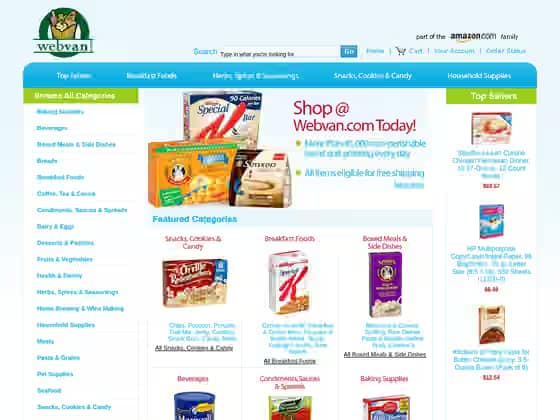
These are screenshots of the Internet Archive’s captures of webvan.com, stored as images. Click one to open the original capture. Captures were found with the CDX API in October 2026. Pages from 1999–2001 are often incomplete.28

Screenshot of http://www.webvan.com/ as archived Nov 9, 2000 · 1:41 AM ET

Captured Nov 9, 2000 · 1:41 AM ET

Pick your city

After the HomeGrocer merger the front door became a market picker: Atlanta, Chicago, Sacramento, San Diego and the Bay Area under one customer-service number, and Los Angeles, Orange County/Inland Empire, Portland and Seattle under another, a sign the two systems hadn’t yet been merged. The truck photo shows the real livery: white box, blue and lime W.

Open this capture on the Wayback Machine

Screenshots were taken from the Internet Archive’s Wayback Machine captures and saved as images, so the page loads without contacting the archive. Click a screenshot to open the original capture. An earlier capture of the Thanksgiving 1999 storefront (Nov 27, 1999) promised “Delivery in our vans within the 30-minute window you choose” and “Free delivery and no tipping.”

Part 4 of 6

People

People · Press

The people

Who built it, and where they went

Ages and titles are from the prospectus. Later careers are included only where we found a source.

People (8)
Name and roleWhat they didAfterwards
Louis BordersFounder; chairman until early 2001

Age 51 in the prospectus. Founded Borders Books in 1971 and Webvan in December 1996. Owned 28.3% before the IPO, the largest stake. He left the board in February 2001.114

George ShaheenCEO, Sep 1999 – Apr 2001

Age 55. Ran Andersen Consulting, later Accenture, for ten years before joining. Became chairman in February 2001 and resigned two months later, saying “a different kind of executive is needed.”11418

Robert SwanCOO, then CEO from Apr 2001

Joined in October 1999 and was named CEO on April 26, 2001. He presided over the Atlanta closure and the July shutdown.1516

Kevin CzingerSenior VP, former CFO

Age 40 in the prospectus, listed as a senior vice president who had earlier served as chief financial officer.1

Michael MoritzDirector; Sequoia Capital

Sequoia held 13.6% before the IPO.1

David BeirneDirector; Benchmark Capital

Benchmark held 12.3% before the IPO. Directors also included Tim Koogle of Yahoo and Christos Cotsakos of E*Trade.1

Doug HerringtonWebvan executive team

Served on Webvan’s executive team before founding KeepMedia.22

Joined Amazon in 2005, led the teams that launched Amazon Fresh, and became CEO of Worldwide Amazon Stores in 2022.22
Mick MountzDirector of business process, logistics

Saw at Webvan how inefficient pallet-and-case fulfillment was, and left in 2000.23

Founded Kiva Systems, which Amazon bought for $775M in 2012 and turned into Amazon Robotics.1923

Press

What was said at the time

Press (7)
In light of the tough climate for raising new funds and our second-quarter order volume, we have made the difficult decision to end all operations effective immediately.
Webvan statement, Jul 9, 2001, via UPI11
The online grocery start-up Webvan may have been the single most expensive flame-out of the dot-com era.
Reuters, Jun 201319
  1. George Shaheen, resigning, Apr 13, 200114

    A different kind of executive is needed to lead the company at this time.
  2. George Shaheen, same statement, via Supermarket News18

    I am convinced, as I have been from the outset, that Webvan has a solid business model, which over time will alter retailing and the way people shop.
  3. Webvan, via E-Commerce Times, Jul 9, 200130

    The company has no plans to resume operations, and it will pursue an orderly wind-down of its operations and sale of its assets and business.
  4. Los Angeles Times, Jul 10, 200113

    Webvan’s stock soared as high as $34 in November 1999, giving the firm a value of more than $10 billion. By Friday, Webvan’s shares had sunk to 6 cents.
  5. Tom Furphy, co-founder of AmazonFresh, to Reuters, 201319

    We had a lot of Webvan DNA in the room and we drew on that experience a lot.

Part 5 of 6

Verdict

Cause of death · What if · Afterlife

Cause of death

Contributing factors, weighted

The weights are our editorial judgment, not a calculation. Click a factor for the evidence.

Cause of death, by editorial weight

One square is one percentage point. The weights are our judgment, not a measurement.

  1. 30%Capacity built years ahead of demand
  2. 25%Fixed costs that grocery margins could not carry
  3. 20%Expansion and a merger before the model worked
  4. 15%The capital window closed
  5. 10%A generous service promise
Data table
Cause of death, by editorial weight
CauseWeight
Capacity built years ahead of demand30%
Fixed costs that grocery margins could not carry25%
Expansion and a merger before the model worked20%
The capital window closed15%
A generous service promise10%

Each distribution center was designed for 8,000 orders a day, and the 10-K admits volumes in every facility were “significantly below” that. Even if all of 2000’s estimated orders had gone through one center, it would have run at about 59% of design. Webvan had several.13

Gross margin was a respectable 26.5% in 2000, but G&A, which held fulfillment, delivery and real estate, was $292.3M, or 164% of sales. Gross profit covered about a sixth of it.3

Atlanta and Chicago opened in 2000 while the Bay Area still lost money, and the $1.04B HomeGrocer merger added five markets on a different technology platform. Dallas closed within six months, with up to $60M in charges.37

The auditors raised going-concern doubt in early 2001. In April Webvan was discussing only about $25M of new money with existing investors, and in July it cited “the tough climate for raising new funds.”71115

Free delivery over $50, no tipping, 30-minute windows and salaried, trained couriers made every order expensive to fulfill at the volumes it actually had.1328

Editorial judgment: How we weight: each factor is scored by how directly the filings tie it to the losses and to the failure to raise money in 2001. Reasonable analysts could weight these differently.

What if

Three forks in the road

Counterfactuals are speculation by definition. Each one starts from a documented decision.

What happened

Webvan signed for up to 26 more distribution centers in July 1999, a month after its first one opened, and opened Atlanta and Chicago in 2000 while the Bay Area was still losing money.13

What if speculative

Holding to one or two Bay Area centers until volume approached the 8,000-order design would have kept 2000 capex far below $259.8M and left a smaller, testable business when the funding window shut in 2001. It might still have failed, but slowly enough to learn whether the model worked.

What happened

Webvan paid about $1.04B in stock for HomeGrocer in September 2000, inherited five more markets on a different technology platform, and closed the Dallas operation within six months.3

What if speculative

Without the merger Webvan would have had fewer markets to convert and no $46M Dallas goodwill write-down. It would also have kept a well-funded rival, so the effect on survival is unclear.

What happened

Webvan built everything itself, from warehouses to vans to couriers. The rivals that lasted, Peapod and Safeway’s GrocerWorks, had grocery chains behind them.3

What if speculative

Picking from an existing chain’s stores would have cost far less up front and given Webvan a supplier with buying power. It would also have given up the automation advantage that was the whole thesis. A decade later, Instacart built a large business on store-based picking.

Afterlife

What happened to everything

Webvan

  1. The warehouses

    Oct 2001

    Court-approved auctions of the equipment at ten facility sites and the Foster City headquarters.28

  2. The shareholders

    Jul 2001

    The company said it expected Nasdaq to delist the stock. Trading was halted the day of the shutdown.1013

  3. The name

    2009 – 2016

    Amazon bought the Webvan name and ran webvan.com as a store for non-perishable groceries, “part of the Amazon family.”192021

  4. The idea

    2007 – today

    AmazonFresh began testing in Seattle in 2007. Four Amazon grocery executives in 2013 were Webvan alumni.1920

  5. The robots

    2012

    Kiva Systems, founded by former Webvan logistics manager Mick Mountz, sold to Amazon for $775M.1923

  6. The alumni

    2022

    Doug Herrington, from Webvan’s executive team, became CEO of Worldwide Amazon Stores.22

Who got the name and the assets

The equipment was auctioned in 2001. The name resurfaced at Amazon eight years later and has since gone dark.

  1. Dec 1996

    Webvan Group, Inc.

    Founded by Louis Borders.1 The webvan.com address was registered on June 29, 1998.32

  2. Jul 2001

    Chapter 11

    Deliveries stop on July 9. The company files in Delaware on July 13 to sell its assets.810

  3. Oct 2001

    Great American Group and DoveBid

    Court-approved auctions of the equipment at ten facility sites, the Foster City headquarters and a San Jose co-location site.28 Prices are not in our sources.

  4. By Sep 2009

    Amazon

    Reported to own the Webvan site and to be using it to sell food by mail.20 How and when Amazon acquired the name is not in our sources.

    not disclosed
  5. 2009 – 2016

    webvan.com, “part of the Amazon family”

    A shop for non-perishable groceries that checked out with Amazon accounts. The last capture we cite is from March 2016.21

  6. Today

    A parked address

    webvan.com is still registered, through the corporate registrar MarkMonitor, but it has no web address record and loads no site. The registrant is not shown in the public record. Checked October 3, 2026.32

Data table
Who got the name and the assets
WhenOwnerWhat happenedPrice
Dec 1996Webvan Group, Inc.Founded by Louis Borders. The webvan.com address was registered on June 29, 1998.
Jul 2001Chapter 11Deliveries stop on July 9. The company files in Delaware on July 13 to sell its assets.
Oct 2001Great American Group and DoveBidCourt-approved auctions of the equipment at ten facility sites, the Foster City headquarters and a San Jose co-location site. Prices are not in our sources.
By Sep 2009AmazonReported to own the Webvan site and to be using it to sell food by mail. How and when Amazon acquired the name is not in our sources.not disclosed
2009 – 2016webvan.com, “part of the Amazon family”A shop for non-perishable groceries that checked out with Amazon accounts. The last capture we cite is from March 2016.
TodayA parked addresswebvan.com is still registered, through the corporate registrar MarkMonitor, but it has no web address record and loads no site. The registrant is not shown in the public record. Checked October 3, 2026.
SEC filings, press and Internet Archive captures as cited1810202128; registry record and DNS lookup for webvan.com32.

Sources

Where every number comes from

SEC filings are cited by accession number and were retrieved from EDGAR in October 2026. Press items are cited as published.

  1. Webvan Group, Inc., Prospectus (Form 424B1), Nov 1999. EDGAR 0000891618-99-004914. sec.gov
  2. Webvan, Annual report for 1999 (Form 10-K405). EDGAR 0000891618-00-001877. sec.gov
  3. Webvan, Annual report for 2000 (Form 10-K). EDGAR 0001012870-01-001485. sec.gov
  4. Webvan, Quarterly report, Q1 2000 (10-Q). EDGAR 0000891618-00-002826. sec.gov
  5. Webvan, Quarterly report, Q2 2000 (10-Q). EDGAR 0001095811-00-002108. sec.gov
  6. Webvan, Quarterly report, Q3 2000 (10-Q). EDGAR 0000891618-00-005126. sec.gov
  7. Webvan, Quarterly report, Q1 2001 (10-Q). EDGAR 0001012870-01-500862. sec.gov
  8. Webvan, Current report (8-K), Item 3 Bankruptcy, Chapter 11 filed Jul 13, 2001, case 01-2404 (D. Del.). EDGAR 0001021408-01-504054. sec.gov
  9. Webvan, Current report (8-K) on the HomeGrocer merger, Sep 2000. EDGAR 0000891618-00-004583. sec.gov
  10. CNNfn, “Webvan shuts down,” Jul 9, 2001. money.cnn.com
  11. UPI, “Webvan to cease operations,” Jul 9, 2001. upi.com
  12. CBS News, “Grocery Dot-Com Folds,” Jul 2001. Reports 750,000 active customers in seven markets. cbsnews.com
  13. Charles Piller, “Online Grocer Webvan Shuts Operations,” Los Angeles Times, Jul 10, 2001. latimes.com
  14. Jon Weisman, “Webvan CEO Shaheen Resigns,” E-Commerce Times, Apr 13, 2001. ecommercetimes.com
  15. CNNfn, “Webvan quits Atlanta, names new CEO,” Apr 26, 2001. money.cnn.com
  16. Greg Sandoval, “Webvan scales back, names CEO,” CNET, Apr 26, 2001. cnet.com
  17. “Webvan’s CEO resigns,” The Seattle Times, Apr 14, 2001. seattletimes.com
  18. “Shaheen exits Webvan; COO Swan named temporary boss,” Supermarket News, Apr 23, 2001. supermarketnews.com
  19. Reuters, “From the ashes of Webvan, Amazon builds a grocery business,” Jun 2013. reuters.com
  20. Lori Preuitt, “Webvan Making a Comeback,” NBC Bay Area, Sep 22, 2009. nbcbayarea.com
  21. webvan.com “About Us” page, Amazon era, Wayback Machine capture of Mar 1, 2016. web.archive.org
  22. Amazon, “10 things to know about Amazon Stores CEO Doug Herrington,” and Amazon IR officer biography. aboutamazon.com
  23. “Kiva Systems Founders Share Company’s Story at Robotics Invest Event in Boston,” Robotics 24/7. robotics247.com
  24. CNNfn, “Kozmo.com ceases operations,” Apr 12, 2001. money.cnn.com
  25. “Streamline to close, victim of losses, tight capital,” Supermarket News, Nov 2000. supermarketnews.com
  26. “HomeGrocer,” Wikipedia (secondary source; used only for HomeGrocer’s IPO size). wikipedia.org
  27. Federal Reserve Bank of St. Louis, FRED, NASDAQ Composite Index (NASDAQCOM), weekly. fred.stlouisfed.org
  28. Internet Archive, Wayback Machine captures of webvan.com, 1999–2016, located via the CDX API. Capture links are given with each view. web.archive.org
  29. U.S. Census Bureau cartographic boundaries via the us-atlas project (states-10m). github.com/topojson/us-atlas
  30. Nora Macaluso, “Webvan Shuts Down, Plans Bankruptcy Filing,” E-Commerce Times, Jul 9, 2001. ecommercetimes.com
  31. Jay R. Ritter, “Initial Public Offerings: Updated Statistics,” University of Florida. ufl.edu
  32. Registry record for webvan.com (Verisign RDAP: created Jun 29, 1998; registrar MarkMonitor Inc.; registrant shown as a proxy service in the registrar’s record), and a public DNS lookup that returned no address record. Both retrieved Oct 3, 2026. rdap.verisign.com
  33. Maplebear Inc. (Instacart), Annual report for 2025 (Form 10-K), filed Feb 26, 2026. EDGAR 0001579091-26-000018. sec.gov
Data notes (13)

Data notes

Note: Quarterly figures for Q4 1999 and Q4 2000 are derived by subtraction from annual and nine-month totals.

Note: Order counts, per-order costs and the break-even calculator are derived from reported totals and the reported average order size. Webvan did not disclose order counts.

Note: The cash balances for Dec 2000 and Mar 2001 are as reported by CNNfn. We did not reconcile them to the balance sheet, which splits cash, short-term investments and restricted cash.

Note: HomeGrocer’s IPO size and Kozmo’s funding come from secondary or press sources and are labeled as such.

Note: Weights in the cause-of-death section and all what-if text are editorial judgment.

Note: The cash flow figure in The numbers is derived from the cash-flow statement in the 2000 10-K. Cash in ($914.5M) is the sum of net preferred stock proceeds ($382.9M), net IPO proceeds ($402.6M), cash acquired with HomeGrocer ($101.1M) and loans, capital leases and other stock sales ($27.9M) for 1998 to 2000. Operating cash use ($324.1M) and capital spending ($356.7M) are three-year sums. The remainder ($21.8M) is $914.5M minus those two figures and the $211.9M of cash and marketable securities reported at Dec 31, 2000.

Note: IPO size: the prospectus covers 25 million shares at $15 ($375M), the figure used in most of this page. The 2000 10-K reports 28,750,000 shares sold in all, for $431.3M gross and $402.6M net. The cash flow figure uses the 10-K’s net amount.

Note: The losses-by-period bars sum to $826.9M (derived: $12.0M + $144.6M + $453.3M + $217.0M).

Note: The overhead-in-orders figure is derived: $292.3M ÷ 365 = $801K a day; $104 × 26.5% = $27.56; $801K ÷ $27.56 ≈ 29,057 orders, drawn as 291 icons of 100 orders.

Note: In the rivals figure, Webvan’s $768M is the derived sum of $118.3M, $275.0M and $375M. Instacart’s figure is revenue, not capital raised, and is shown only to mark the survivor.

Note: Video dates: the years of the three commercials come from their uploaders and are unverified. The distribution-center footage is undated; 2010 is its upload year. The two TechTV clips carry no air date at the Internet Archive; their dates are inferred from the file names (April 25 and July 13, 2001) and from what is on screen.

Note: The current state of webvan.com (registered, no website) is what the registry and DNS returned on Oct 3, 2026. We found no source for how or when Amazon acquired the name, or for who controls it now. The photo of the two trucks is undated; the Commons record gives only the 2005 posting date.

General knowledge: Instacart’s listing on the Nasdaq in 2023 is uncited general knowledge.