Data notes (8)
Data notes
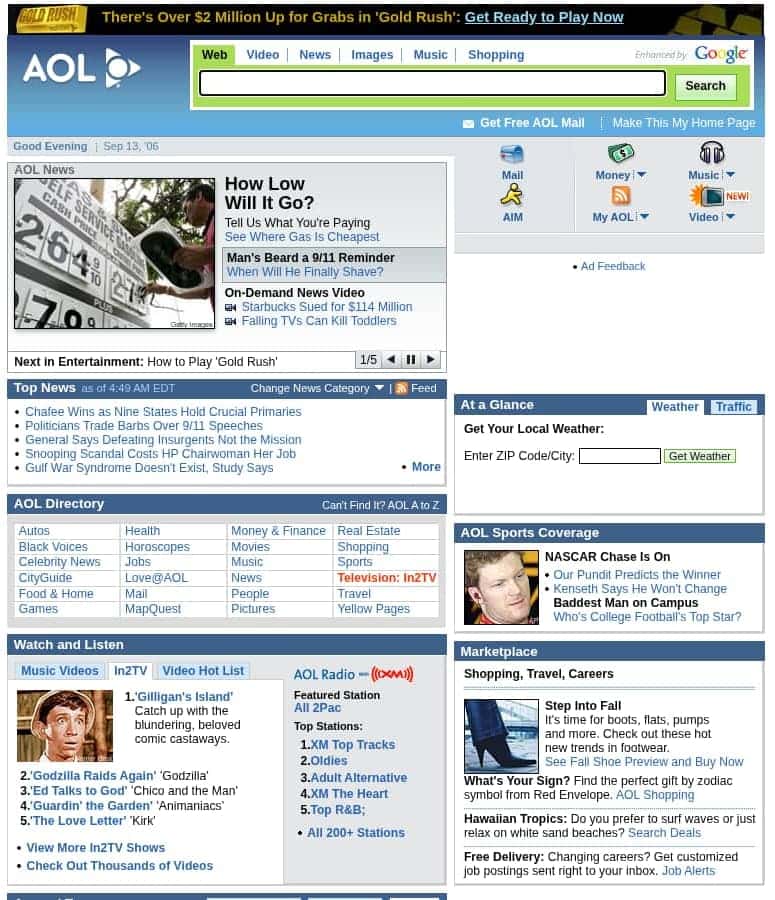
Editorial: We set “died” to 2025, the year AOL discontinued dial-up access, the product the company was built on. Other defensible dates are 2006, when AOL stopped charging broadband users; 2009, when Time Warner spun it off; and 2015, when it ceased to be an independent company. AOL is classed as a ghost, not dead: the portal and the mail service operate under Bending Spoons.
Subscriber series: The basis changes. 1992–1997: worldwide subscribers at June 30. 1998: North America at June 30 (11.237M of 12.535M worldwide). 1999–2000: U.S. at June 30. 2001 onward: U.S. “AOL brand” subscribers at December 31, which in the Time Warner years included members on free trials and retention offers. The 26.7M peak is the September 30, 2002 figure given in the 2002 10-K. No subscriber figures were published after 2014 that we could verify, so the line stops there.
Derived: −92%: (26.7M − 2.2M) ÷ 26.7M. 6.3M lost in 2006: 19.5M − 13.2M. 2.4M lost in 2008: 9.3M − 6.9M. Subscription share of revenue: $6,754.9M ÷ $8,202.1M = 82% (2005); $606.5M ÷ $2,527.2M = 24% (2014). “Advertising and other” for 2005–2009 is the sum of two reported lines. Marketing as a share of revenue, fiscal 1994–1997: 20%, 20%, 19%, 24%. Total 2002 write-downs: $54.235B + $45.538B = $99.773B, which matches the total stated in the 10-K. Scale block: $98.696B ÷ $4.4B = 22.4.
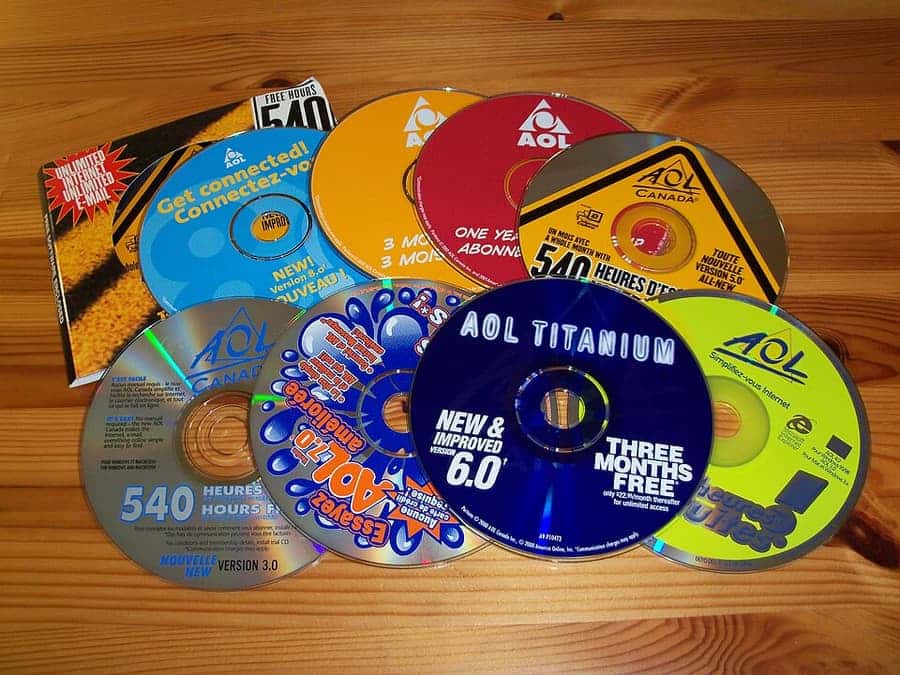
Estimates: Spending on the trial discs (“over $300 million”), the $1.19 cost per floppy disk, the 10% response rate, the 50% share of world CD production and the $35 cost per subscriber are recollections by Jan Brandt and Steve Case posted on Quora in 2010 and reported by TechCrunch. AOL did not publish these figures. The audited equivalents are the marketing costs and deferred subscriber acquisition costs in the 10-Ks. The value of the merger on the day it was announced (“more than $160 billion”) is CNET’s calculation from that day’s share prices; other outlets published other figures.
Unverified: Brandt’s claim that half of all CDs produced worldwide once carried an AOL logo has not been independently verified. The price Bending Spoons paid was not in its announcement; press reports before closing put it at about $1.4 to $1.5 billion, and we use the $1,456 million cash consideration stated in its draft registration statement. The active-user figures for AOL in 2025 are the buyer’s statement. The number of AOL dial-up customers at shutdown is unknown. Upload-supplied dates on three commercials are labelled as such in their captions.
Revenue bases: Fiscal 1994–1997 revenue is as first reported. Fiscal 1998–2000 is as restated in the fiscal 2000 10-K to include companies merged by pooling of interests; the fiscal 1998 and 1999 10-Ks first reported $2,600M and $4,777M. 2001–2004 is the AOL segment as reported by its parent. 2005–2014 is from AOL Inc.’s own filings.
Method: SEC filings were read in full text from EDGAR, or from Internet Archive copies of the same EDGAR documents, in October 2026. Two sources were read through a text-extraction tool and not as raw pages: the Verizon release of May 3, 202116 and the Tech.eu article21. The fiscal 1999 U.S. subscriber figure (15.3M) is taken from the fiscal 2000 10-K.
General knowledge: The film You’ve Got Mail was released by Warner Bros. in 1998. Q-Link was Quantum’s service for Commodore computers. Dial-up modems of the late 1990s were rated at up to 56 kilobits per second.




![The later logo, which appears on the archived home page of September 2006.[^37]](/aol/img/logo-2006.jpg)


