Spectre Brands

DeadPancake and coffee shops · Santa Barbara, California

Sambo’s

First restaurant opened Jun 17, 1957. Chapter 11 filed Nov 27, 1981. Last restaurant renamed Jul 2020.

It had 1,117 coffee shops in 47 states and a name it defended in court for a decade. The name outlived the company by 36 years, on one building.

Why dead: The last restaurant trading as Sambo’s, the 1957 original in Santa Barbara, was renamed Chad’s in July 2020; an unrelated Oregon diner called Lil’ Sambo’s closed in 2022, and the most recent federal trademark application for the name was abandoned in 2010.212627

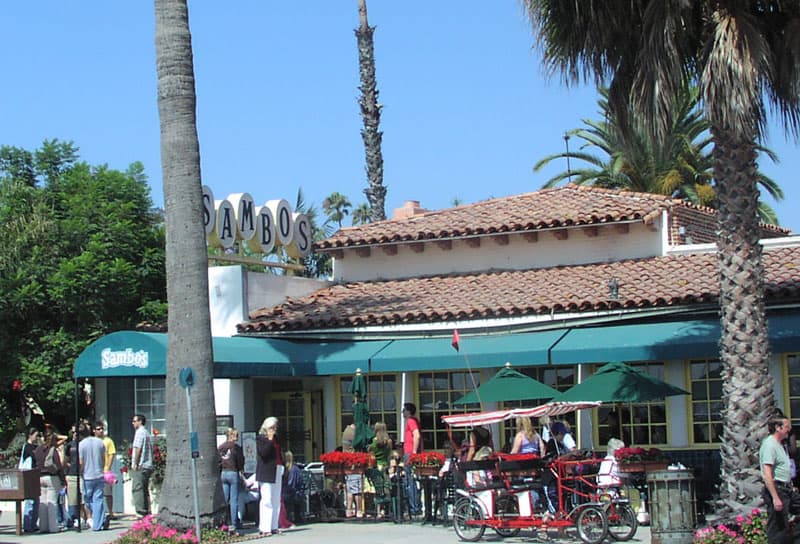
A tile-roofed restaurant with green awnings and a rooftop sign of round discs spelling Sambo’s, with people waiting outside
The original, Santa Barbara, 2005Photo: Antandrus, via Wikimedia Commons, public domain.
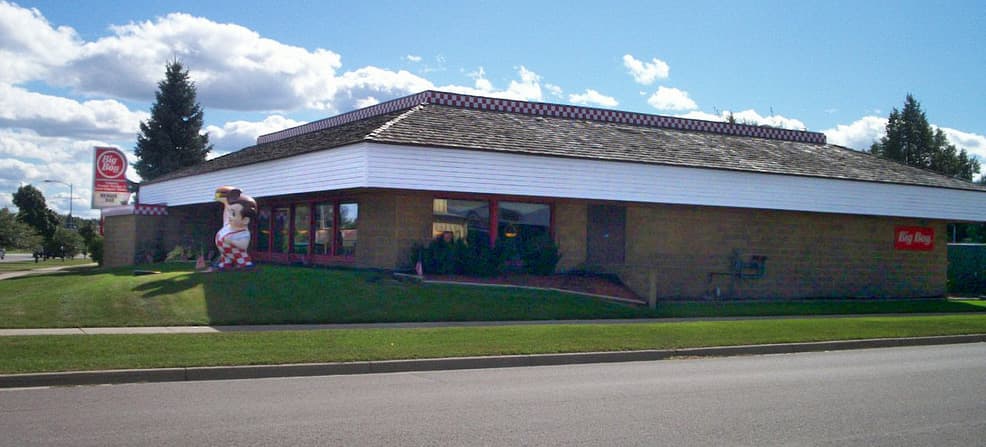
A low single-storey restaurant building with a shingled roof, operating as a Big Boy
A former Sambo’s in Michigan, 2010Photo: TenPoundHammer, cropped by Ubcule, via Wikimedia Commons, CC BY 2.0.

Sambo’s began as a pancake house on the Santa Barbara waterfront and became a chain of more than 1,100 coffee shops. It grew on a plan that sold restaurant managers a share of the profits, and it counted the money they paid in as income. In 1977 the Securities and Exchange Commission objected, the plan was scrapped and most of the managers quit. Losses, a bank default and Chapter 11 followed within four years. All through that time the company was also in court over its name, a slur against Black people that it said was only a blend of its founders’ names. This page is built from court opinions and the newspapers, wire services and magazines of the time, because the company’s filings predate EDGAR. It says where those sources disagree.

The chain in four numbers

1,117
restaurants in 47 states in 1981, the highest count a contemporary source gives36
$77.8M
lost in 1979, two years after a record $22.8M profit67
447
restaurants closed between November 9 and November 25, 1981810
$54.8M
paid by Vicorp in 1984 for 166 restaurants, the last large block14

Key findings

  1. The growth was financed by the managers. A manager paid $20,000 for 20% of a restaurant, and the company booked that money as income. The chain went from 67 restaurants in 1967 to 869 in 1977.26
  2. An accounting ruling broke the model. In 1977 the SEC said the $20,000 was a deposit, not income. Sambo’s restated 20 years of earnings and replaced the plan. Within two years more than 70% of its managers had resigned.2
  3. Profit turned to loss in two years. Earnings fell from $22.8M in 1977 to $7.6M in 1978. The company lost $77.8M in 1979 and had not earned a profit since when it filed for bankruptcy.279
  4. The name was a second, separate crisis. City officials and civil rights groups in Michigan, Ohio and New England fought the name from 1972 on. A federal appeals court upheld the company’s right to use it on November 4, 1981. Sambo’s filed for Chapter 11 twenty-three days later (derived).161012
  5. The name went before the restaurants did. In bankruptcy more than 600 restaurants were converted to a format called Season’s. What was left was sold to Godfather’s Pizza, Vicorp and others, and only the first restaurant kept the old sign.131417

The story

A pancake house, a profit-sharing plan and a name

Sambo’s had two problems that are often confused. One was its name, which drew protests and lawsuits for a decade. The other was its bookkeeping, which is what the business press of the time blamed for the collapse.

Chapter 1 of 6

67

restaurants by 1967, ten years after the first

A tile-roofed restaurant with green awnings and a rooftop sign spelling Sambo’s on round discs
The first restaurant, at 216 West Cabrillo Boulevard in Santa Barbara, photographed in August 2005. Photo: Antandrus, via Wikimedia Commons, public domain.32

1957 – 1967 · Santa Barbara

Sam, Bo and a pancake house on the beach

The first Sambo’s opened on June 17, 1957 at 216 West Cabrillo Boulevard in Santa Barbara, across the road from the beach.1724 Its founders were Sam Battistone, who had worked his way up through California restaurants, and F. Newell Bohnett, a restaurant-equipment salesman known as Bo.1718 Pancakes cost 45 cents.17

The company always said the name was a blend of the two men’s names.12 In facts agreed by both sides in a later federal case, Battistone’s son suggested it because it “conjured up associations with pancakes and, coincidentally, combined the names of the founders.”12 The association was with “The Story of Little Black Sambo,” an 1899 children’s book set in India in which tigers turn into butter for a boy’s pancakes. The chain decorated its restaurants with murals from the book.118

In the United States the word was a slur for Black people, and had been since before the book was written.127 Both sides in the federal case agreed that it was offensive to some Black people.12 That did not slow the chain in California. By 1967 it had 67 restaurants and an income of about $1 million.6

Chapter 2 of 6

869

restaurants in 1977, thirteen times the 1967 count (derived)

Original illustration: a manager’s one-fifth share. Not an official asset.

1967 – 1977 · Fraction of the Action

Every manager a part-owner

In 1967 the company began a profit-sharing plan it called Fraction of the Action.6 A restaurant manager was paid a basic salary of only $9,000 a year. For $20,000 the manager bought 20% of the restaurant, and could then buy 5% shares in other restaurants. Some earned as much as 60% a year on the investment.2 A former manager told Time that recruits were promised they would be “set for the rest of your life” if they stayed ten years.6

It worked. Managers commonly worked seven days a week.9 Sambo’s went public in 1969. The shares, split five times between 1970 and 1974, rose from a low of 2¾ in 1970 to a peak of 27 in 1977.9 The chain grew from about 200 restaurants around 1972 to more than 1,000 by late 1978.1 Income reached $22.8M in 1977.6

The weakness was in how the plan was booked. Money paid in by managers was recorded as income, and it “became critically important to Sambo’s bottom line,” the Times wrote later. To keep that income rising, the chain had to add restaurants faster every year.9

They recruited us by saying that if you’ll stay with Sambo’s for ten years, you’ll be set for the rest of your life.

John Puccinelli, former manager in Concord, Calif., in Time, Aug 17, 19816

Chapter 3 of 6

$77.8M

lost in 1979, as reported by UPI

Commercial · 1979A breakfast commercial Dated 1979 by the uploader, robatsea2009.33 That was the year the company lost $77.8M and most of its original managers.27 Watch on YouTube

1977 – 1980 · The ruling

A deposit, not income

In the fall of 1977 the Securities and Exchange Commission told Sambo’s it could not record the managers’ payments as sales, because the company kept the right to buy each share back at the purchase price when a manager left. The $20,000 was a deposit.29 The company restated its earnings downward for 20 years and brought in a new incentive formula that gave it a larger share of each restaurant’s earnings.2

The managers revolted. Time reported that half of them quit within six months; by December 1979 the Times put the figure at more than 70% in two years.26 Former managers sued, calling the old plan a pyramid scheme, and an Oregon court awarded one of them $925,000.6 Buying back the shares of departing managers drained cash, and inexperienced replacements ran the restaurants. Revenue per restaurant fell.29

Earnings dropped from $22.8M in 1977 to $7.6M in 1978. Sambo’s began losing money in the fourth quarter of 1978 and lost $77.8M in 1979.279 Creditors forced four outside directors onto the board in August 1979, and Sam Battistone Sr., then 69, resigned as chairman in favour of his son. Late that year GDV, a unit of City Investing, paid $13.7M for convertible preferred shares, a 16% holding as the Times described it, and installed the management team of Motel 6.2 In 1980 City Investing completed the purchase of 34% of the chain for $29M.6

In focusing on cost-cutting, the company has neglected sales with predictable results - continuing heavy losses.

Michael Culp, analyst, on the City Investing turnaround, The New York Times, Nov 27, 19819

Chapter 4 of 6

18

New England restaurants renamed “No Place Like Sam’s” in March 1981

Original illustration of a roadside coffee shop of the period. The sign is deliberately blank; this is not a drawing of a real restaurant.

1971 – 1981 · The name

Won in court, changed anyway

The objections began as soon as the chain left the West. In 1972 the city council of Ann Arbor, Michigan approved a restaurant only after the company agreed not to call it Sambo’s. It opened as the Jolly Tiger.12 When the chain reached New England in 1978 it met pickets, petitions and lawsuits. The Massachusetts attorney general sued under the state’s public-accommodation law, the town of Reading refused a licence, and the Urban League and the NAACP filed a complaint in Rhode Island.14

The company fought. Its spokesman told the Times in 1978 that it had “a legal right to retain the name.”1 It had spent more than $31M on national advertising since 1971 to build that name, and it argued the First Amendment protected it.12 On November 4, 1981 the Sixth Circuit agreed and ordered Ann Arbor to let the sign stay.12

By then the company was already retreating. Thirteen restaurants had been renamed Jolly Tiger, and in March 1981 it renamed 18 in Massachusetts, Connecticut and New Hampshire “No Place Like Sam’s,” while denying that criticism was the reason.35 That same month the Rhode Island Commission for Human Rights ordered its four restaurants there renamed.4 The Times had reported in 1978 that the protests slowed expansion in New England but were “not directly tied” to the fall in earnings.1

I think I can go to Sam’s to eat without feeling degraded.

Nan Ellison, president of the Brockton, Mass. NAACP, The Christian Science Monitor, Apr 22, 19815

Chapter 5 of 6

447

restaurants closed between November 9 and 25, 1981

Commercial · 1982A commercial dated 1982 Uploaded by Captioning for Everyone with closed captions and dated 1982 by the uploader.33 If the date is right, it aired while the company was in Chapter 11 and shortly before the restaurants became Season’s.13 Watch on YouTube

Nov 1981 – 1984 · Chapter 11

Finish your meal and leave

On September 30, 1981 Sambo’s failed to pay $4.8M, the first instalment on a $100M loan it had restructured with 17 lenders.10 On November 9 it began closing restaurants, some so abruptly that customers were reportedly asked to finish their meals and leave.9 By November 25 it had closed 447 and sold 12, leaving 667 in 46 states, and had put as many as 10,000 people out of work.810 That day trading in the shares was halted for most of the day, after a federal grand jury indicted two former officers and three other executives on fraud charges. The shares last changed hands at 1¾.9

The lenders served a notice of default, and on November 27, 1981 Sambo’s filed for Chapter 11 in Los Angeles.1016

In bankruptcy the company gave up the name. Late in 1982 it borrowed $30M to convert more than 600 restaurants to a format called Season’s. By May 1983 a court examiner said the Season’s restaurants needed “a more dramatic increase in sales” to become profitable. Sambo’s sold 250 unprofitable ones and agreed to turn 112 into Godfather’s Pizza franchises.13 In August 1984 the trustee, Charles J. McLaughlin, sold 166 restaurants, 107 of them in California, to Vicorp for $54.8M. Vicorp said it would convert them to Village Inn and Bakers Square.14

We will continue to operate 667 restaurants nationwide under our present supervision and employees.

Arthur Dowd, Sambo’s vice president, on the day of the filing, The New York Times, Nov 28, 198110

Chapter 6 of 6

1

restaurant still called Sambo’s after the chain was sold

Original illustration of the sign being covered in June 2020. Not a photograph, and not an official asset.

1984 – 2020 · The last one

One sign, 36 more years

One restaurant never changed its name: the first. Sam D. Battistone, the founder’s son, bought it back from Vicorp after he sold the Utah Jazz basketball team in 1985–86, and his brother Roger ran it.17 In 1998 the founder’s grandson Chad Stevens took it over and talked of relaunching the chain. “It started making me think that this was a valuable brand,” he told the Los Angeles Times.181924 Two academics quoted in the same article said the name could not be made acceptable.18

No second restaurant followed. A company at a Santa Barbara address applied to register the name for restaurant services in January 2010 and abandoned the application that October.21

In June 2020, after the killing of George Floyd, a Santa Barbara resident, Rashelle Monet, petitioned for the name to go. Stevens agreed within days. On June 5 the letters were covered with a peace symbol and the words “& LOVE,” and on July 14 a new sign went up: Chad’s.232426 The restaurant is still open under that name.28

I am not saying that Sambos and the owners are racist. I am saying the slur is racist.

Rashelle Monet, who petitioned for the change, KEYT, Jun 5, 202024

Timeline

Sixty-three years, 34 moments

From a beachfront pancake house to a covered sign. Filter by thread.

All 34 events as a list
  1. Jun 171957
    Corporate

    The first restaurant opens

    Sam Battistone and F. Newell Bohnett open a pancake house at 216 West Cabrillo Boulevard, Santa Barbara.1724

  2. 1967
    Corporate

    Fraction of the Action begins

    Managers can buy 20% of their restaurant for $20,000. The chain has 67 restaurants.6

  3. 1969
    Money

    Sambo’s goes public

    The shares are split five times between 1970 and 1974.9

  4. Dec1971
    The name

    Ann Arbor application

    The company files a site plan for a restaurant in Ann Arbor, Michigan. Council members and the mayor object to the name.12

  5. Late1972
    The name

    The first Jolly Tiger

    Ann Arbor approves the restaurant after the company agrees not to use the name Sambo’s there.12

  6. 1977
    Money

    The peak year

    869 restaurants, income of $22.8M and a share price that touches 27.69

  7. Fall1977
    Money

    The SEC objects

    The commission says managers’ payments cannot be recorded as sales. The company restates 20 years of earnings and replaces the plan.29

  8. Nov 171978
    The name

    Under fire in New England

    The Times reports pickets, a suit by the Massachusetts attorney general and a licence refused in Reading. Nine-month earnings have fallen to $3.1M from $6.8M.1

  9. Dec1978
    The name

    Rhode Island complaint

    The Urban League of Rhode Island, the local NAACP and two individuals complain to the state human rights commission.4

  10. Late1978
    Money

    Losses begin

    Sambo’s loses money in the fourth quarter and never reports another profit.9

  11. May1979
    Corporate

    Shareholder revolt

    Dissident shareholders almost elect two directors.2

  12. Aug1979
    Corporate

    Battistone Sr. steps down

    Creditors press for four outside directors. The founder, 69, resigns as chairman and is replaced by his son, Sam D. Battistone, 39.2

  13. Dec1979
    Corporate

    The Motel 6 team arrives

    GDV, a unit of City Investing, pays $13.7M for a 16% holding and installs Daniel R. Shaughnessy as president. The chain has 1,090 restaurants.2

  14. 1979
    Money

    $77.8M loss

    The loss for the year, as UPI later reported it. More than 70% of managers have resigned in two years.27

  15. 1980
    Corporate

    City Investing reaches 34%

    The conglomerate completes its purchase of 34% of the chain for $29M. The loss for the year is $11.6M.67

  16. Jan1981
    Corporate

    Suing the founders

    New management files a $100M suit against 28 former officials, including Battistone and Bohnett.67

  17. Mar1981
    The name

    No Place Like Sam’s

    The company renames 18 restaurants in Massachusetts, Connecticut and New Hampshire. It has 1,117 restaurants.35

  18. Mar 161981
    The name

    Rhode Island order

    The Commission for Human Rights orders the four Rhode Island restaurants renamed. The company says it will appeal.412

  19. Jul1981
    Money

    $925,000 verdict

    An Oregon court awards damages to a former manager who sued for fraud over the profit-sharing plan.6

  20. Sep 301981
    Money

    Default

    Sambo’s misses a $4.8M payment, the first instalment of a $100M restructured loan from 17 lenders.10

  21. Nov 41981
    The name

    Sixth Circuit rules for the name

    The court of appeals orders Ann Arbor to let the restaurant use the name Sambo’s.12

  22. Nov 91981
    Bankruptcy & end

    Closings begin

    Restaurants in Michigan, Ohio and Kentucky shut first. Until then the new management had closed only five or six.7

  23. Nov 251981
    Bankruptcy & end

    447 closed, shares halted

    The company says it has closed 447 restaurants and sold 12, leaving 667. Five men, including two former officers, are indicted for fraud.89

  24. Nov 271981
    Bankruptcy & end

    Chapter 11

    Sambo’s Restaurants Inc. files a voluntary petition in the Central District of California.101116

  25. Late1982
    Bankruptcy & end

    Season’s

    With $30M borrowed from GDV and the Foothill Group, more than 600 restaurants are converted to a new format and name.13

  26. May1983
    Bankruptcy & end

    Examiner’s warning

    A court examiner says Season’s needs a sharper rise in sales. The company sells 250 restaurants and agrees to convert 112 to Godfather’s Pizza.13

  27. Jul 11983
    Bankruptcy & end

    A third format

    Sambo’s says it may turn its remaining 320 Season’s restaurants into Coco’s and Baxter’s franchises for W.R. Grace.13

  28. Aug 31984
    Bankruptcy & end

    Vicorp buys 166

    The trustee and Vicorp announce a court-approved sale for $54.8M: 107 restaurants in California, 46 in Florida, 9 in Arizona and 4 elsewhere.14

  29. About1986
    Afterlife

    The family buys back the first one

    After selling the Utah Jazz in 1985–86, Sam D. Battistone persuades Vicorp to sell him the Santa Barbara restaurant. The exact date is not in our sources.17

  30. Nov 91989
    Afterlife

    Registration cancelled

    The federal trademark registration filed by the company in October 1981 is cancelled for want of a renewal declaration.22

  31. Jan1998
    Afterlife

    Talk of a revival

    Chad Stevens, the founder’s grandson, tells the Los Angeles Times and CNN he wants to relaunch the chain under its old name.1819

  32. Jan 192010
    Afterlife

    A new trademark application

    Palm Beach Restaurants, Inc. of Santa Barbara applies to register the name for restaurant services. The application is abandoned on October 21.21

  33. Jun 52020
    Afterlife

    The sign is covered

    After a petition by Rashelle Monet, the owners cover the letters with a peace symbol and the words “& LOVE.”232425

  34. Jul 142020
    Afterlife

    Chad’s

    A new sign goes up on the building after 63 years.26

A low brick restaurant with a shingled roof and a Big Boy statue at the door
2010 A former Sambo’s in Alpena, Michigan, operating as a Big Boy.Photo: TenPoundHammer, cropped by Ubcule, via Wikimedia Commons, CC BY 2.0.

Part 2 of 6

Business

The numbers · Marketing

The money

Up for ten years, down in four

Sambo’s was a public company from 1969, but its filings predate EDGAR and are not online. What follows is every figure we could confirm in court opinions and the press of the time. Gaps in the charts are gaps in the record.

Restaurants: one, then 1,117, then one

Restaurants at the dates a source gives a count. After November 1981 the figures are not like for like; see the source line.

05001,0001,50019571967c. 19721977Dec ’79Mar ’81Nov 25 ’81Jul ’83Aug ’84199412345605001,0001,5001957c. 1972Dec ’79Nov 25 ’811994123456
  1. 1967 · the plan starts 67 restaurants when Fraction of the Action begins.6
  2. 1977 · the peak year for profit 869 restaurants and $22.8M of income. The SEC objects to the accounting that fall.69
  3. Mar ’81 · the peak count 1,117 restaurants as the first New England units are renamed.3
  4. Nov 25 ’81 · the purge 667 left after 447 closings and 12 sales in under three weeks. Chapter 11 follows two days later.810
  5. Jul ’83 · Season’s 320 restaurants remain, all under the Season’s name, after 250 are sold and 112 promised to Godfather’s Pizza.13
  6. Aug ’84 · the sale 166 restaurants go to Vicorp.14
Data table
Restaurants: one, then 1,117, then one
Date of the report (not evenly spaced)Restaurants
19571
196767
c. 1972200
1977869
Dec ’791,090
Mar ’811,117
Nov 25 ’81667
Jul ’83320
Aug ’84166
19941
1957: the first restaurant.17 67 and 869: Time.6 About 200 “only six years ago”, from a November 1978 article.1 1,090.2 1,117.3 667 remaining.8 320 Season’s restaurants.13 166 is the number sold to Vicorp, not a count of all restaurants then open.14 One: the Santa Barbara original, as described in 1994.17

Profit and loss, where reported

$ millions. Six figures over fifteen years; the last covers nine months only.

Data table
Profit and loss, where reported
PeriodProfit or loss ($M)
1967$1M
1977$22.8M
1978$7.6M
1979$-77.8M
1980$-11.6M
Jan–Sep 1981$-29.8M
1967 (“about $1 million”) and 1977: Time.6 1978: The New York Times.2 1979, 1980 and the first nine months of 1981: UPI.7 The 1977 and 1978 figures are as the press gave them; the company restated earlier years after the SEC ruling and we have not seen the restated figures.2 In December 1979 the Times expected the 1979 loss only to “top $50 million.”2

The share price, at five moments

Dollars per share, at the highs and lows the Times gave in November 1981.

Data table
The share price, at five moments
PeriodShare price ($)
1970 low$2.75
1973 high$24.38
1974 low$6.63
1977 high$27.00
Nov 25, 1981$1.75
Robert Metz, Market Place, The New York Times, November 27, 1981. Prices were quoted in fractions (2¾, 24⅜, 6⅝, 27 and 1¾) and are converted to decimals here. The shares were split five times between 1970 and 1974; the article does not say whether the earlier prices are adjusted.9

What happened to the chain in November 1981

Share of the 1,126 restaurants accounted for in the company’s announcement of November 25 (derived).

  1. 59%Kept open667 restaurants in 46 states
  2. 40%Closed447 restaurants, from November 9
  3. 1%Sold12 restaurants
Data table
What happened to the chain in November 1981
OutcomeShare of restaurants
Kept open59%
Closed40%
Sold1%
UPI, November 25, 1981.8 Percentages are derived: 667, 447 and 12 as shares of their sum, 1,126, rounded to whole squares. The Times gave the chain 1,114 restaurants two days later, so the three figures do not reconcile exactly with the total.9

What Vicorp paid for 166 restaurants

The August 1984 sale approved by the bankruptcy court, $ millions.

$54.8M Purchase price
$35.5M 65%Vicorp convertible preferred stock$19.3M 35%Cash and assumed secured debt (derived remainder)$35.5M 65%Vicorp convertible preferred stock$19.3M 35%Cash and assumed secured debt(derived remainder)
  • Vicorp convertible preferred stock. Dividend of 10% to 13%14
  • Cash and assumed secured debt (derived remainder). 54.8 − 35.5; the split between the two is not in our source
Data table
What Vicorp paid for 166 restaurants
Where it wentAmountShareNote
Vicorp convertible preferred stock$35.5M65%Dividend of 10% to 13%
Cash and assumed secured debt (derived remainder)$19.3M35%54.8 − 35.5; the split between the two is not in our source
UPI, August 3, 1984.14 The second figure is derived. That works out to about $330,000 a restaurant (derived: $54.8M ÷ 166).

Thirteen restaurants in 1977 for every one in 1967

869restaurants in 19776
=
13 ×restaurants in 1967 (67; each icon is the whole 1967 chain (67 restaurants))

Derived 869 ÷ 67 ≈ 13.0. Both counts are from the same Time article.6

Data table
Thirteen restaurants in 1977 for every one in 1967
Value
restaurants in 1977869
restaurants in 196767
Ratio13 (derived)

The debt that forced the filing

$100M
loan restructured with 17 lenders, among them Prudential, First Interstate, Bank of America, Crocker and Citibank10
$4.8M
first instalment, missed on September 30, 198110
$29.8M
lost in the first nine months of 1981, against $9.35M a year earlier7
10,000
jobs lost in the November closings, at the top of the company’s range1011
The New York Times10 and UPI.711 UPI gave the job losses as 9,000 to 10,000.
Fraction of the Action, as the Times described it in 1979
$9,000basic annual salary of a restaurant manager2
$20,000paid by the manager for 20% of the restaurant, and booked by the company as income2
60%annual return some managers earned on that investment2
70%or more of the managers resigned in the two years after the plan was changed2
Pamela G. Hollie, The New York Times, December 3, 1979.2 Book value per share, by Value Line’s calculation, went from $9.39 in 1977 to $1.95 in 1980 and zero in 1981.9

The brand

A name defended in court, then changed three times

The company spent a decade and tens of millions of dollars on a name that part of the public read as an insult. This section sets out what the record says about that name. We have no figure for what the controversy cost in sales, and we do not guess.

Where the name came from

The company’s account never changed: “Sam” from Sam Battistone and “Bo” from F. Newell Bohnett.12 The facts agreed in the Ann Arbor case add that the name was chosen because it “conjured up associations with pancakes.”12 For years the restaurants used the children’s book openly. Signs at many older restaurants showed a boy, and murals of the story lined the walls; the company said in 1978 that restaurants opened in the previous four years used only tigers.1 By 1979 the chain’s symbol was a tiger.2

The word itself was the problem. The Urban League’s Emergy Jackson told the Times in 1978 that it had been a derogatory term for Black people long before the book was written.1 Rhode Island’s Commission for Human Rights found that the name had the effect of telling Black people they were unwelcome.18

The name in numbers
$31Mand more spent on national advertising between 1971 and the Ann Arbor trial12
214of 238 people surveyed for Rhode Island’s commission said they would avoid the restaurants because of the name4
6 yearsthe Ann Arbor restaurant traded as the Jolly Tiger before the company put up Sambo’s signs12
70restaurants first planned for New England, a target cut back as hearings dragged on1
Sambo’s Restaurants v. City of Ann Arbor12, UPI4 and The New York Times1. In the Rhode Island survey 89% of those asked were Black; 214 of 238 is 90% (derived).4

Three replacement names

Restaurants trading under each substitute name, at the date a source gives a count.

Jolly Tiger (by March 1981)
13
A trademark the company already owned13
No Place Like Sam’s (March 1981)
18
Massachusetts, Connecticut, New Hampshire3
No Place Like Sam’s (August 1981)
more than 100
Time’s count6
Season’s (late 1982)
more than 600
After the bankruptcy filing13
Data table
Three replacement names
NameRestaurantsNote
Jolly Tiger (by March 1981)13A trademark the company already owned
No Place Like Sam’s (March 1981)18Massachusetts, Connecticut, New Hampshire
No Place Like Sam’s (August 1981)more than 100Time’s count
Season’s (late 1982)more than 600After the bankruptcy filing
The New York Times1313 and Time6. The last two bars are lower bounds: the sources say “more than.”
Commercial · 1975Sambo’s commercial A thirty-second spot from the years of fastest growth, uploaded by Retro Man and dated 1975 by the uploader.33 The chain went from 67 restaurants in 1967 to 869 in 1977.6 Watch on YouTube

Did the name kill it?

Contemporary reporting says no, or not mainly. The Times wrote in 1978 that the earnings decline was “not directly tied to the controversy over the company’s name,” and its 1981 analysis of the collapse, headlined “Mistakes at Sambo’s,” does not mention the name at all.19 The Los Angeles Times concluded in 1998 that the chain’s demise “had more to do with financial mismanagement than with African American opposition to the concept.”18

The name still cost something. Protests led to long licensing hearings, a closed restaurant in Reading in which the company had invested $800,000, and a shrinking plan for New England.1 The restaurants renamed Jolly Tiger did less well than those under the old name, the Times reported.2 And a chain that tried three replacement names gave up the recognition its advertising had bought.

There can be no doubt that the name “Sambo’s” is offensive and harms the general community by promoting racial insensitivity.

Judge Damon J. Keith, dissenting, Sambo’s Restaurants v. City of Ann Arbor, Nov 4, 198112

Part 3 of 6

Brand

Commercials & footage · Brand gallery

Commercials & footage

The chain on television, and the last sign on the news

Four spots as collectors have preserved them, and three pieces from June and July 2020. Airing years of the commercials come from the uploaders and we could not confirm them. Advertising of this period may include the chain’s mascots.

Commercial · 1975Sambo’s commercial A thirty-second spot from the years of fastest growth, uploaded by Retro Man and dated 1975 by the uploader.33 The chain went from 67 restaurants in 1967 to 869 in 1977.6 Watch on YouTube
Commercial · 1977“Just What The Family Ordered...” Uploaded by The Museum of Classic Chicago Television, which dates it to 1977, the chain’s best year for profit.336 Watch on YouTube
Commercial · 1979A breakfast commercial Dated 1979 by the uploader, robatsea2009.33 That was the year the company lost $77.8M and most of its original managers.27 Watch on YouTube
Commercial · 1982A commercial dated 1982 Uploaded by Captioning for Everyone with closed captions and dated 1982 by the uploader.33 If the date is right, it aired while the company was in Chapter 11 and shortly before the restaurants became Season’s.13 Watch on YouTube
News segment · 2020KEYT: “American restaurant history changing in Santa Barbara with the end of Sambos” The Santa Barbara station’s report on the decision to drop the name, published on the station’s News Channel 3-12 channel in 2020. The written version of the report is one of our sources.24 Watch on YouTube
News segment · 2020KEYT: “Chad’s name now on historic restaurant site” The same station on the new sign, July 2020.26 Watch on YouTube
Interview · 2020Restaurant Hospitality: the owner on changing the name A five-minute interview with the owner of the last restaurant, published by the trade magazine Restaurant Hospitality in 2020. It is his account, not a source for any figure on this page.33 Watch on YouTube

Videos are embedded from the services that host them and load only when you press play. YouTube embeds use youtube-nocookie.com. Each video belongs to its uploader or rights holder and is shown here for commentary; we do not host any of the files. We found no embeddable news footage of the November 1981 closings or the bankruptcy filing.

Part 4 of 6

People

People · Press

The people

Founders, fixers and the grandson

Ages and titles are as given in the press at the time. Later careers are left out where we have no source.

People (9)
Name and roleWhat they didAfterwards
Sam Battistone Sr.Co-founder; chairman until Aug 1979

Worked as a busboy, waiter and manager in California restaurants before opening the first Sambo’s with Bohnett in 1957. Resigned as chairman at 69 under pressure from creditors, and stayed on as a director.218

Sued by the company’s new management in 1981, with Bohnett and 26 others, for $100M. The outcome of that suit is not in our sources. The Los Angeles Times says he died in 1991.6718
F. Newell “Bo” BohnettCo-founder

A restaurant-equipment salesman and former Marine Corps pilot who supplied the second half of the name.1729

Moved to Hawaii in 1968 and bought a 107,000-acre ranch there in 1972. Died on January 1, 2017, aged 93.29
Sam D. BattistoneChairman from Aug 1979

The founder’s son, who cooked beside his father at the 1957 opening and became chairman at 39. He was also one of the founding owners of the New Orleans Jazz basketball team, which he later moved to Salt Lake City.217

Bought the Santa Barbara restaurant back from Vicorp after selling the Utah Jazz in 1985–86.17
Daniel R. ShaughnessyPresident from Dec 1979

Head of the Motel 6 management team that City Investing’s affiliate installed at Sambo’s. He declined to describe his strategy: “In March, we’ll have something to talk about.”2

George T. ScharffenbergerChairman, City Investing

Led the New York conglomerate that owned Motel 6 and, through GDV, took 34% of Sambo’s by 1980.26

Arthur K. DowdVice president and spokesman, 1981

The voice of the company through the renamings, the closings and the filing. He said the Chapter 11 petition would “have absolutely no effect on the company’s operations.”510

Charles J. McLaughlinBankruptcy trustee

The trustee who announced the court-approved sale of 166 restaurants to Vicorp in August 1984.14

Chad StevensOwner of the last restaurant from 1998

Battistone Sr.’s grandson. He planned a revival of the chain in 1998, kept the name for 22 years and replaced it with his own in July 2020.182426

Still runs the restaurant as Chad’s, according to its website.28
Rashelle MonetPetitioner, 2020

The Santa Barbara resident whose petition and public comment to the city council led to the change. She helped cover the sign from a crane.2324

The clippings

What they said at the time

Press (10)
When business gets bad enough, a company will try just about anything.
Time, “A New Name,” Aug 17, 19816
Sambo’s Restaurants Inc., once a rapidly growing and highly regarded chain of coffee shops, is now in deep trouble, its survival threatened.
Robert Metz, Market Place, The New York Times, Nov 27, 19819
  1. David Severson, Sambo’s spokesman, The New York Times, Nov 18, 19781

    We are aware that some blacks find our name insensitive, but we have a legal right to retain the name and plan to do so.
  2. Arthur K. Dowd, on renaming 18 restaurants, The Christian Science Monitor, Apr 22, 19815

    We are taking this step to improve our market position in New England.
  3. Abner Darby, New England president of the NAACP, The Christian Science Monitor, Apr 22, 19815

    We asked them to change the name, and they have complied.
  4. Judge Anthony J. Celebrezze, Sambo’s Restaurants v. City of Ann Arbor, Nov 4, 198112

    This case raises novel freedom of speech issues regarding the standard for the waiver of first amendment rights and the scope of first amendment protection to be afforded “offensive” commercial speech.
  5. Robert S. Benson, president of Vicorp, in Nation’s Restaurant News, 1989, as quoted in a reference history15

    We shot ourselves in the foot in 1985, pushing too many people into outlying Sambo’s locations, which proved non-viable.
  6. Chad Stevens, before deciding to keep it, Los Angeles Times, Jan 12, 199818

    My main goal a year ago was to change the name.
  7. Jeffrey T. Sammons, professor of history, New York University, Los Angeles Times, Jan 12, 199818

    There is no way that they cannot know that this is problematic.
  8. The owners’ statement, June 2020, as quoted by NBC News25

    Our family has looked into our hearts and realize that we must be sensitive when others whom we respect make a strong appeal.

Part 5 of 6

Verdict

Cause of death · What if · Afterlife

Cause of death

The autopsy

Tap a cause to see the evidence. The percentages are our editorial weighting. The evidence under each one is sourced.

Cause of death, by editorial weight

One square is one percentage point. The weights are our judgment, not a measurement.

  1. 35%The incentive plan, and the way it ended
  2. 20%Growth that needed more growth
  3. 20%Debt and impatient lenders
  4. 15%The name
  5. 10%A turnaround that cut and rebranded
Data table
Cause of death, by editorial weight
CauseWeight
The incentive plan, and the way it ended35%
Growth that needed more growth20%
Debt and impatient lenders20%
The name15%
A turnaround that cut and rebranded10%

Managers’ payments were booked as income until the SEC objected in 1977. The company restated 20 years of earnings and imposed a less generous formula. More than 70% of managers resigned within two years, former managers sued, and an analyst called the abrupt end of the plan the company’s most critical mistake.269

The chain went from 67 restaurants to 869 in ten years and passed 1,000 in 1978. The Times wrote that it had to add restaurants at an ever faster rate to keep income from the plan rising. In 1981 the new management sued 28 former officials, charging that they had inflated profits and expanded too rapidly.169

By late 1979 Sambo’s had about $100M of obligations and was in technical default. It missed the first $4.8M instalment of a restructured $100M loan in September 1981, and the 17 lenders’ notice of default prompted the Chapter 11 filing.210

Lawsuits, licence refusals and a state human rights order slowed expansion in the Northeast and tied up management for a decade. The company won in the Sixth Circuit and still tried three replacement names, giving up a name on which it had spent more than $31M in advertising.1341213

City Investing’s team cut costs and staff while losses continued, then closed 447 restaurants in under three weeks. The Season’s format that followed fell short of what a court examiner said it needed, and the estate was sold off in pieces.891314

Editorial judgment: the weights are an interpretive model by the Spectre Brands editors, not a measured quantity. The press of the time documents the symptoms. How much each one contributed, and how far the name deepened the financial trouble, is a matter of opinion.

The fork in the road

What if…

Three decisions where the story could have gone differently. The “What if” panels are speculation, labeled as such.

What happened

After the SEC challenged the accounting in 1977, Sambo’s replaced Fraction of the Action with a formula that raised the company’s share of each restaurant’s earnings. Half the managers left within six months and more than 70% within two years.26 An analyst told the Times the abrupt termination was the most critical mistake the company made.9

What if speculative

The accounting had to change whatever the company did; the SEC’s point was about how the payments were recorded, not about sharing profits. Keeping the managers’ existing stakes and restating the books might have cost several years of reported earnings and kept the people who ran the restaurants. Whether the company could have afforded those payouts is unknowable from our sources: Time reported that it had decided it could not.

What happened

The company accepted a different name in Ann Arbor in 1972, then went to court to take it back. It fought suits across New England from 1978, renamed 13 restaurants Jolly Tiger and 18 No Place Like Sam’s, won in the Sixth Circuit in November 1981 and converted more than 600 restaurants to Season’s a year later.131213

What if speculative

A single national change in the mid-1970s, when the chain had cash and momentum, would have spared it a decade of litigation and three sets of signs. The company’s own experience argues the other way: the Times reported that its Jolly Tiger restaurants did less well than those under the old name.2 It would not have fixed the accounting.

What happened

The management installed in late 1979 closed only five or six restaurants in two years while the company lost $77.8M, $11.6M and then $29.8M in nine months. Then it closed 447 in under three weeks.78

What if speculative

Closing a few hundred restaurants in 1980, with City Investing’s money newly in hand, might have stopped the losses before the $100M loan came due. It would also have meant admitting the size of the problem to lenders two years earlier, and they might have acted two years earlier as well.

Where are they now

The afterlife

Sambo’s

  1. The name

    Retired

    No restaurant we could find trades as Sambo’s. The original gave up the name in July 2020.26 The company’s 1981 federal registration was cancelled in 1989, and a 2010 application by a Santa Barbara company was abandoned the same year.2122 We did not search every trademark record, so we cannot say that nobody holds a claim to it.

  2. The first restaurant

    Open

    The building at 216 West Cabrillo Boulevard serves breakfast and lunch as Chad’s, run by the founder’s grandson. Its website says it has been serving “since 1957.”2628

  3. The restaurants

    Converted

    Vicorp took 166 in 1984 to turn into Village Inn and Bakers Square, a job that took almost four years instead of two and depressed its profits.1415 Others became Godfather’s Pizza and Denny’s restaurants.132431 Old buildings are still recognisable; one in Alpena, Michigan was a Big Boy in 2010.32

  4. The company

    Sold off

    Sambo’s Restaurants Inc. went into Chapter 11 on November 27, 1981 and its restaurants were sold by a trustee.1416 What creditors and shareholders finally received is not in our sources.

  5. The lawsuits

    Unresolved

    Former managers won at least one verdict, of $925,000, and ten other cases were settled in 1980.6 The $100M suit against the founders and the 1981 fraud indictments appear in our sources only when they were filed; we do not know how they ended.68

  6. The court cases

    Cited

    Later courts have cited Sambo’s Restaurants v. City of Ann Arbor on commercial speech and the waiver of constitutional rights, and Sambo’s Restaurants v. Wheeler on informal proofs of claim in bankruptcy, both as recently as 2017 according to the case database we used.1216

  7. The other Sambo’s

    Closed

    Lil’ Sambo’s in Lincoln City, Oregon, a diner that said it was never part of the chain, faced the same petition in 2020, kept its name and closed in November 2022 when its manager retired from the business.27

Who owned the name

From two partners to a public company, a conglomerate, a bankruptcy trustee and back to the family.

  1. 1957

    Sam Battistone and F. Newell Bohnett

    Open the first restaurant in Santa Barbara.17

  2. 1969

    Sambo’s Restaurants Inc., public

    The company’s shares begin trading.9

  3. 1979–80

    City Investing, 34%

    Buys in through its GDV unit and installs new management. The public company still owns the name.26

    $29M
  4. Nov 1981

    Sambo’s Restaurants Inc., in Chapter 11

    Files with 667 restaurants left. Most are renamed Season’s within a year.1013

  5. Aug 1984

    Vicorp Restaurants

    Buys 166 restaurants from the trustee, the original among them by a later account, to convert to its own brands.1417

    $54.8M
  6. About 1986

    The Battistone family

    Sam D. Battistone buys back the Santa Barbara restaurant, the only one still called Sambo’s. The price is not in our sources.17

  7. 1998

    Chad Stevens

    The founder’s grandson takes over the restaurant.24

  8. Jul 2020

    Name retired

    The restaurant becomes Chad’s. No one we could find uses the old name.26

Data table
Who owned the name
WhenOwnerWhat happenedPrice
1957Sam Battistone and F. Newell BohnettOpen the first restaurant in Santa Barbara.
1969Sambo’s Restaurants Inc., publicThe company’s shares begin trading.
1979–80City Investing, 34%Buys in through its GDV unit and installs new management. The public company still owns the name.$29M
Nov 1981Sambo’s Restaurants Inc., in Chapter 11Files with 667 restaurants left. Most are renamed Season’s within a year.
Aug 1984Vicorp RestaurantsBuys 166 restaurants from the trustee, the original among them by a later account, to convert to its own brands.$54.8M
About 1986The Battistone familySam D. Battistone buys back the Santa Barbara restaurant, the only one still called Sambo’s. The price is not in our sources.
1998Chad StevensThe founder’s grandson takes over the restaurant.
Jul 2020Name retiredThe restaurant becomes Chad’s. No one we could find uses the old name.
The New York Times291013, Time6, UPI14, Deseret News17 and KEYT.2426 That Vicorp held the Santa Barbara restaurant rests on the 1994 Deseret News account, which calls the company “Vicor.”

Sources & data notes

Show your work

Sambo’s SEC filings predate EDGAR and are not online, so the primary sources here are two federal appeals court opinions and two trademark records. Everything else is contemporary press, read in full unless a note below says otherwise. New York Times archive links may need a subscription; we read those articles through Internet Archive copies of the same pages.

  1. “Sambo’s Under Fire Over Name”, The New York Times, Nov 18, 1978.
  2. Pamela G. Hollie, “A New Shake at Sambo’s”, The New York Times, Dec 3, 1979.
  3. The Associated Press, “Sambo’s to Alter Northeast Names”, The New York Times, Mar 11, 1981.
  4. Ken Franckling, “Sambo’s restaurants ordered to change name”, UPI, Mar 19, 1981.
  5. Luix Overbea, “Sambo’s fast-food chain, protested by blacks because of name, is now Sam’s in 3 states”, The Christian Science Monitor, Apr 22, 1981.
  6. “A New Name”, Time, Aug 17, 1981 (Internet Archive copy of time.com).
  7. “Sambo’s Restaurant Inc., has closed a number of money-losing...”, UPI, Nov 10, 1981.
  8. “Sambos shuts 447 restaurants”, UPI, Nov 25, 1981.
  9. Robert Metz, “Market Place: Mistakes at Sambo’s”, The New York Times, Nov 27, 1981.
  10. “Chapter 11 Petition Is Filed by Sambo’s”, The New York Times, Nov 28, 1981.
  11. Roger Bennett, “Embattled Sambo’s Restaurants Inc., failing to secure new money...”, UPI, Nov 27, 1981.
  12. U.S. Court of Appeals, Sixth Circuit, Sambo’s Restaurants, Inc. v. City of Ann Arbor, 663 F.2d 686, decided Nov 4, 1981.
  13. “New Change For Sambo’s”, The New York Times, Jul 5, 1983.
  14. “Sambo agreement announced”, UPI, Aug 3, 1984.
  15. “History of VICORP Restaurants, Inc.”, FundingUniverse, reproducing the International Directory of Company Histories. A reference history.
  16. U.S. Court of Appeals, Ninth Circuit, Sambo’s Restaurants, Inc. v. Wheeler, 754 F.2d 811, decided Feb 13, 1985.
  17. Lee Benson, “Battistone returns to his - and Jazz’s - roots”, Deseret News, Dec 11, 1994.
  18. Valerie Burgher, “Sambo’s Owner Plans Comeback for Eatery”, Los Angeles Times, Jan 12, 1998.
  19. “Sambo’s revival running into hot water”, CNN, Jan 28, 1998 (Internet Archive copy).
  20. The restaurant’s own website, “Across America”, sambosrestaurant.com, as captured by the Internet Archive on Mar 12, 2007.
  21. U.S. Patent and Trademark Office, TSDR status record, serial no. 77915048, SAMBO’S for restaurant services, filed Jan 19, 2010 by Palm Beach Restaurants, Inc.; abandoned Oct 21, 2010.
  22. U.S. Patent and Trademark Office, TSDR status record, serial no. 73333854, registration no. 1247362, filed Oct 23, 1981; cancelled Nov 9, 1989.
  23. Delaney Smith, “Amid Protests, ‘Peace & Love’ Is New Motto for Last Standing Sambo’s Restaurant”, Santa Barbara Independent, Jun 5, 2020.
  24. John Palminteri, “American restaurant history changes in Santa Barbara with the end of Sambo’s”, KEYT News Channel 3-12, Jun 5, 2020.
  25. Phil McCausland, “Sambo’s, which once had 1,100 restaurants, changes name amid national George Floyd protests”, NBC News, Jun 6, 2020.
  26. John Palminteri, “It’s official – Chad’s replaces Sambo’s after 63 years in Santa Barbara”, KEYT News Channel 3-12, Jul 15, 2020.
  27. Andi Prewitt, “Lincoln City Restaurant Lil’ Sambo’s Is Closing”, Willamette Week, Nov 2, 2022.
  28. Chad’s Café, the restaurant’s website, read on Oct 8, 2026.
  29. “F. Newell Bohnett”, obituary, Honolulu Star-Advertiser, Jan 10, 2017.
  30. Heather Lalley, “The last remaining Sambo’s finally erases its name”, Restaurant Business, Jun 8, 2020.
  31. Franklin Hughes, “Denny’s and Sambo’s”, Jim Crow Museum, Ferris State University, Question of the Month, August 2018. A secondary account citing 1982 newspapers.
  32. Wikimedia Commons: “Sambos.jpg”, photograph by Antandrus, Aug 21, 2005, public domain; “Big Boy former Sambos cropped.jpg”, photograph by TenPoundHammer, Sep 5, 2010, cropped by Ubcule, CC BY 2.0.
  33. YouTube uploads, with the uploaders’ own titles and dates: Retro Man, The Museum of Classic Chicago Television, robatsea2009, Captioning for Everyone and Restaurant Hospitality.
Data notes (8)

Data notes

Derived: 869 ÷ 67 ≈ 13.0.6 1,126 restaurants is 667 + 447 + 12, and the waffle shares are each figure divided by that sum.8 $19.3M of cash and assumed debt is $54.8M − $35.5M, and about $330,000 a restaurant is $54.8M ÷ 166.14 214 of 238 is 90%.4 Twenty-three days is November 4 to November 27, 1981.1012 Share prices are converted from fractions.9 “63 years” and “36 more years” are 2020 − 1957 and 2020 − 1984.

The homepage sparkline: The card’s series (1, 67, 200, 869, 1,090, 1,117, 667, 320, 166, 1) mixes sources and kinds of count: reported totals to 198112368, the 320 Season’s restaurants of July 198313, the 166 restaurants sold to Vicorp, which is a transaction and not a census14, and the single surviving restaurant.17 The figure of 200 is the Times’s round number for “six years ago” in 1978, so about 1972.

Conflicts between sources: The peak count is 1,117 in the Times and Time in 1981, 1,114 in November 1981 and 1,118 in the Times in 1983; later accounts round up to “1,200”, which we treat as unverified.369131719 The November 1981 closings are 447 in UPI and the Times at the time and 438 in the Times in 1983.81013 The 1979 loss is $77.8M in UPI in 1981; the Times in December 1979 expected it to top $50M, and a 1998 article puts the manager walkout at 600.2718 The Vicorp sale is 166 restaurants in UPI’s report of the agreement, 175 in a reference history that dates the acquisition to October 1984, and 183 in a museum summary.141531 The Christian Science Monitor gives the founding year as 1967; every other source says 1957.5 The Los Angeles Times says the chain reached 48 states; contemporary sources say 47.318

Secondary and retrospective: The sale of 48 restaurants to Denny’s in October 1982 comes from a museum summary of 1982 newspapers we did not read ourselves.31 The family’s repurchase of the Santa Barbara restaurant, the 45-cent pancakes and the detail that Vicorp owned that restaurant come from a 1994 newspaper column.17 The Rhode Island commission’s finding is quoted from a 1998 Los Angeles Times article, not from the decision.18 A 2020 trade article repeats a figure of $380M in sales for 1976 from a history we could not open; we have not used it.30

Unknown: Annual revenue for any year. Restaurant counts between 1957 and 1967. The restated earnings after 1977. How the $100M suit against former officials and the 1981 indictments ended. When the Chapter 11 case closed and what creditors and shareholders recovered. The date and price of the family’s repurchase of the first restaurant. Advertising spending after the Ann Arbor trial. Whether anyone holds a current claim to the name.

How we read the sources: New York Times articles were read in Internet Archive copies of the nytimes.com pages. The five UPI articles would not load directly and were read through a text-extraction tool that returned their contents; the UPI figures (the 1979, 1980 and nine-month 1981 losses; 447 closed, 12 sold and 667 kept; the Rhode Island survey; the terms of the Vicorp sale) should be checked against the linked pages before being reused, and we quote no one from those articles. The two trademark records were read on the USPTO’s status server on October 8, 2026.

Images: The two photographs are from Wikimedia Commons under the licences stated.32 We did not use the chain’s logo, mascots or advertising art, and the drawings avoid them on purpose. Embedded commercials are shown as they aired and may include them. The accent green was matched by eye to the 2005 photograph.

General knowledge: That “The Story of Little Black Sambo” was published in 1899 and is set in India (also stated in several of the sources above). That George Floyd was killed in Minneapolis in May 2020.