
Spectre Brands

GhostElectronics retail · Fort Worth, Texas

RadioShack

Founded in Boston in 1921. Filed for Chapter 11 on February 5, 2015. The name is still for sale on shelves.

For decades RadioShack was the store within a short drive of almost every American, selling batteries, cables and a part for anything. It kept the stores long after the reason to visit them had moved online and into phone carriers’ hands.

Why ghost: RadioShack Corporation went into Chapter 11 in 2015 and its successor General Wireless did the same in 2017, but the name is still in use: Unicomer Group has owned the brand since 2023, and it sells online and through dealer and franchise stores.15263031

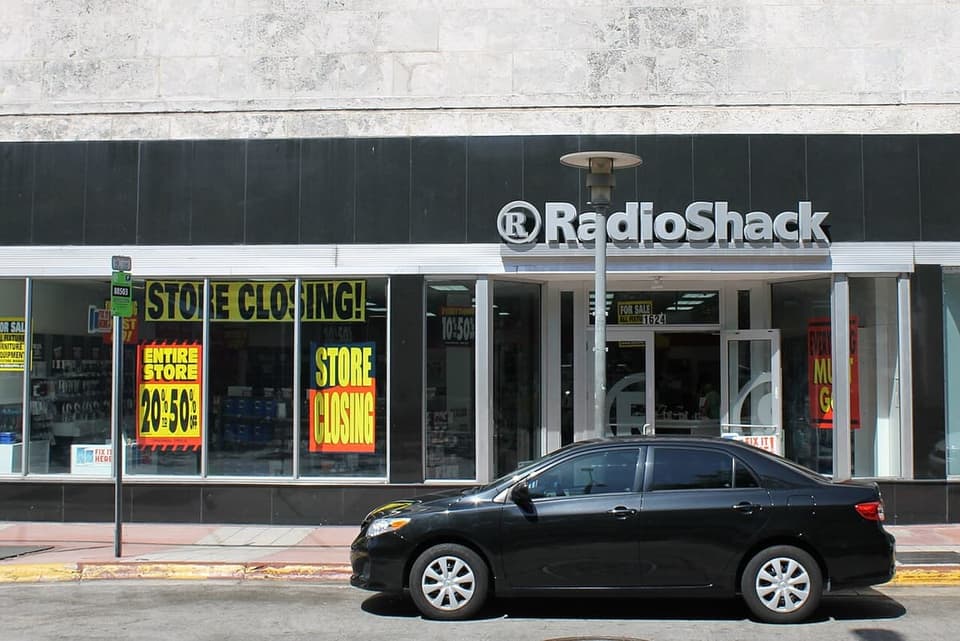
A RadioShack storefront with yellow store closing and discount posters in the windows
Apr 2015 “Store closing” signs on a RadioShack in South Beach, Miami Beach, dated April 14, 2015 in the file’s metadata, the month the store sale was completed.16Photo: Phillip Pessar, via Wikimedia Commons, CC BY 2.0. Resized.38
RadioShack archive image: First website, 1996
First website, 1996
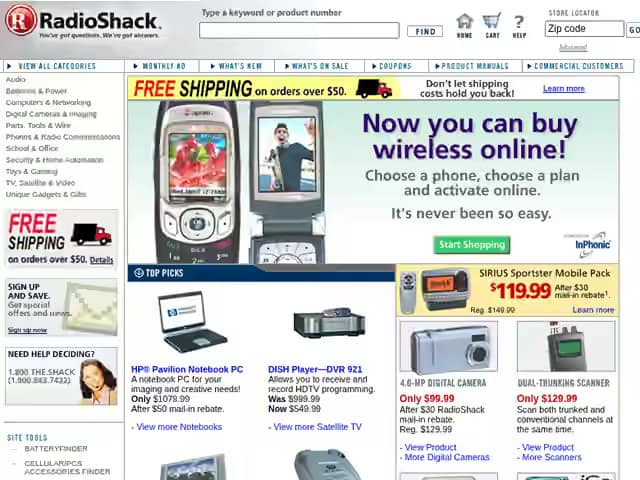
RadioShack archive image: The phone store, 2005
The phone store, 2005
RadioShack archive image: Last redesign, 2014
Last redesign, 2014

At its peak in 2001 it ran 5,289 company stores in the U.S. and about 2,100 more dealer outlets. By 2013 it had lost $400.2M in a year, and its stockholders’ equity had fallen by four-fifths in four years. Two bankruptcies later the brand belongs to a Central American retailer and lives on through dealer stores and a website. This post-mortem is built from 20 years of RadioShack’s 10-Ks, its bankruptcy filings, contemporary press and the archived website.

The company in four numbers

5,289
company-operated U.S. stores at the end of 2001, the peak6
$5.08B
net sales and operating revenues in 2005, the highest as RadioShack Corporation9
−$400.2M
net loss in 2013, after a $139.4M loss in 201213
1,743
stores sold to a Standard General affiliate in the April 2015 bankruptcy sale. The rest closed1621

Key findings

  1. The footprint outlived the business. Company stores peaked at 5,289 in 2001 and were still 4,297 at the end of 2013, while sales per store fell by about a fifth between 2005 and 2013 (derived).613
  2. Phones became half the company, on someone else’s terms. Wireless was 28.7% of sales in 2003 and the mobility platform 52.4% in 2013. In 2013 the 10-K blamed falling postpaid phone sales and rising handset costs for a “substantial decrease” in gross profit.913
  3. Margins went first. Gross margin was 50.3% in 2004. By our calculation from the 10-K it was 34.1% in 2013.813
  4. The cash ran out quickly at the end. Cash fell from $908.2M at the end of 2009 to $43.3M by November 1, 2014. Chapter 11 followed three months later.1415
  5. The name never died. It has since passed through a hedge-fund affiliate, a second bankruptcy, an e-commerce roll-up that used it for a crypto token, and a Salvadoran retailer that has been a franchisee since 1998.262830

Before the fall

A parts store that became a computer company, then a phone store

RadioShack wasn’t born in a bubble. It was a 1921 Boston radio-parts shop that a Fort Worth leather company turned into a national electronics chain. Its trouble began when the things people needed from it stopped being small parts.

The chain before the decline
1921founded in Boston by brothers Theodore and Milton Deutschmann, according to the brand’s later owner28
1963Tandy Corporation of Fort Worth bought the struggling chain and made it profitable within two years18
7,000+locations by 1988, counting company stores and dealers18
~43,600employees at the end of 20005

Sales and net income, 1995–2014

$ billions for sales, $ millions for net income. Hover for the year. The 1995–1998 bars are Tandy Corporation, which still included other chains.

Data table
Sales and net income, 1995–2014
PeriodNet income ($M, right)Net sales ($B, left)
1995n/a$5.839B
1996n/a$6.286B
1997n/a$5.372B
1998n/a$4.788B
1999$297.9M$4.126B
2000$368M$4.795B
2001$166.7M$4.776B
2002$263.4M$4.577B
2003$298.5M$4.649B
2004$337.2M$4.841B
2005$267M$5.082B
2006$73.4M$4.778B
2007$236.8M$4.252B
2008$192.4M$4.225B
2009$205M$4.066B
2010$206.1M$4.201B
2011$72.2M$4.032B
2012$-139.4M$3.831B
2013$-400.2M$3.434B
2014*$-396.8M$2.061B
10-K filings for each year14913. 2009–2013 use the figures as restated in the 2013 10-K. 2014 is the first 39 weeks only, from the Q3 10-Q14. Earlier years are as first reported.

The story

Ninety-four years, five chapters

The chain survived the end of radio kits, the end of CB radio and the end of its own computer business. It didn’t survive the smartphone and its own lease book.

Chapter 1 of 5

1921

a radio-parts store opens in Boston

Original drawing of a 1920s radio receiver with a horn loudspeaker, the kind of set the first store sold parts for. Not a specific product.

1921 – 1963 · Boston

Parts for people who built their own radios

The company’s later owner dates RadioShack to 1921, when Theodore and Milton Deutschmann opened a store in Boston selling radio equipment.28 By the early 1960s the Boston chain was in financial trouble.18

In 1963 Charles Tandy, whose Fort Worth company sold leather-craft supplies, bought it. The Handbook of Texas says he made it profitable within two years.18

Chapter 2 of 5

7,000+

company stores and dealers by 1988

Commercial · 1978Radio Shack introduces the TRS-80 A 30-second spot for Tandy’s own personal computer, sold through the stores. The 1978 date comes from the uploader; we could not confirm when it aired. Watch on YouTube

1963 – 1999 · The Tandy years

A store in every town

Under Tandy the chain spread through company stores and independent dealers in small towns, passing 7,000 locations by 1988.18 Tandy also sold its own computers through the stores, starting with the TRS-80 in 1977 (date from general knowledge, not our sources).18

In the 1990s Tandy tried bigger formats, including Computer City and Incredible Universe, then exited them. By the 1999 10-K it was a single chain, and in 2000 it renamed itself RadioShack Corporation.3418

Chapter 3 of 5

5,289

company-operated stores at the end of 2001, the most ever

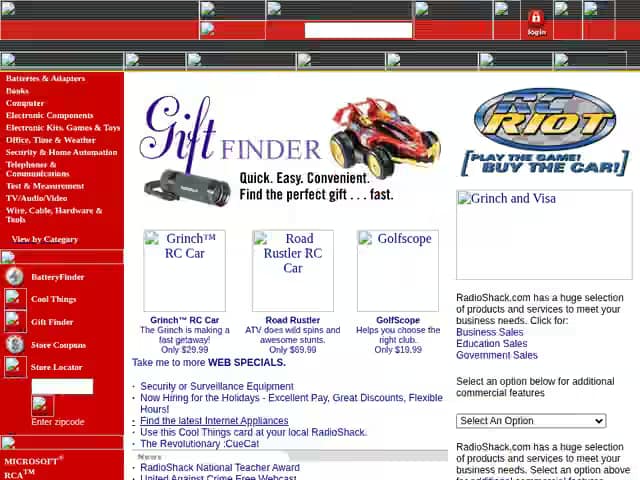
RadioShack home page in December 2000, a red catalog page with category lists and partner logos
The home page on December 3, 2000: parts in the left column, partner logos up front.33

2000 – 2005 · The peak

Phones, partners and record profits

Net income reached $368.0M in 2000.5 The website of the time sold “Batteries & Adapters,” “Electronic Components” and “Wire, Cable, Hardware & Tools,” and advertised partners: Microsoft, RCA, Compaq and Sprint.33 Company stores peaked at 5,289 at the end of 2001.6

Wireless grew from 28.7% of sales in 2003 to 34.3% in 2005, when sales reached $5.08B.9 Profit was already falling: net income was $267.0M in 2005, down from $337.2M.9

Chapter 4 of 5

−505

net change in company stores during 2006, the only large cut before bankruptcy (derived)

A small free-standing RadioShack store with the circle-R sign, seen from across a lawn
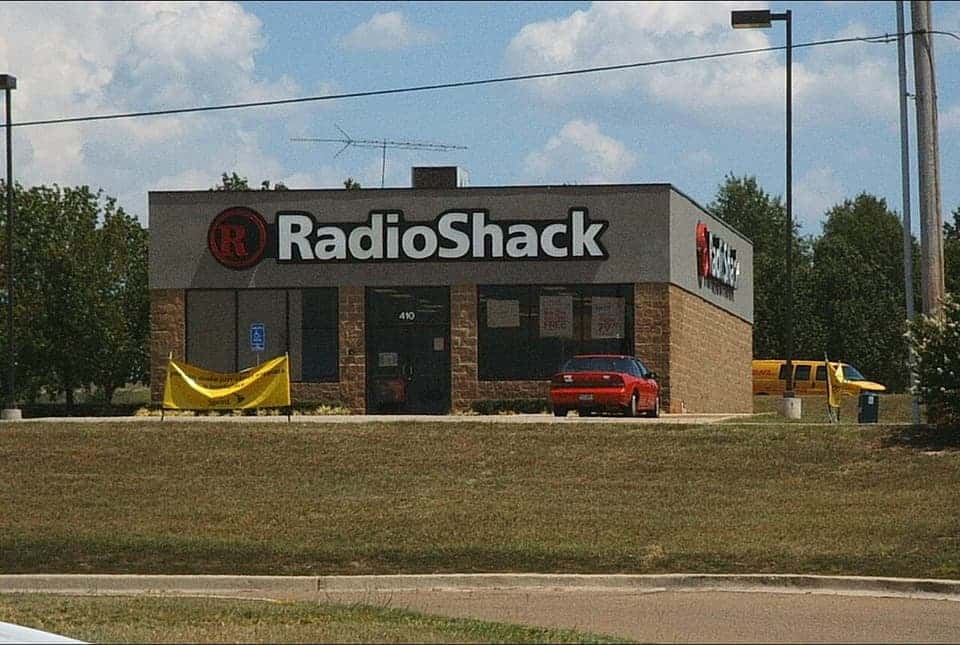
A free-standing RadioShack in Texarkana, dated August 2006 in the file’s metadata. Photo: freakofnurture, via Wikimedia Commons, public domain.38

2006 – 2011 · Turnaround attempts

A résumé, an email and a nickname

CEO David Edmondson resigned in February 2006 after questions about academic degrees he had claimed.17 Julian Day became CEO in July. Company stores fell from 4,972 to 4,467 that year, and in August about 400 headquarters employees were told by email that their jobs were gone.91022

Profits recovered to about $200M a year. In 2009 the company began calling itself “The Shack” in advertising, while the signs stayed the same.1123 James Gooch, the former CFO, became CEO in May 2011.19

Chapter 5 of 5

$43.3M

cash on November 1, 2014, down from $908.2M at the end of 2009

Commercial · 2014“The ’80s called,” the Super Bowl XLVIII spot Aired February 2, 2014: 1980s characters arrive to take an old-style RadioShack store back.24 This 72-second cut was uploaded by a viewer on the day of the game. Chapter 11 followed a year later.15 Watch on YouTube

2012 – 2015 · Collapse

Losing money on the phones

RadioShack lost $139.4M in 2012 and $400.2M in 2013.13 Joseph Magnacca, from Walgreens, became CEO in February 2013, and the company’s 2014 Super Bowl ad joked that “the ’80s called” and wanted their store back.1324

Sales in the first 39 weeks of 2014 fell to $2.06B from $2.49B.14 On February 5, 2015 the company filed for Chapter 11 in Delaware, with a plan to sell up to 2,400 stores to an affiliate of the hedge fund Standard General and close most of the rest.1520

Timeline

From Boston radio parts to a brand without stores

Filter by thread.

All 26 events as a list
  1. 1921Boston
    Corporate

    A radio-parts store opens

    Theodore and Milton Deutschmann open the first store, according to the brand’s 2020 owner.28

  2. 1963Fort Worth
    Corporate

    Tandy buys the chain

    Charles Tandy’s company acquires the struggling Boston chain and makes it profitable within two years.18

  3. 1977
    Stores

    The TRS-80

    Tandy sells its own personal computer through the stores (year from general knowledge).18

  4. 1988
    Stores

    More than 7,000 locations

    Company stores and dealers combined pass 7,000.18

  5. 1999Q4
    Money

    Stock peaks

    Shares trade as high as $79.50, split-adjusted.4

  6. 2000
    Corporate

    Tandy becomes RadioShack Corporation

    Net income reaches $368.0M, the most in our data.518

  7. 2001Dec 31
    Stores

    5,289 company stores

    The most the chain ever operated, plus 2,119 dealer outlets.6

  8. 2005
    Money

    Sales peak at $5.08B

    Net income has already fallen to $267.0M.9

  9. 2006Feb
    Corporate

    CEO resigns over résumé

    David Edmondson steps down after questions about degrees he claimed.17

  10. 2006Jul
    Corporate

    Julian Day becomes CEO

    He takes over as chairman and chief executive.10

  11. 2006Aug
    Corporate

    Layoffs by email

    About 400 headquarters employees are told by email that their jobs are gone.22

  12. 2006Dec 31
    Stores

    505 fewer stores

    Company stores fall from 4,972 to 4,467, the only large cut before bankruptcy.910

  13. 2009Aug
    Corporate

    “The Shack”

    The company starts calling itself The Shack in advertising.2336

  14. 2011May
    Corporate

    James Gooch becomes CEO

    The former CFO is promoted from president.19

  15. 2012
    Money

    First annual loss in our data

    A net loss of $139.4M. The share price falls below $3.13

  16. 2013Feb
    Corporate

    Joseph Magnacca becomes CEO

    He arrives from Walgreens.13

  17. 2013Mar
    Stores

    Out of Target

    All 1,522 Target Mobile centers are closed or handed off by March 31.13

  18. 2013
    Money

    A $400.2M loss

    Equity falls to $206.4M.13

  19. 2014Feb 2
    Corporate

    “The ’80s called”

    A Super Bowl ad mocks the company’s own old stores.24

  20. 2014Nov 1
    Money

    $43.3M in cash

    Down from $908.2M at the end of 2009.14

  21. 2015Feb 5
    Death & estate

    Chapter 11

    Filed in Delaware with a plan to sell up to 2,400 stores to a Standard General affiliate.152025

  22. 2015Apr
    Death & estate

    1,743 stores sold

    General Wireless buys them; many are co-branded with Sprint. The rest close.1621

  23. 2017Mar
    Death & estate

    Second bankruptcy

    General Wireless files for Chapter 11 and starts closing stores.26

  24. 2020Nov
    Death & estate

    Sold to an e-commerce roll-up

    Retail Ecommerce Ventures buys the brands.2829

  25. 2022
    Death & estate

    A crypto token

    radioshack.com becomes a waitlist for a cryptocurrency project.3233

  26. 2023May
    Death & estate

    Unicomer buys the brand

    The Salvadoran retailer acquires the IP in about 70 countries.3031

The map

Everywhere, and too many

At the end of 2013, a year before bankruptcy, RadioShack still operated 4,297 company stores in every state but Alaska, plus 901 dealer outlets that reached the smallest towns. Two years of losses had closed only 179 company stores since 2009.

RadioShack’s footprint, from one store to 5,289 and back

What this map shows: where the chain began, where it was run from, and how many company stores and dealer outlets each state had before the end. Step through the timeline: the states shade in when we have state-level store counts (2009 and 2013).

Where it beganHeadquartersClosed by the selected date
All 2 places as a list
  1. Boston, MA: where it began 1921
    The first store opened here in 1921.28
  2. Fort Worth, TX: headquarters from 1963
    Tandy bought the chain in 1963 and ran it from here. The last head office was at 300 RadioShack Circle.1813
Store counts by state are from the store tables in the 2013 and 2009 10-Ks1113. Puerto Rico (58 stores) and the U.S. Virgin Islands (4) are not drawn. Base map: U.S. Census Bureau via us-atlas34.

U.S. company stores and dealer outlets, 1995–2014

At year end. Dealer counts stop after 2004 in our extracted data. 2014 is November 1.

Data table
U.S. company stores and dealer outlets, 1995–2014
PeriodCompany-operated storesDealer and franchise outlets
19954,8312,005
19964,9421,927
19974,9721,934
19985,0391,991
19995,0872,099
20005,1092,090
20015,2892,119
20025,1612,052
20035,1211,921
20045,0461,788
20054,972n/a
20064,467n/a
20074,447n/a
20084,453n/a
20094,476n/a
20104,486n/a
20114,476n/a
20124,395n/a
20134,297n/a
2014*4,216n/a
10-K store tables14681013, Q3 2014 10-Q14, April 2015 8-K16. The 1996 figure includes 53 McDuff stores.

After April 2015 we have no reliable count of RadioShack-branded stores. General Wireless’s 2017 filing planned to close or hand over 552 stores in its first month, and later RadioShack locations in the U.S. are dealer or franchise stores.2627

A small free-standing RadioShack store seen from across a lawn
Aug 2006 A free-standing store in Texarkana with the circle-R sign, in the year the chain cut 505 stores.910Photo: freakofnurture, via Wikimedia Commons, public domain. Resized.38

Part 2 of 6

Business

The numbers · Unit economics · Marketing · Rivals

The money

A $79 stock that fell below $3

RadioShack’s shares more than tripled in 1999. They spent the next decade in the $15–$35 range, then fell below $3 in 2012, as investors priced in what the 10-Ks were starting to show.

RSH share price, quarterly high and low, 1996–2013

NYSE, $ per share, adjusted for the 1999 two-for-one split. Hover for the quarter.

Data table
RSH share price, quarterly high and low, 1996–2013
PeriodQuarterly low–high
Q1 1996$8.53 to $12.06
Q2 1996$11.19 to $14.78
Q3 1996$9.56 to $11.84
Q4 1996$9.28 to $11.81
Q1 1997$10.16 to $13.44
Q2 1997$12.19 to $14.44
Q3 1997$13.16 to $17.39
Q4 1997$16.66 to $23.00
Q1 1998$15.19 to $24.44
Q2 1998$20.53 to $27.31
Q3 1998$25.41 to $31.94
Q4 1998$18.50 to $26.63
Q1 1999$20.59 to $32.06
Q2 1999$30.09 to $51.00
Q3 1999$37.38 to $56.75
Q4 1999$41.38 to $79.50
Q1 2000$35.06 to $57.25
Q2 2000$38.25 to $59.50
Q3 2000$45.56 to $69.75
Q4 2000$39.34 to $72.94
Q1 2001$31.31 to $56.50
Q2 2001$25.27 to $38.50
Q3 2001$20.10 to $33.85
Q4 2001$23.11 to $31.60
Q1 2002$26.13 to $31.85
Q2 2002$27.50 to $36.21
Q3 2002$19.11 to $30.25
Q4 2002$16.99 to $24.72
Q1 2003$18.74 to $22.65
Q2 2003$21.45 to $27.00
Q3 2003$25.37 to $31.62
Q4 2003$27.90 to $32.48
Q1 2004$28.86 to $36.24
Q2 2004$28.28 to $33.73
Q3 2004$26.04 to $31.27
Q4 2004$28.09 to $34.06
Q1 2005$23.75 to $34.48
Q2 2005$23.11 to $26.43
Q3 2005$22.81 to $27.24
Q4 2005$20.55 to $25.00
Q1 2006$18.74 to $22.90
Q2 2006$14.00 to $18.83
Q3 2006$13.76 to $19.71
Q4 2006$16.49 to $20.40
Q1 2007$16.69 to $27.88
Q2 2007$26.66 to $35.00
Q3 2007$20.09 to $34.98
Q4 2007$16.72 to $23.42
Q1 2008$13.31 to $19.46
Q2 2008$11.93 to $17.62
Q3 2008$11.56 to $19.90
Q4 2008$8.06 to $17.28
Q1 2009$6.47 to $12.95
Q2 2009$8.38 to $15.20
Q3 2009$12.66 to $17.45
Q4 2009$14.82 to $20.57
Q1 2010$18.55 to $23.91
Q2 2010$17.70 to $24.00
Q3 2010$17.87 to $23.16
Q4 2010$17.93 to $23.38
Q1 2011$13.61 to $18.74
Q2 2011$12.28 to $16.70
Q3 2011$11.38 to $16.25
Q4 2011$9.15 to $13.94
Q1 2012$6.14 to $11.10
Q2 2012$3.78 to $6.38
Q3 2012$2.36 to $4.17
Q4 2012$1.90 to $2.71
Q1 2013$2.08 to $3.87
Q2 2013$2.94 to $4.28
Q3 2013$2.18 to $4.36
Q4 2013$2.57 to $3.88
Quarterly price ranges from the market-information section of each 10-K24691113. 1996–1997 values are halved by us for the split. We don’t have a sourced 2014 range.

Company stores, 1996–2014: one big cut before the end

Company-operated U.S. stores at year end. 2014 is the November 1 count.

02,0004,0006,00019961998200020022004200620082010201220141234502,0004,0006,0001996200020042008201412345
  1. 2001 · the peak 5,289 company stores at the end of 2001, plus 2,119 dealer outlets.6
  2. 2006 · the one big cut Stores fall from 4,972 to 4,467 during 2006, a net 505 (derived), in Julian Day’s first months as CEO.910
  3. 2009 · “The Shack” 4,476 stores at the end of 2009, the year of the nickname campaign. The count has barely moved in three years.1123
  4. 2013 · still 4,297 After net losses of $139.4M and $400.2M, the chain is only 179 stores smaller than in 2009 (derived).13
  5. 2014 · the last count 4,216 stores on November 1, 2014, with $43.3M in cash. Chapter 11 follows on February 5, 2015.1415
Data table
Company stores, 1996–2014: one big cut before the end
YearCompany-operated stores
19964,942
19974,972
19985,039
19995,087
20005,109
20015,289
20025,161
20035,121
20045,046
20054,972
20064,467
20074,447
20084,453
20094,476
20104,486
20114,476
20124,395
20134,297
20144,216
10-K store tables4681013 and the Q3 2014 10-Q14, the same series as the chart in the map section, which also shows 1995. The 1996 figure includes 53 McDuff stores.

Cash, long-term debt and equity, 2009–2014

$ millions at year end. 2014 is November 1 cash only.

Data table
Cash, long-term debt and equity, 2009–2014
PeriodCashLong-term debtStockholders’ equity
2009$908.2M$627.8M$1048.3M
2010$569.4M$331.8M$842.5M
2011$591.7M$670.6M$753.3M
2012$535.7M$499M$598.7M
2013$179.8M$613M$206.4M
Nov 2014$43.3Mn/an/a
XBRL financial data from the 10-K and 10-Q filings121314, as reported in the most recent filing for each date.

Gross profit against operating costs, by quarter

$ millions, 2012–2013. When the gap closes, the stores stop paying for themselves.

Data table
Gross profit against operating costs, by quarter
PeriodGross profitSG&A
Q1 12$370.1M$345.3M
Q2 12$340.2M$337M
Q3 12$340.8M$354M
Q4 12$419.3M$383.5M
Q1 13$337.3M$337.9M
Q2 13$313.8M$336.9M
Q3 13$242.7M$343.3M
Q4 13$278.4M$389.3M
Quarterly XBRL data filed with the 2013 10-K and 2014 10-Qs1314. Operating costs are selling, general and administrative expense, before depreciation and impairments.

Five years of cash, counted in what was left

$908.2Mcash at the end of 200912
=
21 ×the cash left on November 1, 201414 ($43.3M)

Derived $908.2M ÷ $43.3M ≈ 21. Both figures are cash and cash equivalents as reported in the filings.1214

Data table
Five years of cash, counted in what was left
Value
cash at the end of 2009$908.2M
the cash left on November 1, 2014$43.3M
Ratio21 (derived)
2010 10-K12 and Q3 2014 10-Q14.
The bankruptcy balance sheet
$1.2Bassets listed in the February 2015 Chapter 11 filing25
$1.38Bdebts listed in the same filing25
$31.9Mpaid by Office Depot de México for the Mexican subsidiaries in 201516
15,969holders of record on Feb 21, 2014, down from 31,087 on Mar 21, 2001513
$12Mpaid by Sprint under a settlement in the second, General Wireless bankruptcy27

The February 2015 filing: more owed than owned

Assets and debts as listed in the Chapter 11 petition, $ billions.

Debts listed
$1.38B
As reported from the filing.25
Assets listed
$1.2B
As reported from the filing.25
Shortfall (derived)
$0.18B
$1.38B − $1.2B, from rounded figures.
Data table
The February 2015 filing: more owed than owned
Item$ billionsNote
Debts listed$1.38BAs reported from the filing.
Assets listed$1.2BAs reported from the filing.
Shortfall (derived)$0.18B$1.38B − $1.2B, from rounded figures.
Reuters report on the Chapter 11 filing25. The shortfall is our subtraction of two rounded figures.

What happened to the stores in 2015

Company-operated stores at the last count before bankruptcy, and how many survived the sale.

4,216 company-operated U.S. stores on November 1, 2014, the last count in our sources
1,743 41%Sold to General Wireless2,473 59%Not in the sale (derived remainder)1,743 41%Sold to General Wireless2,473 59%Not in the sale (derived remainder)
  • Sold to General Wireless. Bought by the Standard General affiliate in the sale completed in April 2015; many were co-branded with Sprint.1621
  • Not in the sale (derived remainder). 4,216 − 1,743. Closed and liquidated in the bankruptcy, or closed between November 2014 and the sale. We do not have a store count for the filing date itself.
Data table
What happened to the stores in 2015
Where it wentAmountShareNote
Sold to General Wireless1,74341%Bought by the Standard General affiliate in the sale completed in April 2015; many were co-branded with Sprint.
Not in the sale (derived remainder)2,47359%4,216 − 1,743. Closed and liquidated in the bankruptcy, or closed between November 2014 and the sale. We do not have a store count for the filing date itself.
Q3 2014 10-Q14, April 2015 8-K16 and the buyer’s announcement21. The remainder is derived.

Store economics

Same stores, less in each one

RadioShack’s model was thousands of small, cheap stores close to customers. It works while each store sells enough high-margin goods. After 2005 sales per store slid, and the growth that remained came from phones, the lowest-margin thing it sold.

Sales per company store, 1999–2013 (derived)

Total net sales and operating revenues divided by company-operated U.S. stores at year end, $ millions. Overstates true store sales, because it includes dealer, online, kiosk and international revenue.

Data table
Sales per company store, 1999–2013 (derived)
PeriodSales per company store (derived)
1999$0.81M
2000$0.94M
2001$0.90M
2002$0.89M
2003$0.91M
2004$0.96M
2005$1.02M
2006$1.07M
2007$0.96M
2008$0.95M
2009$0.91M
2010$0.94M
2011$0.90M
2012$0.87M
2013$0.80M
Our calculation from the 10-K sales and store counts46913. 2009–2013 use sales as restated in the 2013 10-K.

Wireless share of sales, and gross margin

Percent. Wireless and “mobility” are the company’s own categories, which it redefined over time, so the lines have gaps.

Data table
Wireless share of sales, and gross margin
PeriodWireless share of salesMobility share (new definition)Gross margin
2002n/an/a48.9%
200328.7%n/a49.8%
200433.8%n/a50.3%
200534.3%n/a46.7%
2006n/an/an/a
200733.3%n/an/a
200832.8%n/an/a
200938.2%n/an/a
2010n/an/an/a
2011n/a50%42.7%
2012n/a52.4%38.4%
2013n/a52.4%34.1%
Wireless share: 2005 and 2009 10-Ks911; mobility share: 2013 10-K13. Gross margin 2002–2005 as reported89; 2011–2013 derived from gross profit and sales in the 2013 10-K.

The postpaid phone squeeze, 2012 and 2013

Change from the prior year at U.S. company stores, percent.

Data table
The postpaid phone squeeze, 2012 and 2013
Period20122013
Postpaid phones sold-20%-23%
Average cost per phone36%14.3%
Average revenue per phone19%7%
2013 10-K, “Update on Postpaid Wireless Business”13. The company sold fewer phones, paid more for each one, and repaid commissions when customers stopped paying for service.
The margin problem in four lines
50.3%gross margin in 2004, as reported8
34.1%gross margin in 2013, derived from $1,172.2M gross profit on $3,434.3M sales13
−23%postpaid phones sold at U.S. company stores in 2013, after −20% in 201213
1,522Target Mobile centers it ran inside Target stores at the end of 2012. It quit all of them by March 31, 201313

RadioShack didn’t report profit by store, so we can’t say how many stores lost money. The 2013 10-K doesn’t give a gross margin rate directly, which is why we derive it.

Marketing

Three ways of saying “we’re not your dad’s RadioShack”

For most of its life the pitch was service: “You’ve got questions. We’ve got answers.” Later campaigns tried to escape the image of a dusty parts store, and spent less money each time.

CampaignYearsWhat it saidWhat happened
“You’ve got questions. We’ve got answers.”Tandy era onwardThe store clerk as expert. The trademark was still among the assets sold in 202028Became the brand’s best-remembered line
Partners: Microsoft, Compaq, RCA, Sprintc. 1999–2001Store-within-a-store alliances shown on the home page33Wireless kept growing, computers did not (no sales split in our sources)
“The Shack”Aug 2009An advertising nickname to modernize the image. Signs and the legal name stayed RadioShack2336Advertising spend fell to $193.0M that year11
“The ’80s called. They want their store back.”Feb 2014Super Bowl XLVIII ad in which 1980s celebrities empty an old-style store24Chapter 11 followed a year later15
Commercial · 1995“You’ve got questions. We’ve got answers.”: cellular phones The service slogan, attached to the product line that would be about half of sales by 2013.13 According to the uploader it was recorded on September 22, 1995 from WJBK in Detroit. The trademark was still among the assets sold in 2020.28 Watch on YouTube

Advertising expense, 1999–2013

$ millions (bars) and as a share of net sales (line, derived). As first reported in each 10-K.

Data table
Advertising expense, 1999–2013
PeriodShare of net sales (derived)Advertising expense ($M)
19994.84%$199.9M
20004.74%$227.1M
20015.32%$253.9M
20025.27%$241M
20035.47%$254.4M
20045.61%$271.5M
20055.18%$263.1M
20064.53%$216.3M
20074.91%$208.8M
20085.08%$214.5M
20094.75%$193M
20104.91%$206.1M
20115.18%$208.9M
20124.77%$182.9M
20135.13%$176.2M
Advertising expense from the 10-K notes for each year456891113. 2001 and 2003 are computed from the year-on-year changes the filings state.
THE SHACK 2009 rebrand
Original drawing of the 2009 campaign mark. Not an official asset.

“The Shack,” 2009

In August 2009 the company began calling itself “The Shack” in advertising while the store signs stayed the same.2336 Ad spending that year fell to $193.0M, the lowest since 1999 at the time (derived from the 10-K series above).

The rivals

Squeezed from both sides

Big-box stores beat RadioShack on selection and price, the carriers opened their own stores, and the internet took the parts business. Its own partners were also its competitors.

CompanyModelEdge over RadioShackFate
RadioShackAbout 4,300–5,300 small company stores plus dealers613Proximity, parts, batteries, serviceChapter 11 in 2015 and a second, as General Wireless, in 20171526
Best BuyBig-box consumer electronicsSelection and price on TVs, computers and appliancesStill operating (general knowledge, not from our sources)
Circuit CityBig-box consumer electronicsSame as Best BuyLiquidated in 2009 (general knowledge, not from our sources)
Wireless carriers’ own storesBranded stores selling phones and plansControl of plans, subsidies and commissionsSprint ended up inside RadioShack’s own surviving stores in 20152021
Amazon and online parts sellersOnline catalog, home deliveryRange, price and no trip to the mallThe online shift is general context; our sources don’t quantify it

Four kinds of rival, and what became of each

RadioShack’s store count is the only series here; our sources do not give comparable figures for the others, so they are shown by outcome only.

RadioShack

Ghost
1995Nov 2014
5,289 company stores at the 2001 peak and 4,216 in November 2014.614 Two bankruptcies; the name survives under new owners.152631

Best Buy

Survived
Big-box selection and price on TVs, computers and appliances. Still operating (general knowledge, not from our sources).

Circuit City

Liquidated
The other big-box chain. Liquidated in 2009 (general knowledge, not from our sources), six years before RadioShack filed.

Carriers’ own stores

Survived
The carriers controlled plans, subsidies and commissions. In 2015 Sprint moved inside the stores General Wireless bought.2021

Amazon and online parts sellers

Survived
Range, price and no trip to the mall. The shift online is general context; our sources do not quantify it.
Data table
Four kinds of rival, and what became of each
CompanyOutcomeCompany storesNotesSeries
RadioShackGhost5,289company stores at the 2001 peak and 4,216 in November 2014. Two bankruptcies; the name survives under new owners.4831, 4942, 4972, 5039, 5087, 5109, 5289, 5161, 5121, 5046, 4972, 4467, 4447, 4453, 4476, 4486, 4476, 4395, 4297, 4216
Best BuySurvivedBig-box selection and price on TVs, computers and appliances. Still operating (general knowledge, not from our sources).
Circuit CityLiquidatedThe other big-box chain. Liquidated in 2009 (general knowledge, not from our sources), six years before RadioShack filed.
Carriers’ own storesSurvivedThe carriers controlled plans, subsidies and commissions. In 2015 Sprint moved inside the stores General Wireless bought.
Amazon and online parts sellersSurvivedRange, price and no trip to the mall. The shift online is general context; our sources do not quantify it.
RadioShack store counts from the 10-K store tables and the Q3 2014 10-Q61314. Outcomes for Best Buy, Circuit City and Amazon are general knowledge and are flagged as such.

RadioShack’s 10-Ks name competitors in general terms. The fates of Best Buy and Circuit City are well known but aren’t covered by the sources on this page, so we flag them.

Part 3 of 6

Brand

Commercials & footage · Old website · Brand gallery

Commercials & footage

From the TRS-80 to “the ’80s called”

Two commercials from the Tandy years, a 1991 television episode about the company’s computers, the Super Bowl spot that made fun of its own stores, the news from the day of the bankruptcy, and a later look back.

Commercial · 2014“The ’80s called,” the Super Bowl XLVIII spot Aired February 2, 2014: 1980s characters arrive to take an old-style RadioShack store back.24 This 72-second cut was uploaded by a viewer on the day of the game. Chapter 11 followed a year later.15 Watch on YouTube
Commercial · 1978Radio Shack introduces the TRS-80 A 30-second spot for Tandy’s own personal computer, sold through the stores. The 1978 date comes from the uploader; we could not confirm when it aired. Watch on YouTube
Commercial · 1995“You’ve got questions. We’ve got answers.”: cellular phones The service slogan, attached to the product line that would be about half of sales by 2013.13 According to the uploader it was recorded on September 22, 1995 from WJBK in Detroit. The trademark was still among the assets sold in 2020.28 Watch on YouTube
Documentary · 1991Computer Chronicles: “Tandy / Radio Shack Computers” A full episode of the television series, first broadcast in 1991, on the role Radio Shack played in early personal computing. A Tandy vice president is a guest and the original TRS-80 is shown.37 Watch on the Internet Archive
News segment · 2015CNBC: “RadioShack Files for Chapter 11 Bankruptcy” A one-minute report posted by CNBC on February 6, 2015, the day after the filing in Delaware.15 Watch on YouTube
News segment · 2015The Dallas Morning News: “RadioShack declares bankruptcy” The home-town paper’s business columnist and a business writer discuss the filing, posted on February 5, 2015. RadioShack was run from Fort Worth.18 Watch on YouTube
Retrospective · 2017Company Man: “The Decline of RadioShack...What Happened?” A fourteen-minute independent retrospective published in August 2017, after the second bankruptcy. Its figures are the uploader’s; ours are in the sections above. Watch on YouTube

Videos are embedded from the services that host them and load only when you press play. YouTube embeds use youtube-nocookie.com. Each video belongs to its uploader or rights holder and is shown here for commentary; we do not host any of the files. Video titles and upload dates are as shown by the host. Where a commercial’s year comes only from the uploader, the caption says so.

The old website

Thirty years of radioshack.com

These are screenshots of the Internet Archive’s captures of radioshack.com, stored as images; click one to open the original capture. The front page tracks the company’s identity: parts, then partners, then phones, then a liquidation, a crypto token and a web shop.33

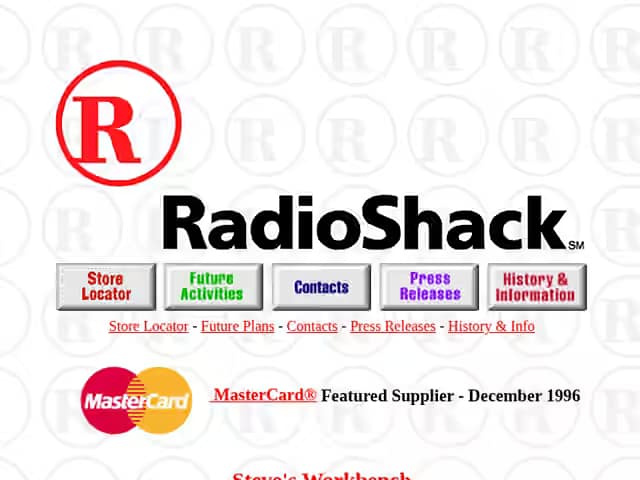
Screenshot of http://www.radioshack.com/ as archived Dec 29, 1996 · 4:41 AM ET

Captured Dec 29, 1996 · 4:41 AM ET

The first storefront

A corporate brochure more than a shop: a big round logo over a tiled background, buttons for Store Locator, Future Activities, Contacts, Press Releases and History & Info, and links to “Steve’s Workbench,” a hobbyist help page, and the company’s “United Against Crime” program.

Open this capture on the Wayback Machine

Screenshots of Internet Archive captures, saved as images; click one to open the original capture. Later captures show the afterlife: a clearance store in Jul 2017, a crypto waitlist in Jan 2022 and a conventional shop under Unicomer in Apr 2025.

Part 4 of 6

People

People · Press

The people

Founders, owners and five chief executives

Titles and dates are from the 10-Ks and 8-Ks unless noted. We include only what a source supports.

People (8)
Name and roleWhat they didAfterwards
Theodore and Milton DeutschmannFounders, 1921

Opened the first store in Boston, according to the 2020 release from the brand’s owner.28

Charles TandyBought the chain, 1963

Head of Tandy Corporation of Fort Worth, which turned the struggling Boston chain profitable within two years.18

David EdmondsonCEO until Feb 2006

Resigned in February 2006 after it emerged that he had claimed degrees he didn’t hold.17

Julian DayChairman and CEO from Jul 2006

Took over after Edmondson. Company stores fell by 505 in 2006, and about 400 headquarters staff were laid off by email that August.1022

James GoochCEO, May 2011 – 2012

Joined as an executive in 2006, served as CFO and became president in January 2011 and CEO in May 2011.19

Joseph MagnaccaCEO, Feb 2013 – 2015

Came from Walgreens. Led the final turnaround attempt, including the 2014 Super Bowl ad, and the company into Chapter 11.132415

Standard GeneralBuyer of 1,743 stores, 2015

Its affiliate General Wireless bought the stores and co-branded many with Sprint, then filed its own Chapter 11 in March 2017.2126

Retail Ecommerce VenturesOwner of the brand, 2020–2023

Founded by Alex Mehr and Tai Lopez, REV bought the RadioShack brands in November 2020 to run them online-first.2829

Then: sold the IP in about 70 countries to Unicomer in 2023.3031

Press

Headlines along the way

These are headlines as published, not quotations from people.

Press (7)
RadioShack Layoff Notices Are Sent by E-Mail
The New York Times, Aug 31, 200622
RadioShack under new ownership again
Retail Dive, Aug 202330
  1. USA Today, Aug 5, 200923

    RadioShack would like you to call it ‘The Shack’
  2. RadioShack Super Bowl ad, Feb 2, 201424

    The ’80s called. They want their store back.
  3. Reuters, Feb 201525

    RadioShack files for bankruptcy; Sprint to take over some stores
  4. AP, Mar 201726

    RadioShack files for second bankruptcy in 2 years
  5. AP, Nov 202029

    Left for dead, twice, RadioShack gets another shot online
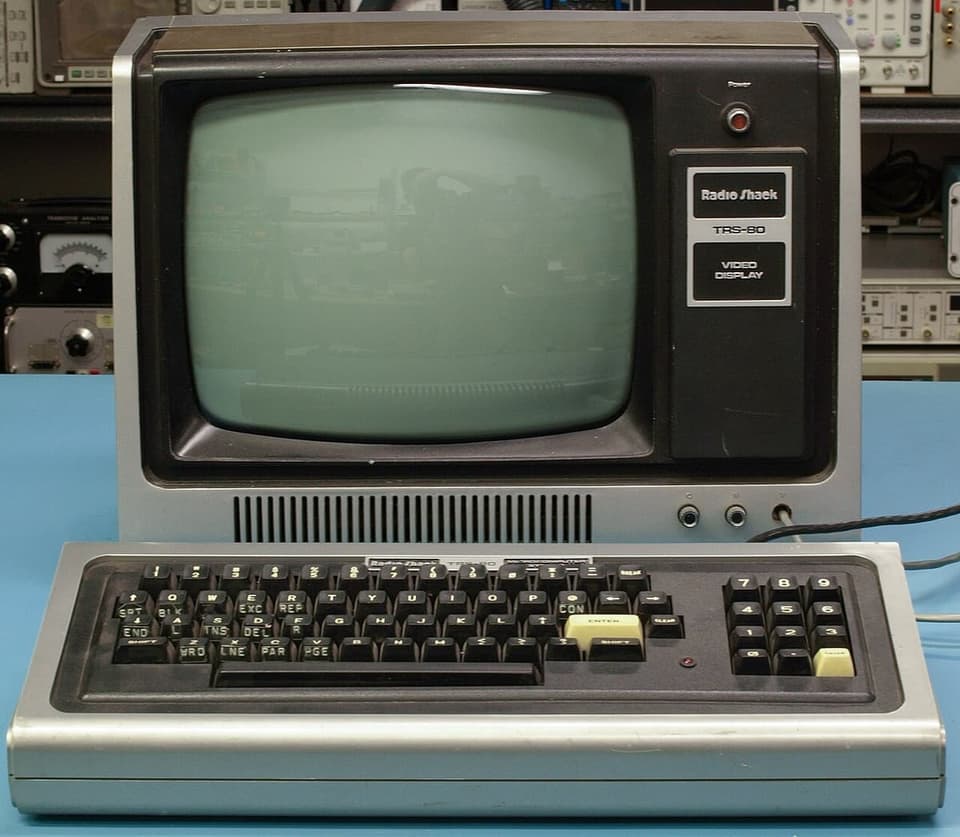
A TRS-80 Model I keyboard unit in front of its Radio Shack video display
1977 model A TRS-80 Model I with its video display, badged Radio Shack. Photographed in 2014; the launch year is general knowledge.Photo: Dave Jones, via Wikimedia Commons, CC BY-SA 4.0. Resized.38

Part 5 of 6

Verdict

Cause of death · What if · Afterlife

Cause of death

Contributing factors, weighted

The weights are our editorial judgment, not a calculation. Click a factor for the evidence.

Cause of death, by editorial weight

One square is one percentage point. The weights are our judgment, not a measurement.

  1. 30%Dependence on phones sold on carriers’ terms
  2. 25%A footprint that never shrank to fit
  3. 20%The reason to visit moved elsewhere
  4. 15%Five chief executives in eight years
  5. 10%No cushion when it mattered
Data table
Cause of death, by editorial weight
CauseWeight
Dependence on phones sold on carriers’ terms30%
A footprint that never shrank to fit25%
The reason to visit moved elsewhere20%
Five chief executives in eight years15%
No cushion when it mattered10%

Wireless went from 28.7% of sales in 2003 to a 52.4% mobility share in 2013. In 2012 and 2013 the company sold fewer postpaid phones, paid more for each, and repaid commissions when customers dropped service. The 10-K calls the result a “substantial decrease in consolidated gross profit.”913

Company stores peaked at 5,289 in 2001 and were still 4,297 at the end of 2013. Apart from 2006, store counts barely moved while sales per store fell by about a fifth between 2005 and 2013 (derived).61013

The chain was built on batteries, parts and advice. The archived home pages show the parts business shrinking to a sidebar as phones took over. Online competition is general context; our sources don’t quantify it.33

Edmondson resigned over his résumé in 2006; Day, Gooch and Magnacca followed, each with a new strategy, including “The Shack” in 2009 and the ’80s ad in 2014.17101913

Equity fell from $1,048.3M in 2009 to $206.4M in 2013, and cash from $908.2M to $43.3M by November 2014. There was no room left to close stores in an orderly way.1314

Editorial judgment: How we weight: each factor is scored by how directly the filings tie it to falling gross profit and to the cash drain of 2012–2014. Reasonable analysts could weight these differently.

What if

Three forks in the road

Counterfactuals are speculation by definition. Each one starts from a documented decision.

What happened

After cutting 505 company stores in 2006, RadioShack held its footprint near 4,450 for six years. It still had 4,297 at the end of 2013, while sales per store kept falling.1013

What if speculative

Closing another thousand of the weakest stores in 2007–2009, when the company earned about $200M a year and held $500M–$900M in cash, would have cut rent and payroll while there was money to pay lease exit costs. A smaller chain might have reached 2014 without needing a lender’s rescue.

What happened

Wireless rose from 28.7% of sales in 2003 to a 52.4% “mobility” share in 2013, and the 2013 10-K blamed postpaid phones for the drop in gross profit.913

What if speculative

Leaning into parts, repair and the hobbyist market it was founded on would have meant a much smaller company. But it would have sold goods that carriers and big-box stores didn’t, at margins near the 50% it earned in 2004.

What happened

The share price fell below $3 in 2012 and stayed there. By the end of 2013 equity was $206.4M, down from $1,048.3M in 2009.13

What if speculative

A sale or merger in 2009–2010, while the shares traded near $20 and the balance sheet was solid, could have returned far more to shareholders than the bankruptcy did. Whether any buyer wanted 4,500 small leases is another question.

Afterlife

Why this one is a ghost

The company is gone. The name has had four owners since 2015 and still sells electronics.

RadioShack

  1. The stores

    Apr 2015

    General Wireless, a Standard General affiliate, bought 1,743 stores, many co-branded with Sprint. The rest were liquidated.1621

  2. Mexico

    2015

    The Mexican subsidiaries went to Office Depot de México for $31.9M.16

  3. Second bankruptcy

    Mar 2017

    General Wireless filed for Chapter 11 and began closing hundreds of stores. Sprint later paid $12M in a settlement.2627

  4. The brand, online

    Nov 2020

    Retail Ecommerce Ventures bought the brands, websites and the “You’ve got questions” trademark.2829

  5. The crypto detour

    2022

    REV turned radioshack.com into a waitlist for a cryptocurrency project, warning visitors about impostor accounts.3233

  6. The new owner

    May 2023 – today

    Unicomer Group of El Salvador, a RadioShack franchisee in Latin America and the Caribbean, bought the IP in about 70 countries. RadioShack-branded stores today are dealer or franchise locations, and the brand sells online.303133

Who has owned the name

Three corporate eras before the bankruptcy, and three owners in the eight years after it.

  1. 1921

    The Deutschmann brothers

    Theodore and Milton Deutschmann open a radio-parts store in Boston, according to the brand’s 2020 owner.28

  2. 1963

    Tandy Corporation

    Charles Tandy’s Fort Worth company buys the struggling chain and makes it profitable within two years.18
  3. 2000

    RadioShack Corporation

    Tandy, by then a single chain, takes the name of its stores.518

  4. Feb 2015

    Chapter 11

    RadioShack Corporation files in Delaware.15

  5. Apr 2015

    General Wireless (Standard General)

    The hedge fund’s affiliate buys 1,743 stores, many co-branded with Sprint. The rest are liquidated.1621

  6. Mar 2017

    Second Chapter 11

    General Wireless files and begins closing hundreds of stores.2627

  7. Nov 2020

    Retail Ecommerce Ventures

    Buys the brands, the websites and the “You’ve got questions” trademark, and in 2022 uses the name for a cryptocurrency project.282932

  8. May 2023

    Unicomer Group

    The Salvadoran retailer, a RadioShack franchisee, buys the IP in about 70 countries.3031

Data table
Who has owned the name
WhenOwnerWhat happenedPrice
1921The Deutschmann brothersTheodore and Milton Deutschmann open a radio-parts store in Boston, according to the brand’s 2020 owner.
1963Tandy CorporationCharles Tandy’s Fort Worth company buys the struggling chain and makes it profitable within two years.
2000RadioShack CorporationTandy, by then a single chain, takes the name of its stores.
Feb 2015Chapter 11RadioShack Corporation files in Delaware.
Apr 2015General Wireless (Standard General)The hedge fund’s affiliate buys 1,743 stores, many co-branded with Sprint. The rest are liquidated.
Mar 2017Second Chapter 11General Wireless files and begins closing hundreds of stores.
Nov 2020Retail Ecommerce VenturesBuys the brands, the websites and the “You’ve got questions” trademark, and in 2022 uses the name for a cryptocurrency project.
May 2023Unicomer GroupThe Salvadoran retailer, a RadioShack franchisee, buys the IP in about 70 countries.
Sources as cited on each step. Purchase prices are not in our sources, so none are shown.

Sources

Where every number comes from

SEC filings are cited by accession number and were retrieved from EDGAR in October 2026. Press items are cited as published. Links open in a new tab.

  1. Tandy Corporation, Annual report for 1995 (Form 10-K). EDGAR 0000096289-96-000004. sec.gov
  2. Tandy Corporation, Annual report for 1996 (Form 10-K). EDGAR 0000096289-97-000006. sec.gov
  3. Tandy Corporation, Annual report for 1998 (Form 10-K). EDGAR 0000096289-99-000008. sec.gov
  4. Tandy Corporation, Annual report for 1999 (Form 10-K). EDGAR 0000096289-00-000005. sec.gov
  5. RadioShack Corporation, Annual report for 2000 (Form 10-K). EDGAR 0000096289-01-000006. sec.gov
  6. RadioShack, Annual report for 2001 (Form 10-K). EDGAR 0000096289-02-000002. sec.gov
  7. RadioShack, Annual report for 2003 (Form 10-K). EDGAR 0000096289-04-000069. sec.gov
  8. RadioShack, Annual report for 2004 (Form 10-K). EDGAR 0000096289-05-000016. sec.gov
  9. RadioShack, Annual report for 2005 (Form 10-K). EDGAR 0000096289-06-000013. sec.gov
  10. RadioShack, Annual report for 2006 (Form 10-K). EDGAR 0000096289-07-000007. sec.gov
  11. RadioShack, Annual report for 2009 (Form 10-K). EDGAR 0000096289-10-000004. sec.gov
  12. RadioShack, Annual report for 2010 (Form 10-K). EDGAR 0000096289-11-000010. sec.gov
  13. RadioShack, Annual report for 2013 (Form 10-K). EDGAR 0000096289-14-000005. sec.gov
  14. RadioShack, Quarterly report for the period ended Nov 1, 2014 (Form 10-Q). EDGAR 0000096289-14-000045. sec.gov
  15. RadioShack, Current report on the Chapter 11 filing (Form 8-K), Feb 6, 2015. EDGAR 0000096289-15-000007. Case No. 15-10197 (Bankr. D. Del.). sec.gov
  16. RadioShack, Current report on the completed store sale (Form 8-K), Apr 2, 2015. EDGAR 0001193125-15-117783. sec.gov
  17. RadioShack, Current report on the CEO’s resignation (Form 8-K), Feb 2006. EDGAR 0000950134-06-003357. sec.gov
  18. Texas State Historical Association, “RadioShack Corporation,” Handbook of Texas Online. tshaonline.org
  19. RadioShack, Annual report for 2011 (Form 10-K). EDGAR 0000096289-12-000009. sec.gov
  20. PR Newswire, “RadioShack Reaches Asset Purchase Agreement with Affiliate of Standard General To Acquire up to 2,400 Stores,” Feb 2015. prnewswire.com
  21. PR Newswire, “Standard General Affiliate Acquires 1,743 RadioShack Stores,” Apr 2015. prnewswire.com
  22. The New York Times, “RadioShack Layoff Notices Are Sent by E-Mail,” Aug 31, 2006. nytimes.com
  23. USA Today, “RadioShack would like you to call it ‘The Shack’,” Aug 5, 2009. usatoday30.usatoday.com
  24. Ad Age, “The Phone Call” (RadioShack Super Bowl XLVIII spot), Feb 2014; Wikipedia, “The ’80s Called” (secondary). adage.com
  25. Reuters, “RadioShack files for bankruptcy; Sprint to take over some stores,” Feb 2015. reuters.com
  26. AP, “RadioShack files for second bankruptcy in 2 years,” Mar 2017. apnews.com
  27. U.S. Bankruptcy Court, D. Del., In re General Wireless Operations Inc., No. 17-10506, docket and opinion and order on the Sprint settlement. courtlistener.com
  28. Business Wire, “Retail Ecommerce Ventures (REV) Acquires RadioShack Brands,” Nov 19, 2020. businesswire.com
  29. AP, “Left for dead, twice, RadioShack gets another shot online,” Nov 2020. apnews.com
  30. Retail Dive, “RadioShack under new ownership again,” Aug 2023. retaildive.com
  31. Unicomer Group, “Unicomer Group Acquires the Global RadioShack Brand,” 2023. grupounicomer.com
  32. The Wall Street Journal, “RadioShack’s NSFW Period Appears Over, as New Owner Plots a Brand Expansion,” 2023. wsj.com
  33. Internet Archive Wayback Machine, captures of radioshack.com, 1996–2025, located via the CDX API in October 2026. web.archive.org
  34. U.S. Census Bureau cartographic boundaries via us-atlas v3 (states-10m). github.com
  35. RadioShack, Annual report for 2007 (Form 10-K). EDGAR 0000096289-08-000008. sec.gov
  36. RadioShack press release, “RadioShack Invites Consumers to Rediscover ‘THE SHACK’,” Aug 4, 2009, via Franchising.com. franchising.com
  37. Computer Chronicles, “Tandy / Radio Shack Computers,” first broadcast 1991 (Stewart Cheifet Productions), via the Internet Archive. archive.org
  38. Wikimedia Commons photographs, with licenses as recorded on each file page in October 2026: RadioShack exterior (freakofnurture, public domain); Another Radio Shack Closing South Beach (Phillip Pessar, CC BY 2.0); Radio Shack Tandy TRS-80 Model I System (Dave Jones, CC BY-SA 4.0).
Data notes (9)

Data notes

Note: Sales per store, the 2011–2013 gross margins and advertising as a share of sales are our calculations from reported totals.

Note: 1995–1998 sales and earnings are Tandy Corporation’s, which still included other chains, so they aren’t comparable with later years.

Note: The 2013 10-K restated 2009–2012 sales. We use the restated figures for those years and first-reported figures before 2009.

Note: We don’t have a sourced share price for 2014, or a reliable count of RadioShack-branded stores after April 2015.

Note: Facts about rivals marked “general knowledge” and the TRS-80’s launch year are not from the sources listed here.

Note: Weights in the cause-of-death section and all what-if text are editorial judgment.

Derived: In the infographics: the 2,473 stores “not in the sale” are 4,216 (November 1, 2014) − 1,743 sold; the $0.18B shortfall is $1.38B of debts − $1.2B of assets, both rounded as reported; the cash ratio of 21 is $908.2M ÷ $43.3M; the 505 and 179 net store changes are differences between year-end counts.

Note: We do not have a store count for the February 5, 2015 filing date, so the 2015 store flow starts from the November 1, 2014 count. Purchase prices for the 2015, 2020 and 2023 sales of the name are not in our sources.

Note: Video dates: the TRS-80 commercial’s year (1978) and the recording date of the 1995 commercial come only from the uploaders. The date of the second bankruptcy filing (March 8, 2017) is from the court docket. Photo dates are from the Wikimedia Commons file metadata.