Spectre Brands

DeadComputer superstores · Dallas, Texas

CompUSA

Founded in Dallas in 1984 as Soft Warehouse. Sold to a restructuring firm on Dec 7, 2007, which closed the stores. Brand retired by its last owner in 2012.

It taught America to buy a computer the way it bought a refrigerator. Then America learned to buy one anywhere.

Why dead: The last 103 stores went into closing sales in December 2007, the buyer of the name stopped using it after October 2012, a 2018 revival as a deals website has lapsed, and compusa.com returned a hosting error page for an unconnected domain when we loaded it on October 8, 2026.1319202122

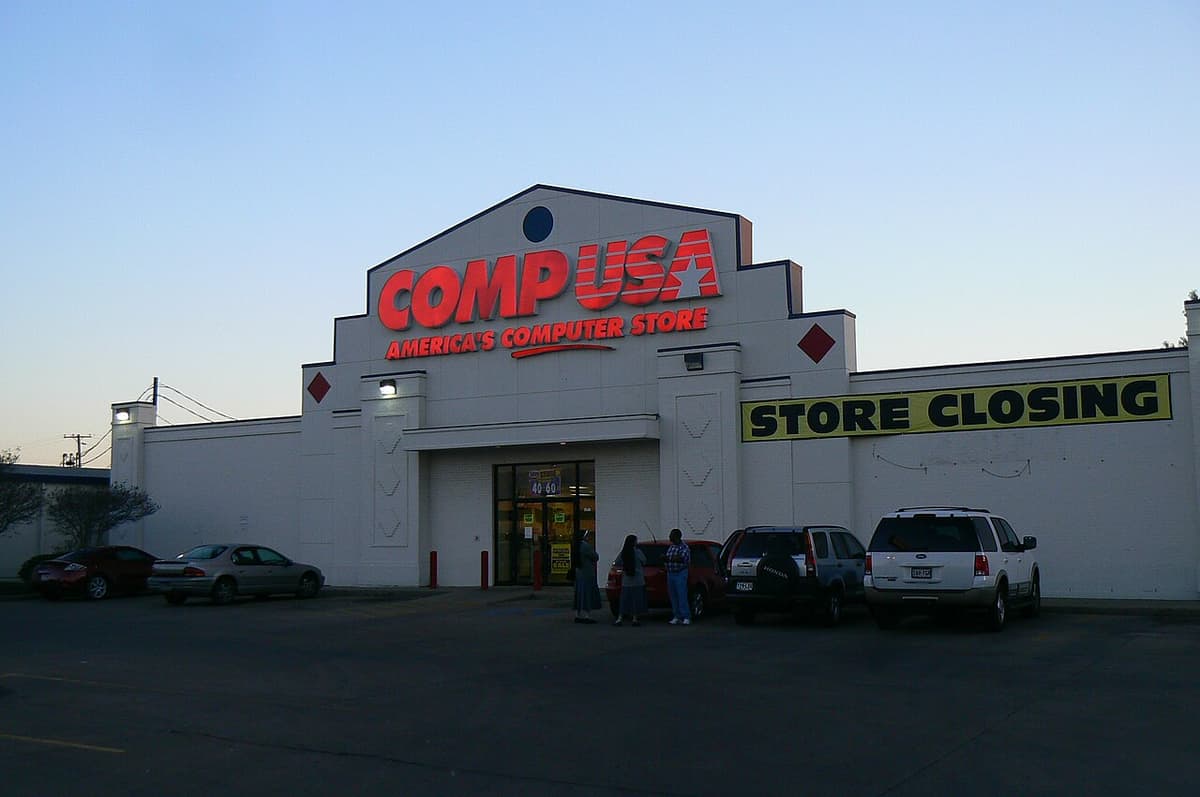
A CompUSA store at dusk with a yellow store closing banner
“Store closing,” Feb 2008Photo: Terry Ross from Corpus Christi, Texas, United States, via Wikimedia Commons, CC BY-SA 2.0.
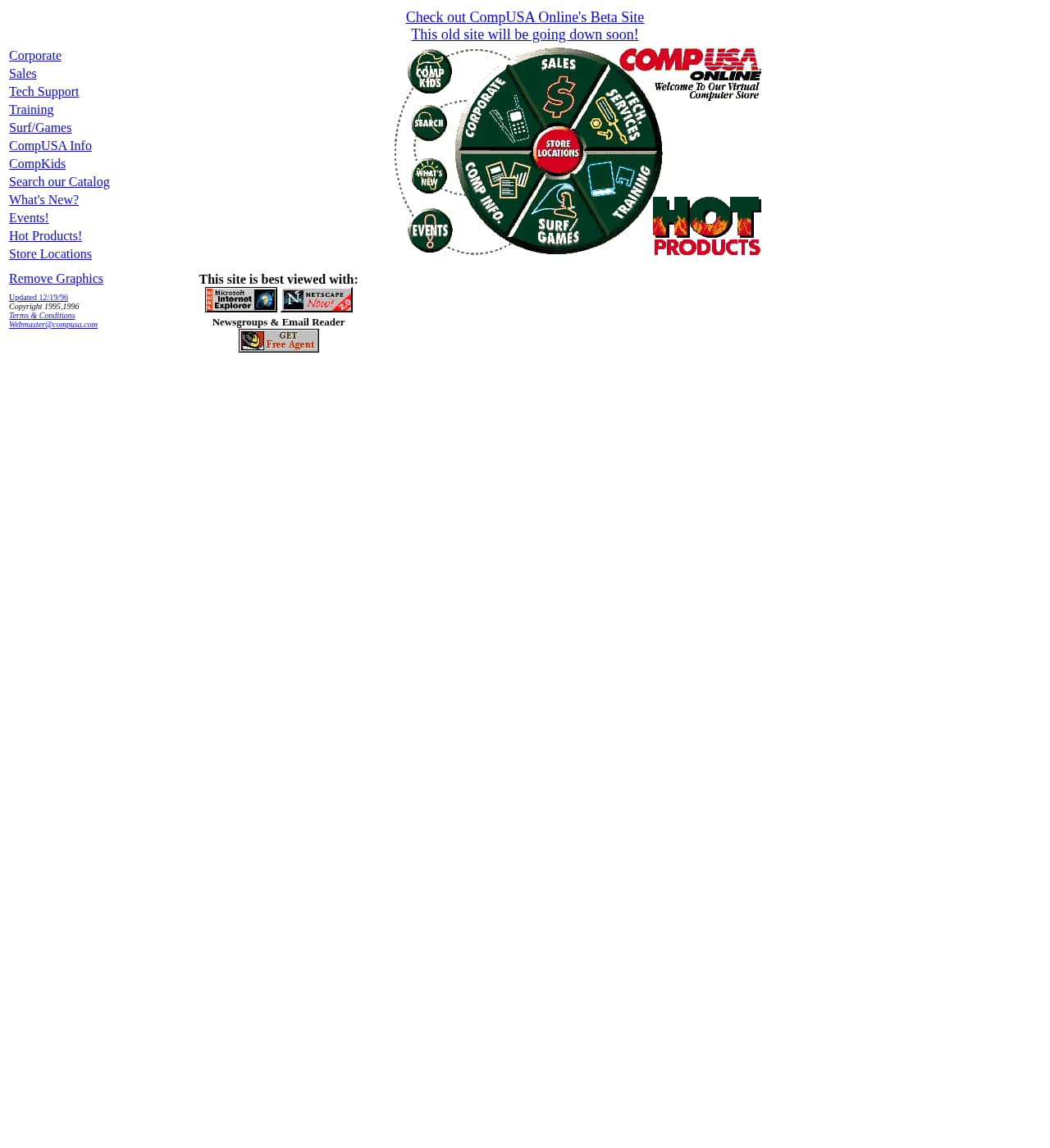
CompUSA Online home page in December 1996 with a round green navigation wheel
compusa.com, Dec 1996
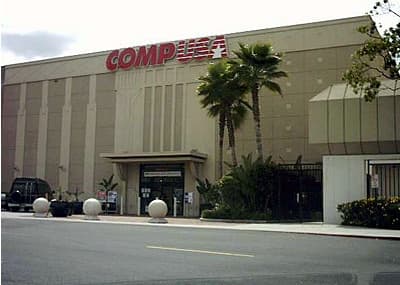
A CompUSA store with palm trees in front in Santa Clara, California
Santa Clara, California, 2005Photo: Coolcaesar at en.wikipedia, via Wikimedia Commons, CC BY-SA 3.0.

CompUSA opened the first computer superstore in 1988 and had 211 of them eleven years later, selling $6.3 billion of hardware, software and training a year. Its own annual report explained the problem: customers needed less help and cared more about price. Carlos Slim’s companies took it private in 2000 for $10.10 a share and spent seven years trying to turn it around. This is the full post-mortem, built from CompUSA’s SEC filings, the filings of its owners and buyers, contemporary press and the archived website. The company was private for its last eight years, so the record is thinner there, and the page says so.

The company in four numbers

$6.32B
net sales in the fiscal year ended June 26, 1999, the last full year it reported2
211
Computer Superstores open at that date, up from 28 in June 199221
$10.10
a share paid by Grupo Sanborns in 2000. The stock had traded as high as $37.81 in fiscal 199852
103
stores still open when the company was sold to a restructuring firm on December 7, 2007, to be sold or closed13

Key findings

  1. It started level with Best Buy. In fiscal 1992 CompUSA sold $823M and Best Buy $930M. By fiscal 1999 it was $6.3B against $10.1B, and Best Buy sold computers as one of four product categories.1223
  2. The stores sold less every year after 1996. Sales per square foot fell from $1,405 in fiscal 1996 to $1,139 in fiscal 1999. The company blamed lower selling prices for desktops, notebooks and monitors.2
  3. The best year earned two cents on the dollar. Net income peaked at $93.9M in fiscal 1997, or 2.0% of $4.61B in sales. Two years later the company lost $45.7M.2
  4. Buying the rival did not help. CompUSA paid about $175M for Computer City in 1998 and closed 59 of its 96 U.S. stores. The ones it kept sold $711 a square foot against $1,177 at its own.2
  5. A rich owner bought seven more years. Carlos Slim’s companies took CompUSA private in 2000. In February 2007 it closed 126 stores; in December it sold what was left to a firm that closed it.51213

The story

The store that explained computers, until nobody needed it to

CompUSA was built on one idea: a computer could be sold like a power drill, off a warehouse shelf, to someone who had never owned one. The idea was right, and it was easy to copy.

Chapter 1 of 6

$600M

sales in 1990, up from $66M in fiscal 1988, according to a reference history

Documentary · 1989“1989 Soft Warehouse Video” A nine-minute company video from before the CompUSA name. The title and the 1989 date are the uploader’s; the upload is from August 2026. The company was called Soft Warehouse until March 1991.1 Watch on YouTube

1984 – 1991 · Soft Warehouse

A software dealer builds a superstore

The company was formed in Dallas in 1984 as Soft Warehouse, Inc. It began by selling software and hardware to corporate customers, opened its first retail store in April 1985 and its first Computer Superstore in April 1988.18

The superstore was the bet. Computer dealers of the time were small shops with expert salespeople. Soft Warehouse guessed that as the public got used to computers, a large store with low prices and a staff that knew retailing better than it knew computers would do for PCs what Toys “R” Us had done for toys.8

In January 1989 a group of investors led by Ronald N. Dubin bought the company. Late that year it hired Nathan Morton, a former Home Depot executive with no background in computers, as president and chief executive.8 Sales went from $66M in fiscal 1988 to $600M in 1990.8 In March 1991 the company took the name CompUSA.1 That year Apple agreed to let it sell the Macintosh, which Apple had not sold through discounters before, and in December the shares began trading at $15.8

Chapter 2 of 6

$93.9M

net income in fiscal 1997, the best year, on $4.61B of sales

Commercial · 1996CompUSA “computer store” commercial A 30-second spot dated 1996 by the uploader. Fiscal 1996 ended with 105 stores and net income of $59.7M.1 Watch on YouTube

1991 – 1997 · The category killer

From 28 stores to 129, and one bad year

CompUSA had 28 stores and $823M in sales in the year to June 1992. Two years later it had 76 stores and $2.2B.1 The growth outran the controls. Fiscal 1994 brought a $17.0M loss and a $9.9M restructuring charge.1 At a board meeting in December 1993 Morton resigned and James Halpin, the president, who had arrived six months earlier from the Home Base home-improvement chain, took over.8

Halpin cut the management structure and kept opening stores.8 By June 1996 there were 105, averaging about 27,000 square feet and selling $1,422 a square foot as first reported. Net income reached $59.7M that year and $93.9M the next.12 The stores sold hardware and software, repaired machines and ran training classes. They also sold direct to companies, government agencies and schools.1

Even the best year was thin. Net income in fiscal 1997 was 2.0% of sales.2 A retailer earning two cents on the dollar has little room when prices fall.

Chapter 3 of 6

$1,139

sales per square foot in fiscal 1999, down from $1,405 three years earlier

$1,405 $1,364 $1,290 $1,139 FY1996FY1997FY1998FY1999 sales per square foot
Original illustration. The four figures are CompUSA’s average net sales per gross square foot for fiscal 1996 to 1999.2 Not an official asset.

1998 – 1999 · The commodity

More stores, more sales, less money

On June 22, 1998 CompUSA agreed to buy Computer City, the superstore chain Tandy had started in 1991, for about $275M.48 The deal closed on August 31 at about $175M. CompUSA closed 59 of the 96 U.S. stores it acquired and sold the seven Canadian stores to Future Shop.2

Sales rose 19.6% to $6.32B in fiscal 1999, and the company lost $45.7M.2 It was selling more computers for less money. Average sales per store fell about 15% in a year. Comparable-store sales fell 3.4%. Gross margin slipped from 14.3% of sales in fiscal 1997 to 12.7%.2 The former Computer City stores sold $711 a square foot against $1,177 at the others.2

The annual report said what had changed: buyers, “having gained familiarity with personal computers, require less assistance in making their purchasing decisions and have become increasingly price sensitive.”2 The list of competitors now ran from consumer electronics and office supply chains to manufacturers selling direct, internet retailers and mass merchants.2

On June 24, 1999 the company announced a restructuring. It handed corporate order fulfilment to Ingram Micro, shut its configuration centre and in August dismissed about 2,200 people who had sold to businesses from the stores. The year’s special charges came to $93.8M.2

The Company believes that individuals, businesses, schools, and governments, having gained familiarity with personal computers, require less assistance in making their purchasing decisions and have become increasingly price sensitive.

CompUSA Inc., annual report on Form 10-K for fiscal 19992

Chapter 4 of 6

$10.10

a share in cash, January 2000. The stock had touched $37.81 in fiscal 1998

CompUSA.com home page in March 2000 with panels for cozone.com, CompUSA PC and CompUSA Stores
compusa.com on March 2, 2000, the week the buyout closed: three businesses on one page, the stores, a build-to-order PC arm and the cozone.com web shop. Internet Archive capture, cropped.26

2000 – 2006 · Private

Carlos Slim buys the store

The shares traded as high as $37.81 in the second quarter of fiscal 1998 and as low as $5.63 in the third quarter of fiscal 1999.2 The Slim family of Mexico reported a stake in a filing dated November 22, 1999.6 On January 24, 2000 Grupo Sanborns, the retail arm of Carlos Slim’s Grupo Carso, agreed to buy the rest for $10.10 a share. It already owned about 14.8%.5 CompUSA then ran 217 superstores and employed about 20,000 people.5

About 69.5 million shares were tendered by February 29, 2000, and the company stopped reporting to the SEC in March.627 The Associated Press later put the buyout at $800M.13

What followed is known mostly from other companies’ filings. América Móvil, which held 49%, reported that CompUSA lost Ps.471M in 2000 and Ps.955.1M in 2001, with 217 superstores and 14,006 employees in March 2002.9 A Dallas jury in February 2001 returned a verdict against CompUSA, Halpin and Slim’s companies over an abandoned plan for franchised stores in Mexico. The trial judge set aside the awards against CompUSA and Halpin that May, and in August 2004 an appeals court ruled that the plaintiff should receive nothing from any defendant.925

In September 2003 CompUSA agreed to buy Good Guys, a West Coast electronics chain, for $2.05 a share.10 According to the AP the chain “went through several CEOs and tried different turnaround strategies.”13 eWeek reported that its owner had been trying to sell it since September 2006.15

Chapter 5 of 6

103

stores left when the company was sold to a restructuring firm

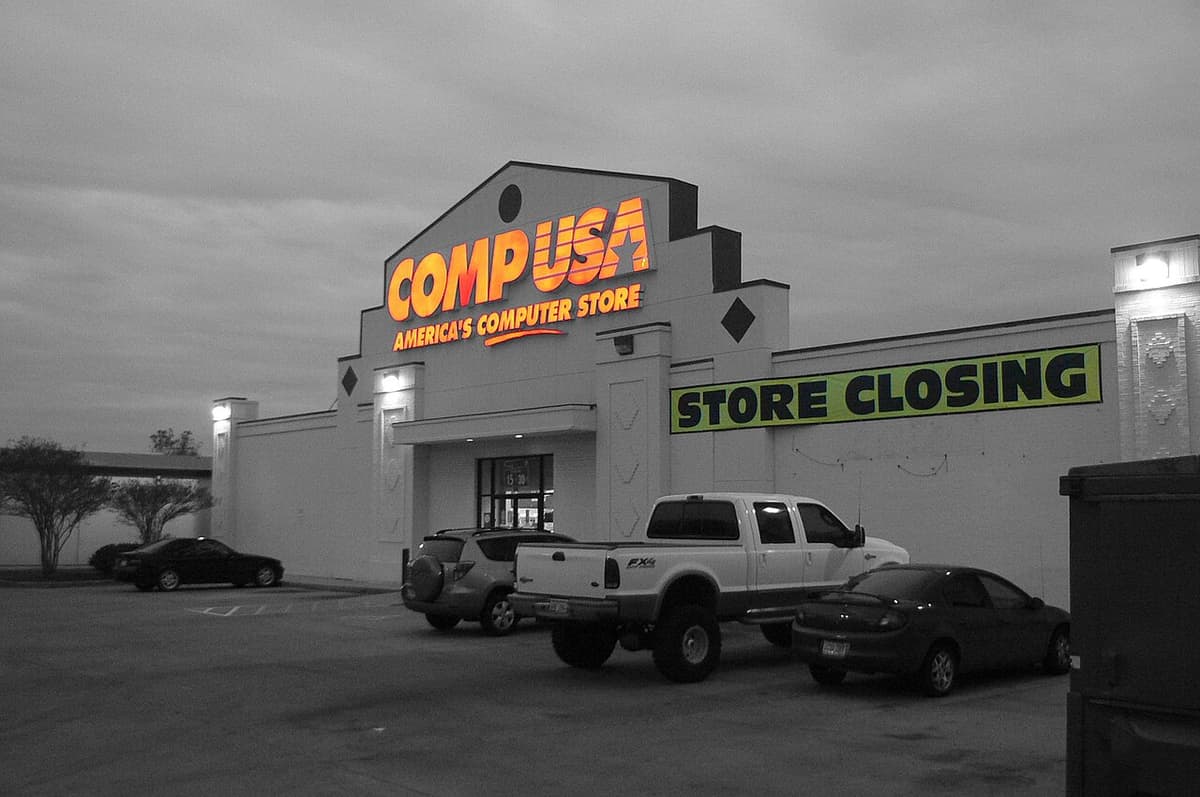
A CompUSA store with an illuminated orange sign and a yellow store closing banner, the rest of the photo in grey
A CompUSA with a “Store closing” banner, photographed on January 22, 2008. Photo: Terry Ross, via Wikimedia Commons, CC BY-SA 2.0. The photographer desaturated everything but the sign.28

Feb – Dec 2007 · The end

126 stores in February, the rest in December

On February 27, 2007 CompUSA said it would close 126 stores within 90 days, leaving 103 in 39 states.1211 Its chief executive, Roman Ross, described the closing stores as ones “with low performance or nonstrategic, old store layouts and locations faced with market saturation.”11 The owner put in new cash: $400M according to Computerworld, $440M according to a company spokeswoman quoted by the Everett Herald and the AP.121113

It was not enough. Computerworld reported a third-quarter 2007 loss of $45.7M on revenue of about $425M, and, citing The Wall Street Journal, that Slim had tried to sell the chain to Circuit City, Micro Electronics and Systemax without a deal and had put about $2 billion into it since 1999.14

On Friday, December 7, 2007 CompUSA said it had been sold to an affiliate of Gordon Brothers Group, a restructuring firm, and would close its store operations after the holidays. Terms were not disclosed. The 103 stores ran closing sales through Christmas.1314 The AP’s summary of the cause: the chain had “struggled for nearly a decade with falling prices on personal computers, its most important product, and competition from big-box retailers such as Best Buy.”13

Chapter 6 of 6

$30.6M

what Systemax paid in 2008 for the web business, the name and 16 store leases

CompUSA.com home page in January 2008 with a banner reading Welcome to the all-new CompUSA.com
compusa.com on January 13, 2008: “CompUSA is now a Systemax Company.” Internet Archive capture.26

2008 – today · The name

Sixteen stores, then a logo, then an error page

On January 6, 2008 Systemax, the owner of TigerDirect, said it would buy the CompUSA brand, trademarks and e-commerce business and as many as 16 stores in Florida, Texas and Puerto Rico.16 It paid about $30.6M in all, $18.9M of it for the web business and intellectual property.17 CompUSA web and retail sales came to $226.3M in Systemax’s 2008 accounts, and by April 2009 PC World counted 30 stores under the name, some of them converted TigerDirect shops.1718

On October 31, 2012 Systemax’s board decided to consolidate its U.S. consumer business under TigerDirect and wrote off about $34M of CompUSA and Circuit City intangibles.19 The company later described this as “ceasing use” of both brands, and in 2015 it left retail altogether.20

In October 2018 a deals website called DealCentral relaunched compusa.com as a page of coupons and links to other retailers.21 The Internet Archive holds a capture of that site from February 2019.26 When we loaded the address on October 8, 2026 it returned a Wix error page for a domain that is not connected to a site.22

Timeline

Forty-two years, 33 moments

From a Dallas software dealer to an error page. Filter by thread.

All 33 events as a list
  1. 1984
    Corporate

    Soft Warehouse is formed

    The company starts in Dallas, selling software and hardware to corporate customers.18

  2. Apr1985
    Stores

    First retail store

    Soft Warehouse opens its first shop.1

  3. Apr1988
    Stores

    First Computer Superstore

    The large-format store that becomes the model for the chain.1

  4. Jan1989
    Corporate

    Investor group buys in

    A group led by Ronald N. Dubin acquires Soft Warehouse. Nathan Morton, from Home Depot, is hired as president and CEO late in the year.8

  5. Mar1991
    Corporate

    Renamed CompUSA

    The company drops the Soft Warehouse name.1

  6. 1991
    Rivals & deals

    Tandy opens Computer City

    The owner of RadioShack starts its own computer superstore chain.8

  7. Dec1991
    Money

    Initial public offering

    Shares begin trading at $15, according to a reference history.8

  8. Jun 271992
    Stores

    28 stores, $823M

    Net sales for the fiscal year are $822.8M. Best Buy’s for its fiscal 1992 are $929.7M.123

  9. 1993
    Corporate

    Morton becomes chairman

    Nathan Morton adds the chairman’s title, replacing Ronald Dubin.8

  10. Dec1993
    Corporate

    Morton resigns

    He leaves at a board meeting. James Halpin, president for six months, takes over.8

  11. Jun 251994
    Money

    A $17.0M loss

    Fiscal 1994 ends with 76 stores, $2.2B in sales, a $9.9M restructuring charge and a net loss.1

  12. Apr 81996
    Money

    Two-for-one stock split

    1

  13. May 301996
    Rivals & deals

    PCs Compleat acquired

    A Massachusetts mail-order reseller, acquired in a merger to build a direct-sales business.1

  14. Jun 281997
    Money

    Peak profit

    Net income of $93.9M on sales of $4.61B, with 129 stores.2

  15. Jun 221998
    Rivals & deals

    Deal for Computer City

    CompUSA agrees to buy the chain from Tandy for about $275M in a note and cash.4

  16. Aug 311998
    Rivals & deals

    Computer City deal closes

    The final price is about $175M. CompUSA will close 59 of the 96 U.S. stores.2

  17. Jun 241999
    Corporate

    Restructuring announced

    Corporate fulfilment is outsourced to Ingram Micro. Special charges for the year reach $93.8M.2

  18. Jun 261999
    Money

    A $45.7M loss on record sales

    Fiscal 1999: 211 stores, $6.32B in sales, comparable-store sales down 3.4%.2

  19. Aug1999
    Corporate

    2,200 dismissed

    The in-store corporate sales force is replaced by a call centre in Dallas.2

  20. Nov 221999
    Money

    The Slim family discloses a stake

    A Schedule 13D is filed for the Slim family, Grupo Carso and Grupo Sanborns.6

  21. Jan 242000
    Money

    Sold for $10.10 a share

    Grupo Sanborns agrees to buy the shares it does not own. CompUSA has 217 superstores.5

  22. Feb 292000
    Money

    Tender offer expires

    About 69.5 million shares are tendered, giving the buyer about 89.9%.6

  23. Mar 102000
    Corporate

    Off the public record

    CompUSA files a Form 15 to end its SEC reporting.27

  24. Feb2001
    Corporate

    Jury verdict in Dallas

    A jury finds against CompUSA, James Halpin and Slim’s companies in a suit over franchised stores in Mexico. The judge sets aside the awards against CompUSA and Halpin in May.9

  25. Sep 292003
    Rivals & deals

    Good Guys bought

    CompUSA agrees to pay $2.05 a share for the West Coast electronics chain.10

  26. Aug2004
    Corporate

    Verdict overturned

    The Dallas Court of Appeals rules that the plaintiff should take nothing from any defendant.25

  27. Feb 272007
    Closure & afterlife

    126 stores to close

    More than half the chain, within 90 days. 103 stores remain.1211

  28. Dec 72007
    Closure & afterlife

    Sold to Gordon Brothers

    The company says it will close its stores after the holidays. Terms are not disclosed.1314

  29. Jan 62008
    Closure & afterlife

    Systemax buys the name

    The owner of TigerDirect agrees to buy the brand, the website and up to 16 stores.16

  30. Jan 102008
    Closure & afterlife

    Web business changes hands

    Systemax completes the purchase of the e-commerce business for $18.9M. The store leases follow in February and March.17

  31. Oct 312012
    Closure & afterlife

    Brand retired

    Systemax consolidates its U.S. consumer business under TigerDirect and writes off the CompUSA intangibles.19

  32. Oct2018
    Closure & afterlife

    A deals site borrows the name

    DealCentral relaunches compusa.com as a coupon and deals page.21

  33. Oct 82026
    Closure & afterlife

    An error page

    compusa.com returns a Wix error page for a domain that is not connected to a site.22

“America’s Computer Store” with a “Store closing” banner. The photographer left only the sign in colour.
Jan 22, 2008 “America’s Computer Store” with a “Store closing” banner. The photographer left only the sign in colour.Photo: Terry Ross from Corpus Christi, Texas, United States, via Wikimedia Commons, CC BY-SA 2.0.

Part 2 of 6

Business

The numbers · Rivals

The money

Sales went up eightfold. Profit never caught up

CompUSA reported to the SEC from its 1991 offering until March 2000. In those years sales rose from $0.8 billion to $6.3 billion and the best annual profit was $93.9 million. After the buyout the company was private, and the figures come from its owners and the press.

Stores open, 1992 to the end

Computer Superstores at fiscal year end (late June) to 1999, then counts from press releases and news reports.

0100200300FY92FY94FY96FY98Jan 200020081234560100200300FY92FY95FY982008123456
  1. FY94 · Growth outruns control 48 stores became 76 in a year. Fiscal 1994 ended with a $17.0M loss and a new chief executive.18
  2. FY97 · Peak profit $93.9M of net income in fiscal 1997, with 129 stores.2
  3. FY99 · Computer City absorbed 37 former Computer City stores and 14 new ones took the count to 211. The year lost $45.7M.2
  4. Jan 2000 · Sold to Grupo Sanborns 217 superstores when the $10.10 offer was announced.5
  5. Feb 2007 · 126 to close Computerworld counted 225 stores in the U.S. and Puerto Rico on the day more than half were ordered shut.12
  6. Mid 2007 · 103 left The stores that were open when Gordon Brothers took over on December 7, 2007.13
Data table
Stores open, 1992 to the end
Fiscal year end, then date of reportStores
FY9228
FY9348
FY9476
FY9585
FY96105
FY97129
FY98162
FY99211
Jan 2000217
Feb 2007225
Mid 2007103
20080
Selected operating data in the 10-Ks for fiscal 1996 and 199912; the buyout press release for January 20005; Computerworld and the AP for 20071213. The 2008 zero is the company-owned chain: 16 locations reopened under Systemax that year and are not shown.17 Counts between 2000 and 2007 are not in our sources.

CompUSA vs. Best Buy: annual sales

$ billions by fiscal year. CompUSA’s year ended in late June; Best Buy’s around the end of February.

Data table
CompUSA vs. Best Buy: annual sales
PeriodBest Buy revenuesCompUSA net sales
FY92$0.93B$0.82B
FY93$1.62B$1.37B
FY94$3.01B$2.22B
FY95$5.08B$2.94B
FY96$7.21B$3.83B
FY97$7.76B$4.61B
FY98$8.34B$5.29B
FY99$10.06B$6.32B
CompUSA: selected financial data in the fiscal 1996 and fiscal 1999 10-Ks; fiscal 1992 to 1996 are restated to include PCs Compleat12. Best Buy: 10-year financial highlights in its fiscal 2001 annual report23. Figures are rounded from thousands. The fiscal years do not cover the same months.

Net income

$ millions by fiscal year.

Data table
Net income
PeriodNet income (loss)
FY92$7.6M
FY93$9.7M
FY94$-17.0M
FY95$24.3M
FY96$59.7M
FY97$93.9M
FY98$31.5M
FY99$-45.7M
Selected financial data, fiscal 1996 and fiscal 1999 10-Ks12. Fiscal 1998 is after a $55.9M pre-tax write-off of information systems.3

Sales per square foot

Average net sales per gross square foot, by fiscal year.

Data table
Sales per square foot
PeriodSales per gross square foot
FY92$1,452
FY93$1,458
FY94$1,268
FY95$1,336
FY96$1,405
FY97$1,364
FY98$1,290
FY99$1,139
Fiscal 1992 to 1994 from the fiscal 1996 10-K1; fiscal 1995 to 1999 from the fiscal 1999 10-K2. The 1996 10-K gave $1,422 for fiscal 1996; the later filing shows $1,405.

Where the fiscal 1999 charges went

Non-recurring and restructuring charges for the year ended June 26, 1999, by programme. $ millions, before tax.

$93.8M total charges for the “Fiscal 1999 Initiatives”
$67.5M 72%Fourth-quarter restructuring$9.9M 11%Information technology$9.9M 10%Computer City transition$6.6M 7%CompUSA Net.com realignment$67.5M 72%Fourth-quarter restructuring$9.9M 11%Information technology$9.9M 10%Computer City transition$6.6M 7%CompUSA Net.com realignment
  • Fourth-quarter restructuring. Mostly write-downs of corporate-sales inventory and the fulfilment centre.2
  • Information technology. Personnel costs and professional fees.2
  • Computer City transition. Converting the stores it kept.2
  • CompUSA Net.com realignment. Turning the mail-order arm into an internet-only business.2
Data table
Where the fiscal 1999 charges went
Where it wentAmountShareNote
Fourth-quarter restructuring$67.5M72%Mostly write-downs of corporate-sales inventory and the fulfilment centre.
Information technology$9.9M11%Personnel costs and professional fees.
Computer City transition$9.9M10%Converting the stores it kept.
CompUSA Net.com realignment$6.6M7%Turning the mail-order arm into an internet-only business.
Table of charges in Management’s Discussion and Analysis, fiscal 1999 10-K2. The filing rounds the total to “approximately $93.8 million.”

The buyout, in the filings

$37.81
highest share price in fiscal 1998, in the quarter that ended December 19972
$5.63
lowest price in fiscal 1999, in the quarter that ended March 19992
$10.10
a share in cash offered by Grupo Sanborns on January 24, 20005
69.5M
shares tendered by February 29, 2000, about 75% of those outstanding6

126 stores, in 90 days

126stores CompUSA said on February 27, 2007 that it would close within 90 days12
=
126 ×store per icon (1)

Derived One icon per store. The Everett Herald reported 126 closing and 103 staying open, which sums to 229; Computerworld counted 225 open at the time.1112

Data table
126 stores, in 90 days
Value
stores CompUSA said on February 27, 2007 that it would close within 90 days126
store per icon1
Ratio126 (derived)

Not shown: annual results after 1999. CompUSA stopped filing in March 2000.27 América Móvil, a 49% owner, reported CompUSA net losses of Ps.471M for 2000 and Ps.955.1M for 2001 in constant Mexican pesos; we have not converted them.9 The last quarterly report it filed showed net sales of $2.73B for the 26 weeks to December 25, 1999, down from $3.13B a year earlier, and a net loss of $14.9M.7 Computerworld reported a loss of $45.7M on revenue of about $425M for the third quarter of 2007.14 The same $45.7M is, by coincidence, the net loss for fiscal 1999.2

The rivals

Everybody started selling computers

CompUSA beat the other computer superstores and bought the largest of them. It lost to stores that sold computers next to televisions, and to manufacturers that sold them with no store at all.

Who sold America its PCs, and what became of them

The headline figure for each, from the filings we could open.

CompUSA

Dead
FY92: $0.82BFY99
$6.32B Net sales in fiscal 1999, its last reported year. Closed in 2007–08; the name was retired in 2012.21319

Best Buy

Survived
FY92: $0.93BFY99: $10.1B
$41.7B Revenue in fiscal 2026. It was $0.93B in fiscal 1992, about the size of CompUSA.2423

Computer City

Bought by CompUSA
96 stores Tandy’s chain, sold to CompUSA in 1998 for about $175M. CompUSA closed 59 of the U.S. stores and kept 37.2

Good Guys

Bought by CompUSA
$2.05 A share, the price CompUSA agreed to pay in September 2003 for the California electronics chain.10

Circuit City

Name bought by Systemax
2012 The year Systemax, which had bought both names, stopped using Circuit City and CompUSA and wrote off about $34M of intangibles.1920

TigerDirect (Systemax)

Sold to PCM, 2015
31 stores Closed in 2015 when Systemax left the retail store business; the rest of the unit was sold to PCM, Inc. that December. The buyer of the CompUSA name did not last as a storekeeper either.20
Data table
Who sold America its PCs, and what became of them
CompanyOutcomeScale and fateNotesSeries
CompUSADead$6.32BNet sales in fiscal 1999, its last reported year. Closed in 2007–08; the name was retired in 2012.0.823, 1.37, 2.219, 2.936, 3.83, 4.611, 5.286, 6.321
Best BuySurvived$41.7BRevenue in fiscal 2026. It was $0.93B in fiscal 1992, about the size of CompUSA.0.93, 1.62, 3.007, 5.08, 7.215, 7.758, 8.338, 10.065
Computer CityBought by CompUSA96 storesTandy’s chain, sold to CompUSA in 1998 for about $175M. CompUSA closed 59 of the U.S. stores and kept 37.
Good GuysBought by CompUSA$2.05A share, the price CompUSA agreed to pay in September 2003 for the California electronics chain.
Circuit CityName bought by Systemax2012The year Systemax, which had bought both names, stopped using Circuit City and CompUSA and wrote off about $34M of intangibles.
TigerDirect (Systemax)Sold to PCM, 201531 storesClosed in 2015 when Systemax left the retail store business; the rest of the unit was sold to PCM, Inc. that December. The buyer of the CompUSA name did not last as a storekeeper either.
Company filings as cited. Sparklines are the fiscal 1992 to 1999 sales series from the chart in The numbers.
Dead

CompUSA

What it sold
Computers, software, training and repairs1
Sales, fiscal 1992
$0.82B1
Sales, fiscal 1999
$6.32B2
Net result, fiscal 1999
$45.7M loss2
Gross margin, fiscal 1999
12.7% of sales2
Outcome
Sold to a restructuring firm and closed, Dec 200713
Alive

Best Buy

What it sold
Four product categories; computers sat in “home office,” the largest23
Revenues, fiscal 1992
$0.93B23
Revenues, fiscal 1999
$10.06B23
Gross margin, fiscal 2000
19.2% of revenues23
On the PC, fiscal 2001
“Desktop computer sales have slowed”23
Outcome
$41.7B revenue, fiscal 202624

The week Dell went to Best Buy

The AP’s report of the December 2007 sale noted that Dell’s U.S. consumer sales had fallen 26% in the first half of that year, and that Dell had announced the same week that it would sell its machines at Best Buy.13 The manufacturer that had done most to sell computers without stores was moving into the big-box chain. The chain built to sell nothing but computers was closing.

Part 3 of 6

Brand

Commercials & footage · Old website · Brand gallery

Commercials & footage

From a 1989 company film to the closing sales

A corporate video from the Soft Warehouse years, three commercials from the growth decade, a news clip from the week of the sale, an advertisement from the Systemax revival and a later retrospective.

Documentary · 1989“1989 Soft Warehouse Video” A nine-minute company video from before the CompUSA name. The title and the 1989 date are the uploader’s; the upload is from August 2026. The company was called Soft Warehouse until March 1991.1 Watch on YouTube
Commercial · 1992CompUSA Christmas commercial A 30-second holiday spot. The 1992 date is the uploader’s. The chain had 28 stores in June 1992 and 48 a year later.1 Watch on YouTube
Commercial · 1994CompUSA commercial, February 26, 1994 According to the uploader, recorded during Winter Olympics coverage on February 26, 1994, two months after James Halpin replaced Nathan Morton and in the one loss-making year of the decade’s first half.81 Watch on YouTube
Commercial · 1996CompUSA “computer store” commercial A 30-second spot dated 1996 by the uploader. Fiscal 1996 ended with 105 stores and net income of $59.7M.1 Watch on YouTube
Commercial · 2001CompUSA commercial with Robert Wagner A spot from the first full year of private ownership. The 2001 date and the identification of the actor are the uploader’s. Watch on YouTube
News segment · 2007MacsimumNews: “CompUSA closing down; demand for Macs up” A three-minute news video from an Apple news site, uploaded on December 10, 2007, three days after the sale to Gordon Brothers.13 CompUSA had sold the Macintosh since 1991.8 Watch on YouTube
Commercial · 2008CompUSA TV ad, South Florida, November 2008 A weekly-offers ad uploaded on October 30, 2008 by a channel named compusatv, for the stores Systemax reopened that year.17 The uploader’s description says it ran on WPLG and LATV. Watch on YouTube
Retrospective · 2022Post-Mortar: “CompUSA: The Death of a Tech Giant” A fourteen-minute independent retrospective published in March 2022. Its claims and figures are the uploader’s; ours are in the sections above. Watch on YouTube

Videos are embedded from the services that host them and load only when you press play. YouTube embeds use youtube-nocookie.com. Each video belongs to its uploader or rights holder and is shown here for commentary; we do not host any of the files. Dates marked as the uploader’s could not be confirmed against a broadcast record.

The old website

Five front pages, 1996 to 2019

Screenshots of pages saved by the Internet Archive’s Wayback Machine, stored as images. Click one to open the original capture.26

Screenshot of http://www.compusa.com/ as archived Dec 27, 1996

Captured Dec 27, 1996

CompUSA Online

A navigation wheel for sales, tech services, training and store locations, with buttons recommending Internet Explorer and Netscape. A notice at the top says the old site “will be going down soon.”

Open this capture on the Wayback Machine

Text preserved in the archived pages

“Welcome To Our Virtual Computer Store”
Home page · Dec 27, 199626
“CompUSA is now a Systemax Company.”
Home page banner · Jan 13, 200826

A capture from February 2007, the week of the store-closing announcement, rendered as a blank page and is not shown.

Part 4 of 6

People

People · Press

The people

Who ran it, who bought it, who buried it

Roles and dates are from the filings and press cited. The founders of Soft Warehouse are not named in the sources we could open, so they are not named here.

People (8)
Name and roleWhat they didAfterwards
Nathan MortonPresident and CEO from late 1989; chairman in 1993

A former Home Depot executive with no background in computers, hired to roll out the superstores. Sales rose from $66M in fiscal 1988 to $600M in 1990. He resigned at a board meeting in December 1993.8

Ronald N. DubinLed the 1989 investor group; chairman until 1993

His group acquired Soft Warehouse in January 1989.8

James F. HalpinPresident and CEO from Dec 1993

Came from the Home Base home-improvement chain six months before taking over, and was still president and chief executive when the sale to Grupo Sanborns was announced in January 2000. A Dallas jury returned a $175.5M verdict against him personally in 2001, which the trial judge set aside.8159

Described as CompUSA’s former chief executive in a filing covering 2001.9
Carlos Slim DomitChairman, Grupo Sanborns

Announced the purchase in January 2000 and said the buyers could “re-energize the organization.”5

Carlos Slim HelúControlling owner through Grupo Carso

The AP described CompUSA in 2007 as controlled by his Grupo Carso. Computerworld, citing The Wall Street Journal, reported that he had put about $2 billion into the chain since 1999.1314

Roman RossChief executive, 2007

Announced the closing of 126 stores in February 2007 and moved to an advisory role when Gordon Brothers took over in December.1113

Bill Weinstein and Stephen GrayRan the wind-down

A Gordon Brothers principal and the managing partner of CRG Partners. eWeek reported them as interim president and chief restructuring officer.1315

Richard Leeds and Gilbert FiorentinoCEOs of Systemax and TigerDirect, 2008

Bought the name, the website and 16 stores. Leeds retired the brand in 2012.1619

The clippings

What they said at the time

Press (8)
CompUSA is a premier retail brand for computer equipment, consumer technology and related services in the U.S., and represents a tremendous opportunity to leverage the management experience of Sanborns in the retail and e-commerce sectors.
Carlos Slim Domit, chairman of Grupo Sanborns, Jan 24, 20005
It would be up to the buyers whether to continue the CompUSA name.
The Associated Press, Dec 7, 200713
  1. James Halpin, president and CEO of CompUSA, Jan 24, 20005

    We believe that this offer represents a good value for our shareholders and an exciting new future for our customers, employees and business partners.
  2. Roman Ross, chief executive, in a statement, Feb 200711

    Based on changing conditions in the consumer retail electronics market, the company identified the need to close and sell stores with low performance or nonstrategic, old store layouts and locations faced with market saturation.
  3. Richard Leeds, chief executive of Systemax, Jan 6, 200816

    We believe the value of the CompUSA brand remains very high.
  4. Gilbert Fiorentino, chief executive of TigerDirect, Jan 6, 200816

    We have a terrific opportunity to continue the great CompUSA brand and establish a new heritage that will extend for generations to come.
  5. Richard Leeds, Nov 1, 201219

    We harvested significant value from the CompUSA and Circuit City acquisitions and are now moving forward with a single and unified consumer platform in the United States.
  6. Shawn Knight, TechSpot, Oct 25, 201821

    The once popular brand is back, but not exactly in a meaningful way.

Part 5 of 6

Verdict

Cause of death · What if · Afterlife

Cause of death

The autopsy

Tap a cause to see the evidence. The percentages are our editorial weighting. The evidence under each one is sourced.

Cause of death, by editorial weight

One square is one percentage point. The weights are our judgment, not a measurement.

  1. 35%The computer became a commodity
  2. 25%Broader stores and direct sellers took the customer
  3. 15%A business with no margin for error
  4. 15%Computer City and the 1999 overhaul
  5. 10%Seven private years without a fix
Data table
Cause of death, by editorial weight
CauseWeight
The computer became a commodity35%
Broader stores and direct sellers took the customer25%
A business with no margin for error15%
Computer City and the 1999 overhaul15%
Seven private years without a fix10%

Sales per square foot fell from $1,405 in fiscal 1996 to $1,139 in fiscal 1999, and average sales per store fell about 15% in the last of those years, while the number of computers sold went up. The company blamed lower selling prices and a shift to lower-end machines, and wrote that buyers “require less assistance” and had become “increasingly price sensitive.”2 A store built to explain the product had less to explain.

Best Buy was about CompUSA’s size in fiscal 1992 and half again as large by fiscal 1999. It reported a gross margin of 19.2% of revenues for its fiscal 2000; CompUSA’s was 12.7% in fiscal 1999.1223 CompUSA’s own list of competitors named electronics and office chains, manufacturers selling direct, internet retailers and mass merchants.2 The AP’s 2007 obituary named “big-box retailers such as Best Buy.”13

The best year, fiscal 1997, earned 2.0% of sales. Gross margin fell from 14.3% that year to 12.7% two years later, and a 1.6-point fall was enough to turn a $93.9M profit into a loss once restructuring charges were added.2

CompUSA paid about $175M for a rival, closed 59 of its 96 U.S. stores and kept 37 that sold $711 a square foot. The same year it wrote off its corporate fulfilment operation and dismissed about 2,200 salespeople. Special charges were $55.9M in fiscal 1998 and $93.8M in fiscal 1999.23

Under Grupo Sanborns and its affiliates the chain lost money in 2000 and 2001, bought Good Guys in 2003 and, in the AP’s words, “went through several CEOs and tried different turnaround strategies.” It still had about 225 stores in February 2007, when it closed 126 of them at once.9101312

Editorial judgment: the weights are an interpretive model by the Spectre Brands editors, not a measured quantity. The filings document the symptoms up to 1999; for the private years we rely on the owners’ filings and press reports. How much each cause contributed is a matter of opinion.

The fork in the road

What if…

Three decisions where the story could have gone differently. The “What if” panels are speculation, labeled as such.

What happened

CompUSA agreed in June 1998 to pay about $275M for Computer City and closed the deal at about $175M. It shut 59 of the 96 U.S. stores, and the 37 it kept sold $711 a square foot against $1,177 at its own stores.42 Fiscal 1999 ended with a $45.7M loss.2

What if speculative

Tandy wanted out of computer superstores either way. Had CompUSA simply let the rival close, it would have kept about $175M and avoided a year of conversions, at the price of letting someone else pick up the better locations. The fall in computer prices would have arrived on the same schedule.

What happened

The chain had 217 superstores when it was sold in January 2000 and about 225 stores in February 2007, when it announced 126 closings in one day.512 By then, by one report, the owner had put about $2 billion into it.14

What if speculative

A new private owner in 2000 could have cut to the hundred or so strongest stores at once, as was done seven years later. A smaller CompUSA aimed at small businesses and enthusiasts, the customers it said it wanted in 200713, might have lasted longer. Whether it would have been worth $10.10 a share is another matter.

What happened

CompUSA described itself to the end of its public life as a retailer of “personal computers and related products and services.”2 It bought a consumer electronics chain, Good Guys, only in 2003.10 Best Buy, which sold computers as one category among several, was half again as large by fiscal 1999.232

What if speculative

Moving into televisions and audio in the mid-1990s, when CompUSA was earning its best profits, would have meant competing with Best Buy and Circuit City on their ground rather than waiting for them on its own. It would also have meant a different company from the one its customers knew.

Where are they now

The afterlife

CompUSA

  1. The name

    Lapsed

    Bought by Systemax in 2008, retired in 2012, used by a deals website from 2018.171921 On October 8, 2026 compusa.com returned an error page.22 We could not establish who holds the trademark now.

  2. The stores

    Closed

    Sixteen passed to Systemax in early 2008 and traded as CompUSA until the brand was dropped. Systemax closed 31 retail stores in 2015 and left the business.1720 The rest ran closing sales from December 2007.13

  3. The website

    Sold

    CompUSA.com went to Systemax for $18.9M with the intellectual property, and contributed to $226.3M of CompUSA sales in Systemax’s 2008 accounts.17

  4. Systemax’s consumer business

    Gone

    The TigerDirect operation that absorbed CompUSA was sold to PCM, Inc. on December 1, 2015 and the remainder wound down in 2016.20

  5. Best Buy

    Winner

    Revenue of $41.7B in fiscal 2026.24

  6. The owner’s bill

    Unknown

    One 2007 report, citing The Wall Street Journal, put Carlos Slim’s total investment at about $2 billion.14 What the Gordon Brothers sale returned was not disclosed.13

Who has owned the CompUSA name

Five owners or users in four decades.

  1. 1984

    Soft Warehouse, Inc.

    Formed in Dallas. Renamed CompUSA in March 1991 and listed that December.18

  2. Mar 2000

    Grupo Sanborns and Telmex

    Tender offer for all the shares. América Móvil later reported a 49% interest.569

    $10.10 a share
  3. Dec 2007

    Specialty Equity (Gordon Brothers)

    Buys the company to sell or close the 103 stores, the web business and the service arm.13

    Not disclosed
  4. Jan 2008

    Systemax (TigerDirect)

    Buys the brand, trademarks, website and 16 store leases.1617

    $30.6M
  5. Oct 2012

    Brand retired

    Systemax consolidates under TigerDirect.19

  6. Oct 2018

    DealCentral

    A deals website relaunches compusa.com. TechSpot reported that it had bought the brand; terms were not disclosed.21

  7. Oct 2026

    Nobody we can find

    The address returns an error page.22

Data table
Who has owned the CompUSA name
WhenOwnerWhat happenedPrice
1984Soft Warehouse, Inc.Formed in Dallas. Renamed CompUSA in March 1991 and listed that December.
Mar 2000Grupo Sanborns and TelmexTender offer for all the shares. América Móvil later reported a 49% interest.$10.10 a share
Dec 2007Specialty Equity (Gordon Brothers)Buys the company to sell or close the 103 stores, the web business and the service arm.Not disclosed
Jan 2008Systemax (TigerDirect)Buys the brand, trademarks, website and 16 store leases.$30.6M
Oct 2012Brand retiredSystemax consolidates under TigerDirect.
Oct 2018DealCentralA deals website relaunches compusa.com. TechSpot reported that it had bought the brand; terms were not disclosed.
Oct 2026Nobody we can findThe address returns an error page.

What CompUSA was worth, twice

The 2000 buyout as reported by the AP, against what Systemax paid in 2008. $ millions.

Whole company, 217 superstores (2000)
$800.0M
The AP’s figure for the buyout.13
Name, website and 16 store leases (2008)
$30.6M
Systemax 10-K.17
Data table
What CompUSA was worth, twice
TransactionPriceNote
Whole company, 217 superstores (2000)$800.0MThe AP’s figure for the buyout.
Name, website and 16 store leases (2008)$30.6MSystemax 10-K.
AP, December 200713; Systemax 10-K for 200817. The two are not like for like: the first bought a whole company with about 20,000 employees5, the second a set of assets. Derived: 800 ÷ 30.6 ≈ 26.

Sources

Sources and data notes

  1. CompUSA Inc. — Form 10-K for the fiscal year ended June 29, 1996, filed Sep 24, 1996.
  2. CompUSA Inc. — Form 10-K for the fiscal year ended June 26, 1999, filed Sep 15, 1999.
  3. CompUSA Inc. — Form 10-K for the fiscal year ended June 27, 1998, filed Sep 23, 1998.
  4. CompUSA Inc. — Form 8-K with press release, “CompUSA to Purchase Computer City”, filed Jun 26, 1998.
  5. CompUSA Inc. — Form 8-K with the merger agreement and joint press release, “Grupo Sanborns to Acquire CompUSA Inc. for $10.10 per Share”, filed Jan 26, 2000.
  6. TPC Acquisition Corp., Grupo Sanborns and Teléfonos de México — Schedule TO, Amendment No. 4 (final), with press release on the results of the tender offer, filed Mar 1, 2000.
  7. CompUSA Inc. — Form 10-Q for the quarter ended December 25, 1999, filed Feb 8, 2000.
  8. “CompUSA, Inc.,” International Directory of Company Histories, as reproduced on Encyclopedia.com.
  9. América Móvil, S.A. de C.V. — Form 20-F for 2001, sections “Other Investments — CompUSA” and “Legal Proceedings.”
  10. Good Guys, Inc. — press release, “Good Guys, Inc. Announces Merger Agreement with CompUSA”, Sep 29, 2003, filed on Form 8-K.
  11. Eric Fetters, “CompUSA to close both county stores”, The Herald (Everett, Wash.), Feb 28, 2007, with the Associated Press.
  12. Gregg Keizer, “CompUSA to shutter more than half its stores”, Computerworld, as published by Macworld, Feb 27, 2007.
  13. The Associated Press, “CompUSA to close doors after holidays”, The Spokesman-Review, Dec 11, 2007; the same report as “CompUSA is sold; will close all stores”, NBC News, Dec 7, 2007.
  14. Agam Shah, “CompUSA to shut down stores”, Computerworld, Dec 8, 2007.
  15. Sharon Linsenbach, “CompUSA to Close All 103 Stores”, eWeek, Dec 10, 2007.
  16. Systemax Inc. — press release, “Systemax Announces Definitive Agreement to Acquire Selected Assets and Retail Stores from CompUSA”, Jan 6, 2008, filed on Form 8-K.
  17. Systemax Inc. — Form 10-K for 2008.
  18. Jeff Bertolucci, “CompUSA Is Back With a New Retail Strategy”, PC World, as published by ABC News, Apr 10, 2009.
  19. Systemax Inc. — Form 8-K and press release, consolidation under TigerDirect, Nov 1, 2012.
  20. Systemax Inc. — Form 10-K for 2015, filed Mar 17, 2016.
  21. Shawn Knight, “CompUSA returns, but not as you remember it”, TechSpot, Oct 25, 2018.
  22. compusa.com (https://www.compusa.com/, not linked because it does not resolve to a site), as loaded on Oct 8, 2026: an HTTP 404 response carrying a Wix.com “ConnectYourDomain” error page, with no shop or other content. The Internet Archive recorded the same error page in a capture dated Sep 21, 2026 (timestamp 20260921093635).
  23. Best Buy Co., Inc. — Form 10-K for fiscal 2001, with the 10-year financial highlights in Exhibit 13.
  24. Best Buy Co., Inc. — Form 10-K for fiscal 2026.
  25. Jenkens & Gilchrist — press release on the Dallas Court of Appeals decision in COC Services v. CompUSA, Aug 27, 2004, as published by LawFuel. The firm represented CompUSA.
  26. Internet Archive Wayback Machine captures of compusa.com: Dec 27, 1996, Mar 2, 2000, Jun 14, 2007, Jan 13, 2008 and Feb 25, 2019.
  27. CompUSA Inc. — Form 15, certification and notice of termination of registration, filed Mar 10, 2000.
  28. Wikimedia Commons photographs: Coolcaesar, Santa Clara store, Mar 20, 2005 (CC BY-SA 3.0); Terry Ross, “Store Closing,” Jan 22, 2008 and “Last Seven Days,” Feb 18, 2008 (CC BY-SA 2.0).
Data notes (10)

Data notes

Tier: CompUSA is listed as dead. The company-owned chain closed in 2007–08; Systemax stopped using the name after October 2012; the deals site launched in 2018 no longer loads.1319202122 We did not search trademark registers, so a live registration or a dormant owner is possible. If the name returns to use the tier should change to ghost.

Derived values: 229 stores in February 2007 is 126 + 103.11 The 49 stores added in fiscal 1999 is 211 − 162; the filing gives 37 acquired, 14 opened and 2 closed.2 Best Buy at “half again” CompUSA’s size is $10.06B ÷ $6.32B ≈ 1.6; in fiscal 1992 it is $930M ÷ $823M ≈ 1.1.2321 “Eightfold” is $6.32B ÷ $0.82B ≈ 7.7.21 The 1.6-point fall in gross margin is 14.3% − 12.7%.2 800 ÷ 30.6 ≈ 26.1317 “Seven years” of private ownership counts March 2000 to December 2007. Chart values are rounded from the filings’ thousands.

Not on a common basis: CompUSA’s fiscal years ended in late June and Best Buy’s around the end of February.223 Fiscal 1992 to 1996 CompUSA figures are restated for the PCs Compleat pooling; sales per square foot for fiscal 1996 is $1,422 in the 1996 filing and $1,405 in the 1999 filing.12 The homepage sparkline mixes fiscal year-end store counts (28, 76, 105, 162, 211) with counts from a press release (217), news reports (225, 103) and the 16 stores Systemax reopened.125121317

Conflicts between sources: The cash put in during the 2007 restructuring is $400M in Computerworld and $440M in the Herald and the AP.121113 The store count before the February 2007 closings is 225 in Computerworld and 229 by the Herald’s arithmetic.1211 The Computer City price was about $275M when announced and about $175M at closing, subject to adjustment.42 TechSpot says Soft Warehouse opened in Addison, Texas in 1986; the company’s 10-K says it was formed in 1984 and opened its first retail store in April 1985. We follow the 10-K.211

Reported, not confirmed: The $800M value of the 2000 buyout is the AP’s figure; the filings give the price per share.135 The “about $2 billion” invested by Carlos Slim and the approaches to Circuit City, Micro Electronics and Systemax are Computerworld’s account of a Wall Street Journal report we did not read.14 The third-quarter 2007 loss and revenue are also Computerworld’s.14 The IPO price of $15, sales of $66M and $600M for 1988 and 1990, and the Morton and Halpin appointments come from a reference history, not from filings.8 The outcome of the COC Services appeal is from a press release by CompUSA’s lawyers; we could not open the court’s opinion (150 S.W.3d 654) directly.25 That DealCentral purchased the brand in 2018 is TechSpot’s report; a widely repeated claim that the trademarks were sold in 2013 and later leased is unverified and is not used.21

Unknown: Who founded Soft Warehouse (names are widely repeated online but are not in the sources we opened). Annual sales and store counts from 2000 to 2006. What Gordon Brothers paid. The date the last company-owned store closed; a photograph dated February 18, 2008 shows one still running a closing sale.28 How many people lost jobs in 2007. Who owns the trademarks today.

Videos: Broadcast years of the commercials are the uploaders’ unless stated. The 1989 Soft Warehouse film is identified only by its uploader’s title.

Archive: Screenshots are of Internet Archive captures and are cropped or shortened; the March 2000 image is cropped to the page content. Missing images in a capture are noted beside it.26

General knowledge: That Dell sold computers directly to customers, that Tandy owned RadioShack, and that Best Buy and Circuit City were national electronics chains in this period.

How the sources were read: SEC filings were downloaded from EDGAR as text and searched. Press articles were fetched from the publishers’ pages on October 8, 2026. The New York Times and Wall Street Journal articles on CompUSA listed in the reference history’s bibliography could not be opened and are not cited.8