Data notes (10)
Data notes
Derived: Per-order figures are quarterly revenue, gross profit and delivery expense divided by orders in the quarter, all from the S-1: for Q4 1999, $2,117K ÷ 177,581 = $11.92, $838K ÷ 177,581 = $4.72 and $2,281K ÷ 177,581 = $12.84; the other quarters are calculated the same way.1 $7.51 lost per $1 of sales is $26,370K ÷ $3,509K. Marketing at nearly three times revenue is $10,252K ÷ $3,509K = 2.92. Total 1999 costs of $30.038M are $1.997M + $28.041M. 2,665 employees is 445 salaried + 2,220 hourly on March 10, 2000. The Starbucks total of $150M is $15M + $25M + $35M + $35M + $40M, and 43 times revenue is $150M ÷ $3.509M = 42.7. The 36-fold rise in the share price is $7.55 ÷ $0.21. $267.7M is the sum of shares × price for Series A to F; 4.0 million Series F shares (3 × 1,323,977) were issued for agreements and stock, not cash. Eight cities in April 2000 is the six in the S-1 plus Chicago and Atlanta.117
The card’s sparkline: The series 1, 2, 4, 5, 6, 8, 11, 9, 0 is the number of cities served in March 1998, June, September and November 1999, February, April and September 2000, January 2001 and April 2001. It mixes the S-1 (to February 2000)1, press reports10141517 and one derived point (eight).
Company claims, not audited: 400,000 members, an average order of $25 or $30, and profits in New York, San Francisco and Boston in December 2000 are statements by the company to reporters.7911 No financial statements for 2000 or 2001 were published.
Conflicts between sources: The average order in early 2001 is $25 in a Bloomberg report and $30 in The Register.711 The fee introduced in January 2001 is “a $2 delivery charge” on orders below “the $25 to $30 range” in Computerworld and $1.99 on orders under $30 in a 2008 retrospective.1221 The closing count of facilities is 16 distribution centers in the Bloomberg report; other accounts give other numbers, which we have not used.7 Private investment was “reported at $268 million” by Computerworld and “more than $250 million” by The Industry Standard; the S-1 gives $232.3M of cash plus $10.0M of securities as of March 2000.11221 A trade report says Kozmo hoped to raise “as much as $160 million” in the IPO; the filing’s fee table says $150,000,000.115 Forbes gives the 1999 loss as $26.3M; the filing says $26.37M.116 Sources call Chris Siragusa both group vice president of technology and chief technology officer.1220
Unverified, and left out or flagged: A former employee told The Globe and Mail that the company was “burning $1-million (U.S.) a day”; nothing in the filing supports a rate that high in 1999, and we have no figures for 2000, so we do not use it as a fact.5 The Register’s line that Kozmo “cut 3,000 staff” in mid-2000 looks like an error and is not used.11 The distributor’s page for e-Dreams says the company reached 3,000 employees and collapsed in “April 2000”; the first is unconfirmed and the second is wrong by a year.29 Reports that Kozmo had paid Starbucks $15M before ending the agreement could not be traced to a source we read; the S-1 only says $15M was due in 2000.1 The founders’ origin story is as told by CNET.4 The exact date Joseph Park stepped down as chief executive is not in our sources; Gerry Burdo is called CEO in a release of December 5, 2000.13
Is the name in use today?: We classify Kozmo as a ghost because the KOZMO registrations are live and were renewed in 2022, and their owner operated a site under the name from 2018.2325 We could not confirm that the service still runs: the Internet Archive’s capture list for kozmo.com ends on May 20, 2022, and the address did not respond from our network on October 8, 2026.27 If the registrations lapse, the tier should change to dead.
Commercials: Air dates of the commercials are the uploaders’ or are unknown; the years shown for three of them are approximate, as their captions say.30 The identification of Jackie Hoffman is the uploader’s. The documentary embed is a third-party upload.
How we read the sources: SEC filings were read in full from EDGAR. Press articles were fetched and read as text on October 8, 2026; CNN, CNET, MSNBC, Business Wire and Industry Standard pieces were read in Internet Archive copies, which are the URLs cited. We did not have access to the New York Times and Wall Street Journal coverage of April 2001 and cite neither.
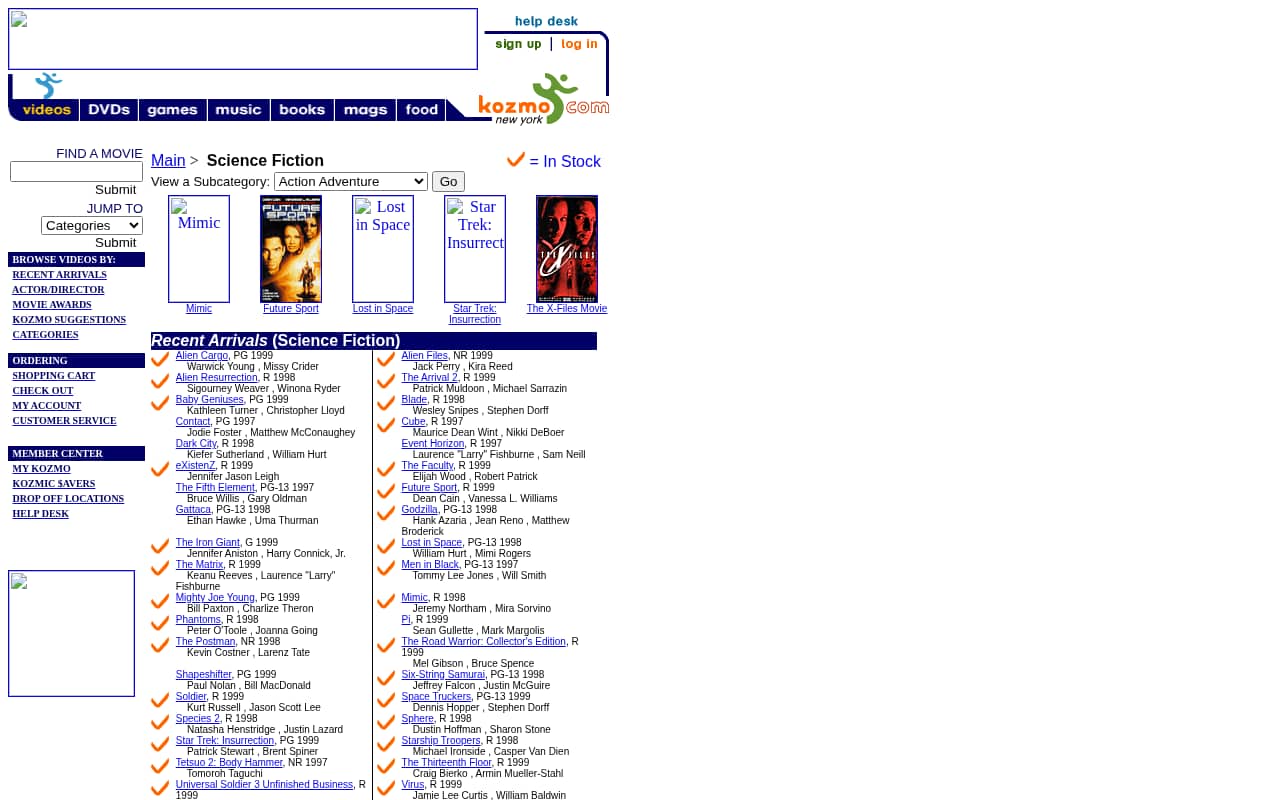
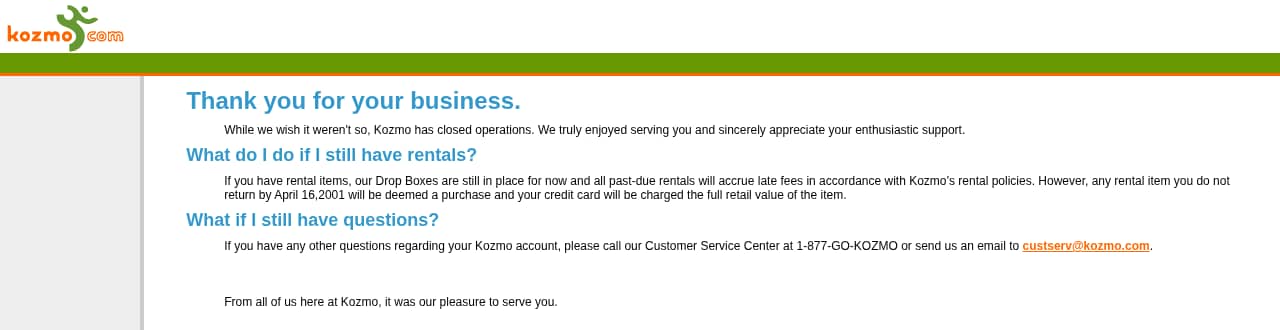
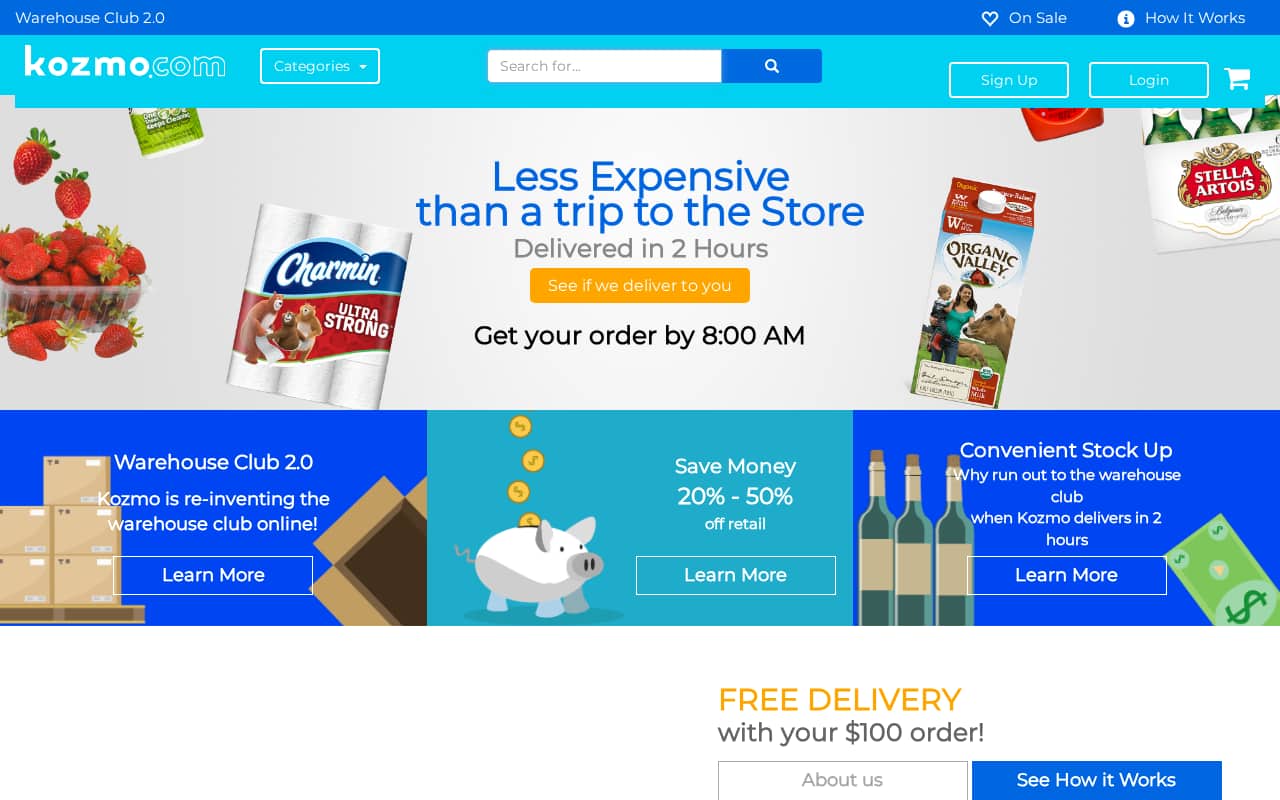
Images: The four screenshots and the logo crop are from Internet Archive captures of kozmo.com.27 The December 1999 capture is missing several images. We found no freely licensed photograph of a Kozmo courier or warehouse on Wikimedia Commons, so the couriers appear only as original drawings.
General knowledge: That the Nasdaq Composite peaked on March 10, 2000. That Webvan, which went public in November 1999, ceased operations in July 2001. That e-Dreams was released in 2001.