Spectre Brands

DeadNon-carbonated fruit drink · Vancouver, British Columbia

Orbitz

Launched in 1996. Discontinued by 1999.

A drink you could chew. Teenagers tried it once.

Why dead: Clearly Canadian stopped making Orbitz by 1999 and said in 2015 that it no longer had the equipment to make it. Old bottles sell to collectors; we found no official revival.5

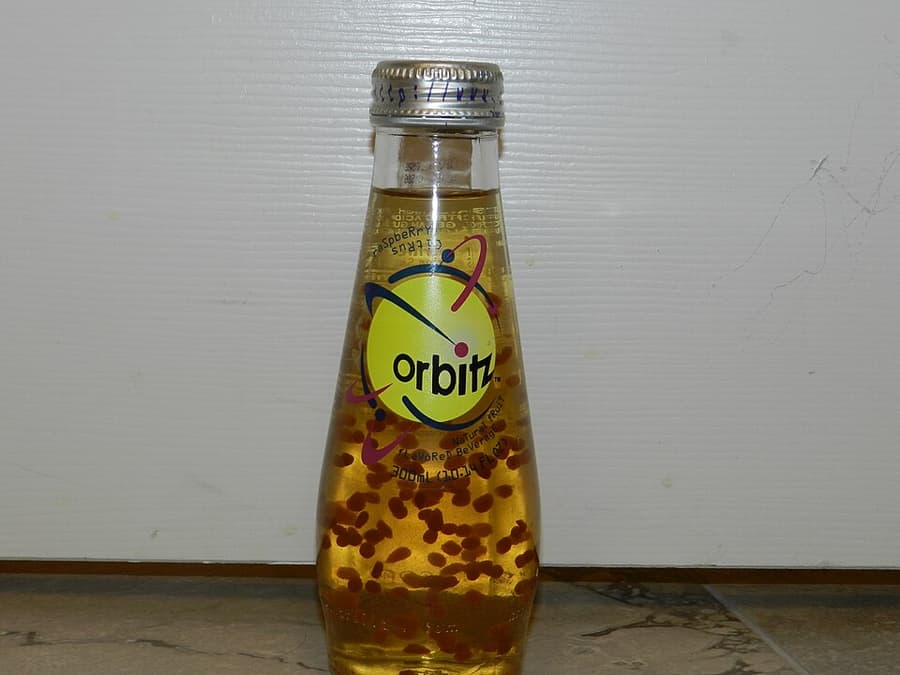
A 300 ml Orbitz bottle with a yellow planet logo and orange gel balls
An unopened Raspberry Citrus bottle, photographed in 2024. Photo: Candeadly, Wikimedia Commons, CC BY 4.0.Photo: Candeadly, via Wikimedia Commons, CC BY 4.0.
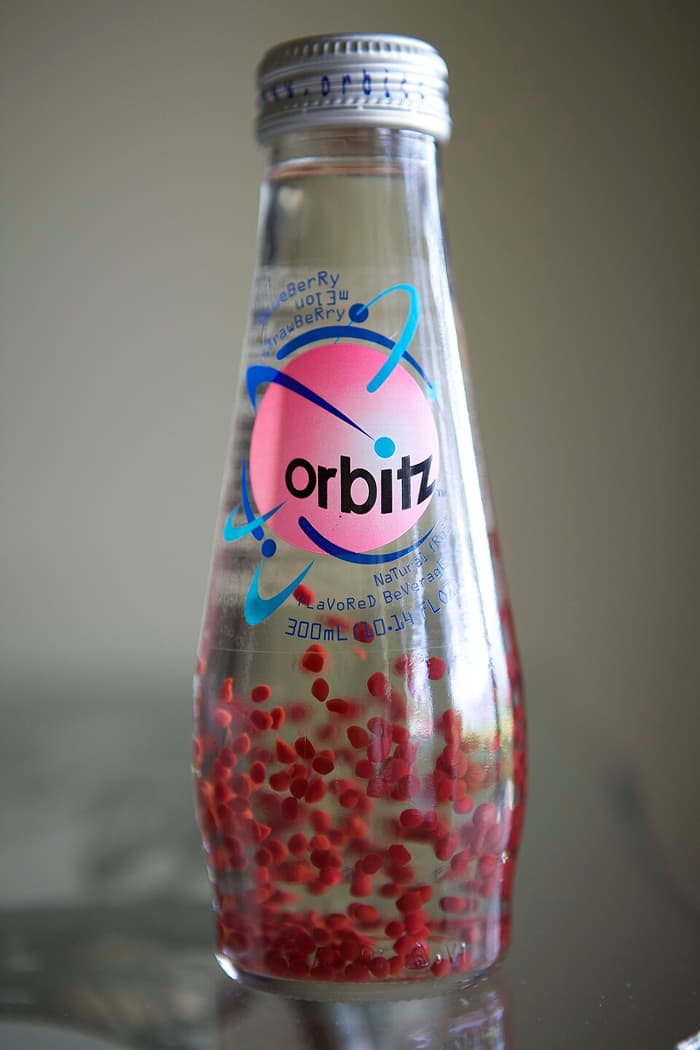
An Orbitz bottle with red gel balls settled at the bottom
A Blueberry Melon Strawberry bottle in 2012. The balls, meant to float, have sunk. Photo: Scott Schiller, Wikimedia Commons, CC BY-SA 2.0.Photo: Scott Schiller, via Wikimedia Commons, CC BY-SA 2.0.

Orbitz was a non-carbonated fruit drink from Clearly Canadian, the Vancouver maker of flavored sparkling waters. Its selling point was the small balls of gellan gum that hung, without sinking, in the liquid. Launched in 1996 for 12- to 17-year-olds, it sold a million cases in its first months, by the company’s account, and was a hit in 1997. In the first half of 1998 its sales fell by almost 85%. The company said this was the life cycle it had expected; by 1999 the drink was gone. This page is built from contemporary press and Clearly Canadian’s own SEC filings.

The drink in four numbers

1M
cases sold by the end of 1996, according to the company1
$9.4M
Orbitz sales in the first half of 19974
$1.46M
in the first half of 19984
$1.09
for a 10.14-ounce bottle in Spokane, January 19972

Key findings

  1. Built to be talked about, not repeated. Its spokesman said the aim was to make whoever brought Orbitz into a room “the center of attention for a few moments.”1 Reviewers called it a lava lamp, tapioca and worse.12
  2. The collapse was in the plan. When first-half sales fell from $9.4M to $1.46M, the marketing chief said: “Our expected life-cycle of the product is coming true.”4
  3. No advertising budget to rescue it. Clearly Canadian relied on product placement, sampling and events, saying advertising was “too mass for our products and, quite frankly, not affordable.”4
  4. The parent kept shrinking. Clearly Canadian’s revenue fell from $34.9M in 1998 to $20.5M in 2002, with losses in every year after 1998. Its own filings warned that beverage brands may last “a few years” before tastes change.6

The story

Planet Orbitz

Orbitz was designed as a novelty and sold like one: fast, then not at all.

Chapter 1 of 4

1M

cases sold by the end of 1996, by the company’s account

Commercial · 1990Original Clearly Canadian commercial Uploaded by Clearly Canadian itself: the sparkling-water advertising that built the company before Orbitz. The year is approximate. Watch on YouTube

1996 · Launch

“A lava lamp you can drink”

Clearly Canadian, then nine years old and known for flavored sparkling water, launched Orbitz in 1996.14 It used “fluid-gel” technology to keep small balls of gellan gum suspended in non-carbonated fruit drink, in flavors such as raspberry citrus and blueberry melon strawberry.1 The company aimed it at 12- to 17-year-olds and talked about a “Jetsons mentality.”1

The Associated Press called it “a lava lamp you can drink” and, less kindly, “fruit-flavored phlegm in a bottle.” A product consultant called it potentially “the pet rock of the beverage industry.”1 The company reported better-than-expected sales: a million cases by the end of the year.1

Chapter 2 of 4

$9.4M

Orbitz sales in the first half of 1997

Orbitz bottle
Raspberry Citrus, 300 ml. Photo: Candeadly, via Wikimedia Commons, CC BY 4.0.

1997 · The hit

Hot with teenagers, panned by adults

By 1997 it came in four flavors and sold for about $1.09 for a 10.14-ounce bottle, at 130 calories. The Spokesman-Review’s adult tasting panel gave it two stars; the only higher score came from a 13-year-old.2 The Washington Post reported that Orbitz had “captured a niche market among young people.”3

Sales in the first half of 1997 were $9.4M.4

Chapter 3 of 4

−84%

first-half sales, 1998 against 1997 (derived)

Retrospective · 2023The 1997 website for Orbitz A walk-through of the archived Orbitz website. Embedded as commentary; nothing on this page is taken from it. Watch on YouTube

1998 – 1999 · The fall

“Orbitz is still weird. It’s just not new.”

In the first half of 1998 Orbitz sales were $1.46M. Clearly Canadian’s vice-president of marketing, Jonathan Cronin, said: “Orbitz is still weird. It’s just not new in 1998. We weren’t expecting Orbitz to sell in 1998 what it sold in 1997.”4 The company had no immediate plan to discontinue it, and moved on to an energy drink and an oxygenated water.4

By 1999 Orbitz had been discontinued.5

Chapter 4 of 4

$50

about what an unopened 1990s bottle can fetch on eBay

Orbitz bottle with red gel balls settled at the bottom
An old bottle in 2012. Photo: Scott Schiller, via Wikimedia Commons, CC BY-SA 2.0.

1999 – today · Cult

Collectors’ bottles

Clearly Canadian’s total revenue fell from $34.9M in 1998 to $20.5M in 2002, and it lost money every year from 1999 to 2002.6 In 2015 a company representative said fans still asked for Orbitz constantly, but that it no longer had the equipment to make it.5

Unopened bottles from the 1990s sell to collectors for around $50.5 The balls do not always stay up: in a 2012 photograph of an old bottle they have sunk to the bottom.

Timeline

Three years in orbit

From launch to the warehouse in about three years. Filter by thread.

All 10 events as a list
  1. 1996
    Product

    Launch

    Clearly Canadian introduces Orbitz, a fruit drink with suspended gel balls, aimed at 12- to 17-year-olds.14

  2. Oct 161996
    Product

    “A lava lamp you can drink”

    An Associated Press feature takes Orbitz national; the company expects a million cases by year end.1

  3. Jan 291997
    Product

    Two stars

    The Spokesman-Review’s panel tastes it: $1.09 a bottle, 130 calories.2

  4. Apr1997
    Product

    “Orbitz is hot”

    The Washington Post reports it has captured a niche among young people.3

  5. 1997
    Money

    $9.4M

    Orbitz sales in the first half of 1997.4

  6. 1998
    Money

    $1.46M

    First-half 1998 sales are down almost 85%.4

  7. Aug 311998
    Decline & after

    “Expected life-cycle”

    The marketing chief says the decline was planned for; new drinks are coming.4

  8. 1999
    Decline & after

    Discontinued

    Orbitz is no longer made.5

  9. 2002
    Money

    Parent shrinks

    Clearly Canadian’s revenue is $20.5M, down from $34.9M in 1998.6

  10. 2015
    Decline & after

    No machines

    A company representative says it no longer has the equipment to make Orbitz.5

The money

From $9.4M to $1.46M

Clearly Canadian did not break out Orbitz in the filings available on SEC EDGAR, which for this company begin in 2002. The Orbitz figures come from the company’s statements to Strategy magazine in 1998; the company figures from its 2002 annual report, in US dollars.

Orbitz sales, first half of each year

$ millions, six months to June 30.

H1 1997
$9.4M
H1 1998
$1.46M
−84% (derived)
Data table
Orbitz sales, first half of each year
PeriodSalesNote
H1 1997$9.4M
H1 1998$1.46M−84% (derived)
Strategy, Aug 31, 1998.4 The article does not say whether these are US or Canadian dollars.

Clearly Canadian’s revenue after Orbitz

Total revenues from continuing operations, $ millions.

$0M$10M$20M$30M$40M1998199920002001200212$0M$20M$40M1998199920002001200212
  1. 1998 · Orbitz fades The last year with a profit: $0.3M.6
  2. 2002 · 2002 $20.5M of revenue and a $3.6M loss.6
Data table
Clearly Canadian’s revenue after Orbitz
PeriodRevenue
1998$34.9M
1999$31.4M
2000$23.2M
2001$23.3M
2002$20.5M
Clearly Canadian annual report (Form 20-F) for 2002.6 Restated for discontinued operations.

Clearly Canadian net income

$ millions.

Data table
Clearly Canadian net income (Net income)
PeriodNet income or loss ($M)
1998$0.31M
1999$-9.95M
2000$-6.45M
2001$-8.75M
2002$-3.58M
Form 20-F for 2002.6

The bottle

300 ml
10.14 fluid ounces, in a tapered glass bottle2
$1.09
shelf price in Spokane, January 19972
130
calories a bottle, no fat2
12–17
the target age range12
Spokesman-Review and Associated Press.12

Part 3 of 6

Brand

Commercials & footage · Brand gallery

Footage

No ads, plenty of reviews

Clearly Canadian did not advertise Orbitz on television; it relied on sampling and events.4 What survives on video is the parent brand’s advertising, a fan’s look at the drink, the 1997 website, and later tastings and retrospectives.

Commercial · 1990Original Clearly Canadian commercial Uploaded by Clearly Canadian itself: the sparkling-water advertising that built the company before Orbitz. The year is approximate. Watch on YouTube
Retrospective · 2009ORBITZ drink: 90s original A short fan upload showing the drink. We could not establish who made it or when it was filmed; the year is the approximate upload date. Watch on YouTube
Retrospective · 2023The 1997 website for Orbitz A walk-through of the archived Orbitz website. Embedded as commentary; nothing on this page is taken from it. Watch on YouTube
Retrospective · 2023Orbitz 1997 soda review A taste test of a decades-old bottle. Embedded as commentary. Watch on YouTube
Retrospective · 2021Orbitz drink: the rise and fall A retrospective; no figure on this page is taken from it. The year is approximate. Watch on YouTube

Videos are embedded from the services that host them and load only when you press play. YouTube embeds use youtube-nocookie.com. Each video belongs to its uploader or rights holder and is shown here for commentary; we do not host any of the files.

The clippings

What they said at the time

Press (4)
This could be the pet rock of the beverage industry.
Ed Rogers, New Products Showcase and Learning Center, Oct 19961
  1. Jonathan Cronin, Clearly Canadian, Oct 19961

    We want to give them something that’s not only delicious but entertaining.
  2. Beverly Smick, Spokesman-Review reader panel, Jan 19972

    I don’t like any soft drink I have to chew - too gimmicky!
  3. Jonathan Cronin, Aug 19984

    Orbitz is still weird. It’s just not new in 1998.

Part 5 of 6

Verdict

Cause of death · What if · Afterlife

Cause of death

The autopsy

Tap a cause to see the evidence. The percentages are our editorial weighting. The evidence under each one is sourced.

Cause of death, by editorial weight

One square is one percentage point. The weights are our judgment, not a measurement.

  1. 45%A novelty, by design
  2. 30%People did not like drinking it
  3. 15%No money to market it
  4. 10%Shelf space and distribution
Data table
Cause of death, by editorial weight
CauseWeight
A novelty, by design45%
People did not like drinking it30%
No money to market it15%
Shelf space and distribution10%

The company built Orbitz to be talked about and expected sales to fade: “Our expected life-cycle of the product is coming true.”14

Adult tasters gave it two stars; an AP office poll found two thumbs up among more than a dozen.12 One panelist wrote: “I don’t like any soft drink I have to chew.”2

Clearly Canadian did not advertise its niche brands, calling advertising “quite frankly, not affordable.”4

The company’s filings describe independent distributors being absorbed by the big soft-drink companies and becoming less willing to carry other makers’ new-age drinks.6

Editorial judgment: The weights are our judgment of how much each factor contributed. Reasonable readers could weigh them differently.

The fork in the road

What if…

Two decisions where the story could have gone differently. The “What if” panels are speculation, labeled as such.

What happened

Orbitz targeted 12- to 17-year-olds and a “Jetsons mentality.”1

What if speculative

Bubble tea later made chewable drinks normal for adults. A version sold as a café drink rather than a teen novelty might have lasted longer. That is hindsight.

What happened

In 2015 the company said it no longer had the equipment to make Orbitz, despite steady requests.5

What if speculative

Keeping a small production line could have allowed occasional nostalgia runs, as other brands have done. Whether demand would cover the cost is unknown.

Where are they now

The afterlife

Orbitz

  1. The drink

    Discontinued

    No longer made since about 1999; Clearly Canadian said in 2015 that it lacked the equipment.5

  2. The bottles

    Collected

    Unopened bottles from the 1990s sell for around $50 on eBay.5

  3. The maker

    Still trading

    Clearly Canadian still sells its sparkling water under its own name. Its online shop showed only a “nearly ready” notice when we loaded it in October 2026.7

Sources & data notes

Show your work

Orbitz was one product of a small Canadian company, so the record is thin: a handful of contemporary articles, the company’s own statements to the trade press, and its later SEC filings. This entry is shorter than most for that reason. Every link was opened while this page was researched.

  1. Ted Anthony (Associated Press), “‘Fluid-Gel’ Soft Drink Has Market in Suspense”, Los Angeles Times, Oct 16, 1996.
  2. Rick Bonino, “Orbitz: The New Soft Drink You Can Chew, Too”, The Spokesman-Review, Jan 29, 1997.
  3. Michael Trimarchi, “Cool Drink”, The Washington Post, April 1997.
  4. “Clearly Canadian not deterred by Orbitz collapse”, Strategy, Aug 31, 1998.
  5. “Orbitz”, Gastro Obscura (Atlas Obscura), undated; quotes a 2015 News-Press interview with Clearly Canadian.
  6. Clearly Canadian Beverage Corporation, annual report (Form 20-F) for the year ended December 31, 2002, SEC EDGAR, filed Jun 24, 2003.
  7. clearlycanadian.com, shop page titled “Clearly Canadian Shop · Nearly ready,” loaded Oct 8, 2026.
Data notes (6)

Data notes

Derived: −84% is ($1.46M − $9.4M) ÷ $9.4M = −84.5%; Strategy says “almost 85%.”4

Company claims: The million cases by the end of 1996 is the company’s own forecast-style claim, reported by AP in October 1996, not an audited figure.1

Conflicts: The Washington Post article is dated April 20, 1997 on its page and April 21 in its web address.3 Atlas Obscura says Orbitz launched and sold through Orbitz.com in 1996 and was discontinued by 1999; we have no exact date for the last production.5

Unknown: Total Orbitz sales over its life; the exact discontinuation date; whether the Strategy figures are US or Canadian dollars. Clearly Canadian’s pre-2002 annual reports were filed on paper and are not on EDGAR.

Videos: No Orbitz television commercial could be found, consistent with the company’s no-advertising approach.4 The other videos are embedded as commentary.

Images: Both photographs are from Wikimedia Commons under the licences in their credits. Swatches are approximations. The drawing is original.